On this page
Textbook tables give a rod's moment of inertia about axes at right angles to it. JEE problems like to tilt the axis. The fix is one line of geometry.
Why does the angle enter as sin²θ?
Moment of inertia is defined as I = ∫ r² dm (OpenStax University Physics Volume 1, section 10.5), where r is the perpendicular distance of each mass element from the axis (HyperPhysics, moment of inertia). The word that matters is perpendicular.
A uniform thin rod has I = ML²/12 about a perpendicular axis through its centre, and I = ML²/3 about a perpendicular axis through one end (HyperPhysics, moment of inertia of a rod).
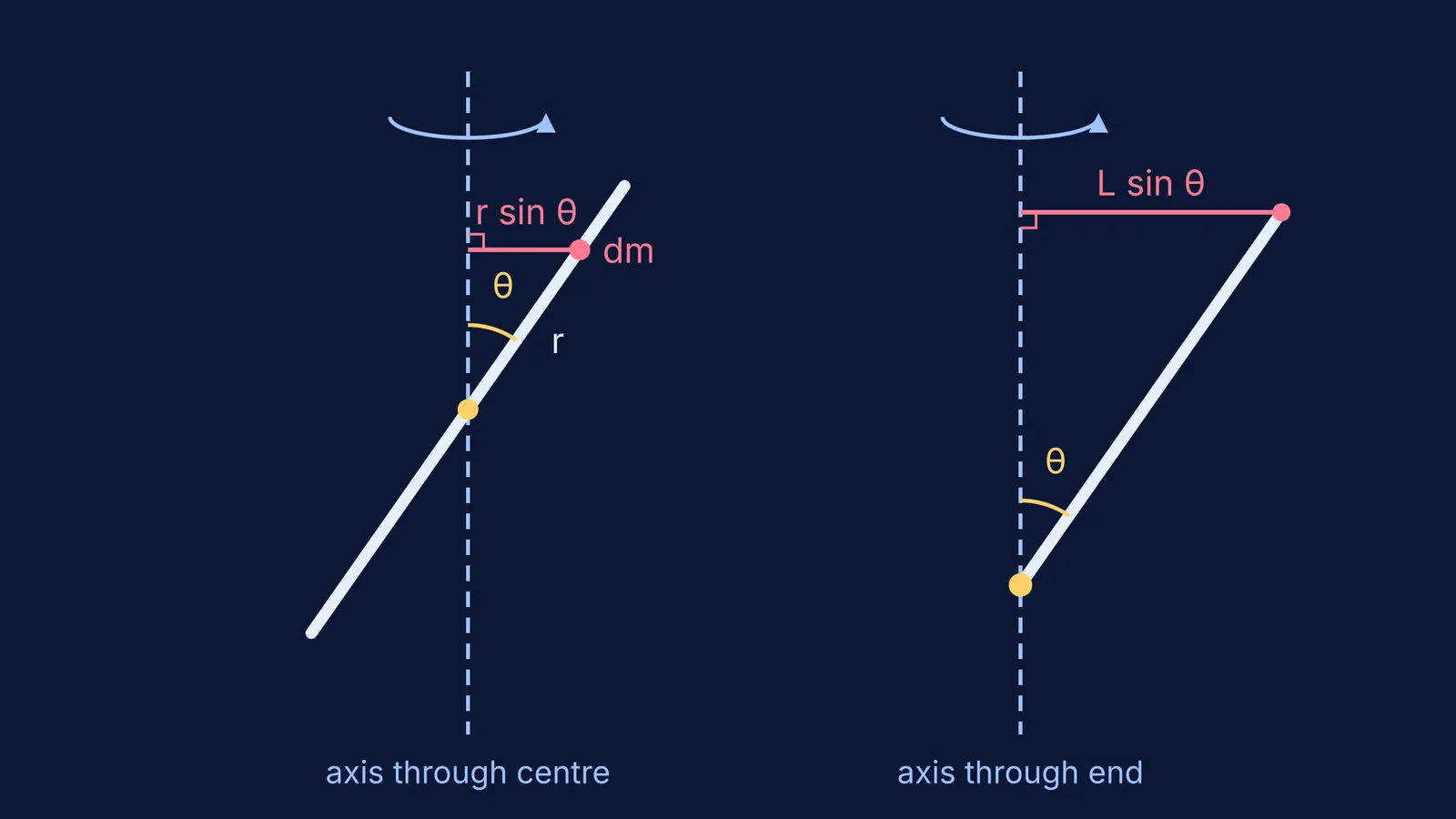
Now tilt the axis so it makes angle θ with the rod. A small piece of rod at distance r from the pivot, measured along the rod, is no longer r away from the axis. Drop a perpendicular from that piece to the axis and you get a right triangle with hypotenuse r and angle θ at the pivot. The side opposite θ is the distance you need: r sin θ.
Square it and sin²θ appears. Since θ is the same for every piece of a straight rod, it comes out of the integral.
How do you derive I = (ML²/12) sin²θ?
Put the pivot at the rod's centre and let x run along the rod from −L/2 to +L/2.
Mass per unit length is M/L, so a slice of length dx has mass dm = (M/L) dx.
Its perpendicular distance from the axis is |x| sin θ.
Set up I = ∫ (x sin θ)² (M/L) dx from −L/2 to +L/2.
Pull out the constants: I = (M/L) sin²θ × [x³/3] between the limits, which is (M/L) sin²θ × L³/12.
So I = (ML²/12) sin²θ.
Two checks catch most errors. At θ = 90°, sin²θ = 1 and you get back ML²/12. At θ = 0° every piece sits on the axis, so I = 0. For a slower walk through setting up dm, see finding moment of inertia by integration.
What is the moment of inertia when the axis passes through one end?
Move the pivot to one end and keep the axis at angle θ to the rod. Now x runs from 0 to L, and the same integral gives I = (M/L) sin²θ × L³/3 = (ML²/3) sin²θ.
You can confirm it with the parallel-axis theorem, I = I_cm + Md², where d is the distance from the axis through the centre of mass to the new, parallel axis (OpenStax, section 10.5). The end axis is parallel to the tilted central axis, and the rod's centre sits (L/2) sin θ from it. So I = (ML²/12) sin²θ + M(L²/4) sin²θ = (ML²/3) sin²θ. Same answer by two routes. For when each theorem applies, see the parallel and perpendicular axis theorems.
Worked example: a 1.2 m rod tilted at 30°
A uniform rod of mass 0.6 kg and length 1.2 m spins about an axis through one end that makes 30° with the rod. Find I, then its kinetic energy at 10 rad/s. Start from the end-axis value ML²/3 (OpenStax, section 10.5).
ML²/3 = 0.6 × 1.44 / 3 = 0.288 kg m².
sin 30° = 0.5, so sin²θ = 0.25.
I = 0.288 × 0.25 = 0.072 kg m².
Kinetic energy = ½ I ω² = 0.5 × 0.072 × 100 = 3.6 J.
Now cross-check with the parallel-axis theorem. About the parallel tilted axis through the centre, I = (0.6 × 1.44 / 12) × 0.25 = 0.018 kg m². The centre is 0.6 × sin 30° = 0.3 m from the end axis, so Md² = 0.6 × 0.09 = 0.054 kg m². Adding gives 0.072 kg m², which matches.
Notice what the tilt did. The same rod at right angles to the axis would have I = 0.288 kg m², so tilting it to 30° cut I to a quarter by bringing every piece closer to the axis. If a question then asks for the radius of gyration, k = √(I/M) = √0.12 ≈ 0.35 m; our set of radius of gyration problems has more of these.
Which mistakes cost marks on inclined-axis questions?
Using r instead of r sin θ for the distance.
Writing sin θ instead of sin²θ: the distance is squared, so the sine is too.
Mixing up the angle with the rod and the angle with the normal to the axis.
Using d = L/2 in the parallel-axis theorem instead of (L/2) sin θ.
Applying the thin-rod result to a thick cylinder, which needs its own treatment.
If your setup keeps drifting, the Fermi Problem Library has worked problems with a step-by-step solver that explains the reasoning rather than printing an answer. If perpendicular distance itself feels shaky, the Fermi Concept Library gives each physics concept its own lesson and its place in the map.
Next time a rod tilts, draw the perpendicular first; the sin²θ follows.