

On this page
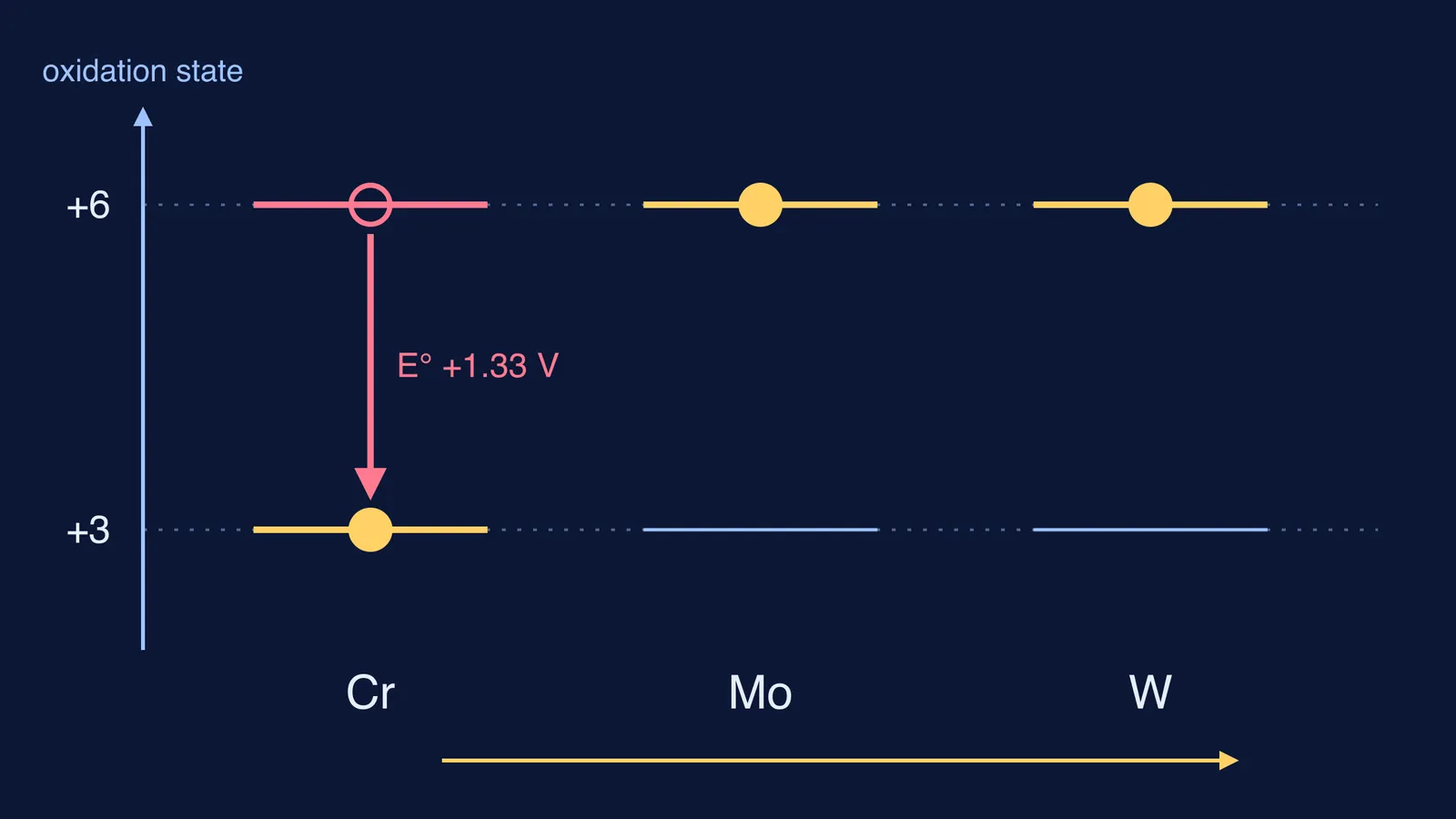
Chromium, molybdenum and tungsten sit one below the other in group 6, and all three can reach the +6 oxidation state. There they behave very differently. Acidified potassium dichromate oxidises iodides, sulphides, tin(II) and iron(II) salts; molybdenum trioxide and tungsten trioxide are not strong oxidising agents. The contrast is in the NCERT d-block chapter, so it is fair game for CBSE boards and JEE Main.
What does "Mo(VI) is more stable than Cr(VI)" actually mean?
In the d-block, the stability of the higher oxidation states progressively increases down a group/Descriptive_Chemistry/Elements_Organized_by_Block/3_d-Block_Elements/1b_Properties_of_Transition_Metals/Oxidation_States_of_Transition_Metals), as Chemistry LibreTexts puts it. The same page notes that chromium is most stable at +3.
The NCERT Class 12 chemistry chapter on the d- and f-block elements gives group 6 as its example: "Mo(VI) and W(VI) are found to be more stable than Cr(VI). Thus Cr(VI) in the form of dichromate in acidic medium is a strong oxidising agent, whereas MoO3 and WO3 are not."
"Stable" here means little tendency to gain electrons and drop to a lower state. Cr(VI) is readily reduced to Cr(III), which is what makes it an oxidising agent. The same NCERT chapter gives the half-reaction: Cr₂O₇²⁻ + 14H⁺ + 6e⁻ → 2Cr³⁺ + 7H₂O, with E° = +1.33 V. A large positive E° like this is the number behind "strong oxidant".
The difference is not in how many electrons each atom has to give. NCERT's Table 4.1 lists the outer configurations as Cr 3d⁵4s¹, Mo 4d⁵5s¹ and W 5d⁴6s². Each has six valence electrons, so +6 means giving up or sharing all six in every case.
Why do molybdenum and tungsten favour higher oxidation states than chromium?
Think of reaching +6 as a bill and a refund: the energy needed to remove or share six electrons, and the energy released when the metal bonds to oxygen or fluorine. The standard textbook explanation puts the difference on the refund side:
The d orbitals get bigger down the group. A Chemistry LibreTexts page on bonding with d orbitals/05%3A_Coordination_Chemistry/5.04%3A_Bonding_with_d-orbitals) explains that d orbitals expand down a group as the principal quantum number rises, and that in the 3d series the contraction of the orbitals limits how well d electrons take part in bonding.
Bigger orbitals overlap better. The same page says the 5d orbitals have good overlap with neighbouring atoms. Better overlap gives stronger bonds, which helps pay for the +6 state in Mo and W. Chromium's compact 3d orbitals get less back, so Cr(VI) is easily reduced.
Ionisation enthalpy does not explain the trend on its own: 5d elements have higher ionisation enthalpy than 4d, yet the +6 state keeps getting more stable down the group. Why do Mo and W behave almost like twins? Lanthanoid contraction gives the 4d and 5d elements very similar radii. NCERT's example from group 4 is Zr at 160 pm and Hf at 159 pm.
Why is the d-block trend opposite to the p-block?
NCERT makes the contrast directly. In the p-block, the heavier members favour the lower oxidation states because of the inert pair effect. In groups 4 to 10 of the d-block, the opposite is true. Our explainer on why heavy p-block elements prefer lower states covers the other half of the picture.
How do you write this answer in an exam?
Use this four-line frame for a two- or three-mark "explain why" question:
State the trend: in the d-block, the stability of higher oxidation states increases down a group.
Apply it: in group 6, Mo(VI) and W(VI) are more stable than Cr(VI).
Give the consequence: Cr(VI), as dichromate in acidic medium, is readily reduced to Cr(III), so it is a strong oxidising agent. MoO₃ and WO₃ are not.
Add the reason if marks allow: the larger 4d and 5d orbitals form stronger bonds that stabilise the +6 state.
Worked example (assertion-reason). Assertion: acidified K₂Cr₂O₇ is a strong oxidising agent, but MoO₃ is not. Reason: the stability of the +6 state increases down group 6. Both statements are true, and the reason correctly explains the assertion. Lines 1 to 3 of the frame are your working.
Before you submit, check for these traps:
Do not say Mo can "lose more electrons". All three have six valence electrons.
Do not bring the inert pair effect into a d-block answer.
Write "in acidic medium" when you call dichromate a strong oxidant.
Do not mix this up with the trend across a row. NCERT's Example 4.5 explains why oxidising power rises in the order VO₂⁺ < Cr₂O₇²⁻ < MnO₄⁻: the lower species they are reduced to become increasingly stable.
If the d-block trends keep blurring together, the Fermi Concept Library gives each concept its own lesson and its place in the map. When you want to test yourself, the Fermi Problem Library has worked problems with a step-by-step solver that explains the reasoning rather than printing an answer.
Next step: say the four-line frame aloud once from memory, then try it on chromium's neighbour, manganese.


