

On this page
Your biology practical asks you to squash a root tip, stain it and find the stages of mitosis. The mitotic index turns that slide into one number.
What is the mitotic index?
The mitotic index is the percentage of cells in a sample that are dividing. The Amrita Vishwa Vidyapeetham virtual lab on mitosis in onion root tips defines it as the ratio of the number of cells in the dividing phase to the total number of cells observed.
Mitotic index = (n ÷ N) × 100, where n is the number of dividing cells and N is the total number of cells observed.
A dividing cell is one in prophase, metaphase, anaphase or telophase. The Pearson Edexcel core practical on observing mitosis in root tips.pdf) puts it plainly: count the cells containing visible chromosomes and divide by the total number of cells in the field of view. Interphase cells, with a round nucleus and no clearly visible chromosomes, go into N but not into n.
If the stages still blur together, our guide to chromosome number and DNA content through the stages of mitosis shows what changes at each one.
How do you calculate mitotic index from a root tip slide?
These steps follow the Pearson root tip practical sheet.pdf), plus a counting rule of our own.
Find the meristem on low power. Pearson describes meristem cells as small and square, with no obvious vacuoles, and usually in rows.
Move to high power (×400) and choose one field of view. Do not move the slide while you count.
Draw a tally with five columns: interphase, prophase, metaphase, anaphase, telophase.
Before you start, decide what to do with cells cut by the edge of the field. One simple rule: count cells crossing the top and left edges, skip those crossing the bottom and right. Use the same rule every time.
Add the four dividing columns to get n, add all five to get N, then calculate.
What does a worked example look like?
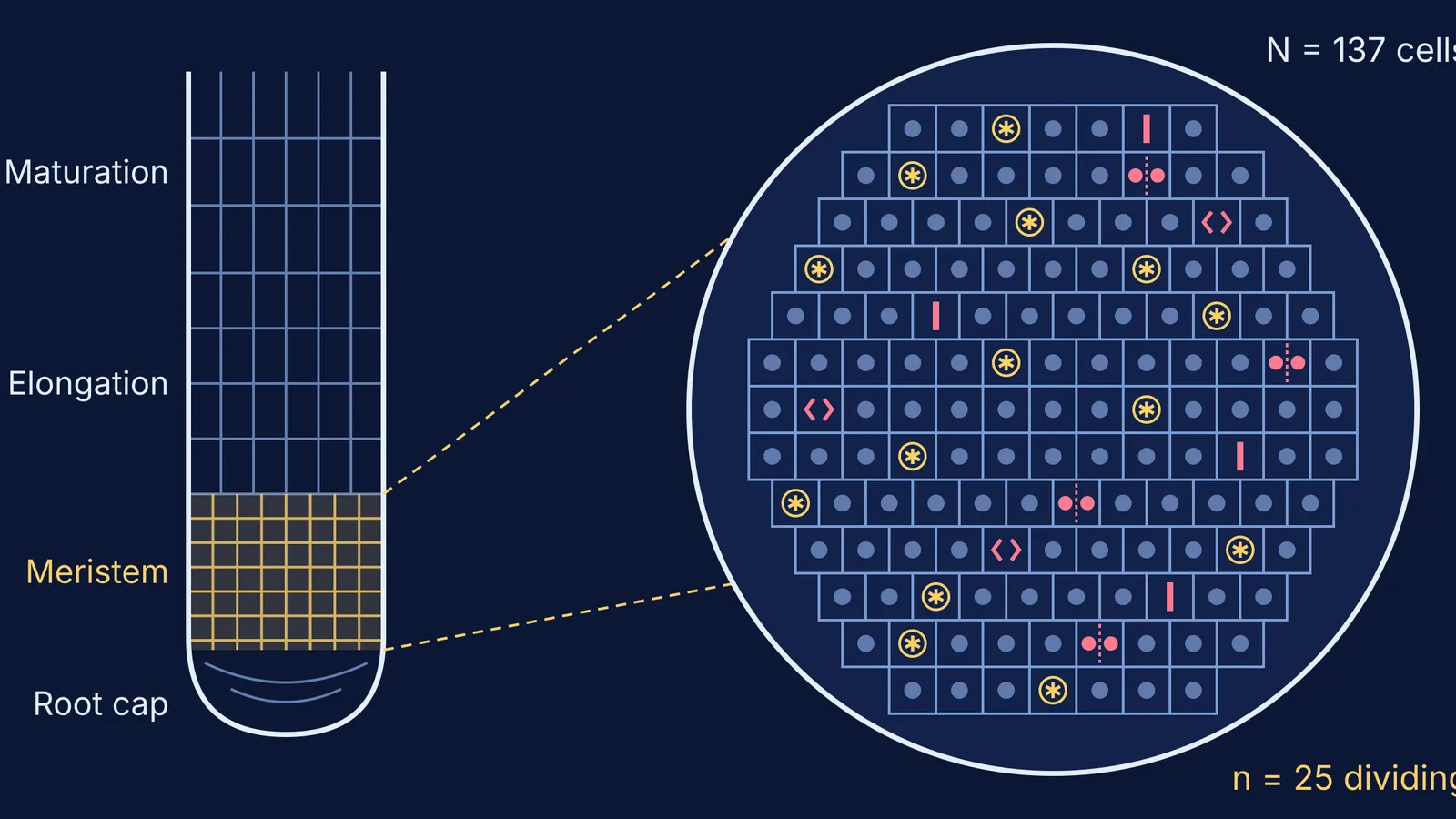
The Pearson teacher sheet.pdf) gives this sample data for a garlic root tip squash:
Interphase: 112 cells
Prophase: 14 cells
Metaphase: 4 cells
Anaphase: 3 cells
Telophase: 4 cells
N = 112 + 14 + 4 + 3 + 4 = 137 cells.
n = 14 + 4 + 3 + 4 = 25 cells.
Mitotic index = 25 ÷ 137 × 100 = 18.2%.
Show every line of that working in your record book. If you count three fields, work out the index for each and report the mean, so that one unusual field does not decide your answer.
What does a high mitotic index say about the region of the root?
It tells you that you are in the zone of cell division. NCERT's Class 11 chapter on plant growth and development splits growth at the root tip into three phases: meristematic, elongation and maturation. The constantly dividing cells sit at the apex; the cells just behind them elongate, with increased vacuolation and cell enlargement; further back, cells mature. Our post on how root tip zones create the sigmoid plant growth curve walks through those zones in more detail.
The same NCERT chapter notes that a single maize root apical meristem can give rise to more than 17,500 new cells per hour.
The Amrita virtual lab states that the mitotic index is high in the meristematic region and decreases with increasing distance from the root tip. Read your own result like this:
High index, small square cells: you are in the meristem.
Low index, long cells with large vacuoles: you have drifted into the elongation zone.
Index near zero, every cell in interphase: you are in non-dividing tissue. Pearson notes that a common mistake is to mix up the tip and the non-dividing end of the root.
Why do those older cells stop? Many have left the cycle altogether, as our post on the G0 phase and why some cells never divide explains.
What else can your counts tell you?
A squash freezes every cell at one moment, so the share of cells in each stage hints at how long that stage lasts. The Pearson sheet.pdf) shows this with the same data: 82% of cells in interphase, 10% in prophase, and only 2% in anaphase. The more cells you see in a stage, the longer that stage is relative to the others. These are relative times, not minutes.
If the meristem or the phases still feel shaky, the Fermi Concept Library has its own lesson for every concept in biology, each with its place in the map. And if you are not sure where to start before the practical, Fermi's AI tutor can work out what you already know and build a plan for the session.
Count one field carefully today, then check your number against the 18.2% example above.


