

On this page
Most of us first draw methane as a flat square: carbon in the middle, a hydrogen at each side. It fits the page, but the real molecule is a tetrahedron. You can prove it two ways: from repulsion and geometry, and from an argument made long before anyone could measure a bond angle.
What shape does VSEPR predict for methane?
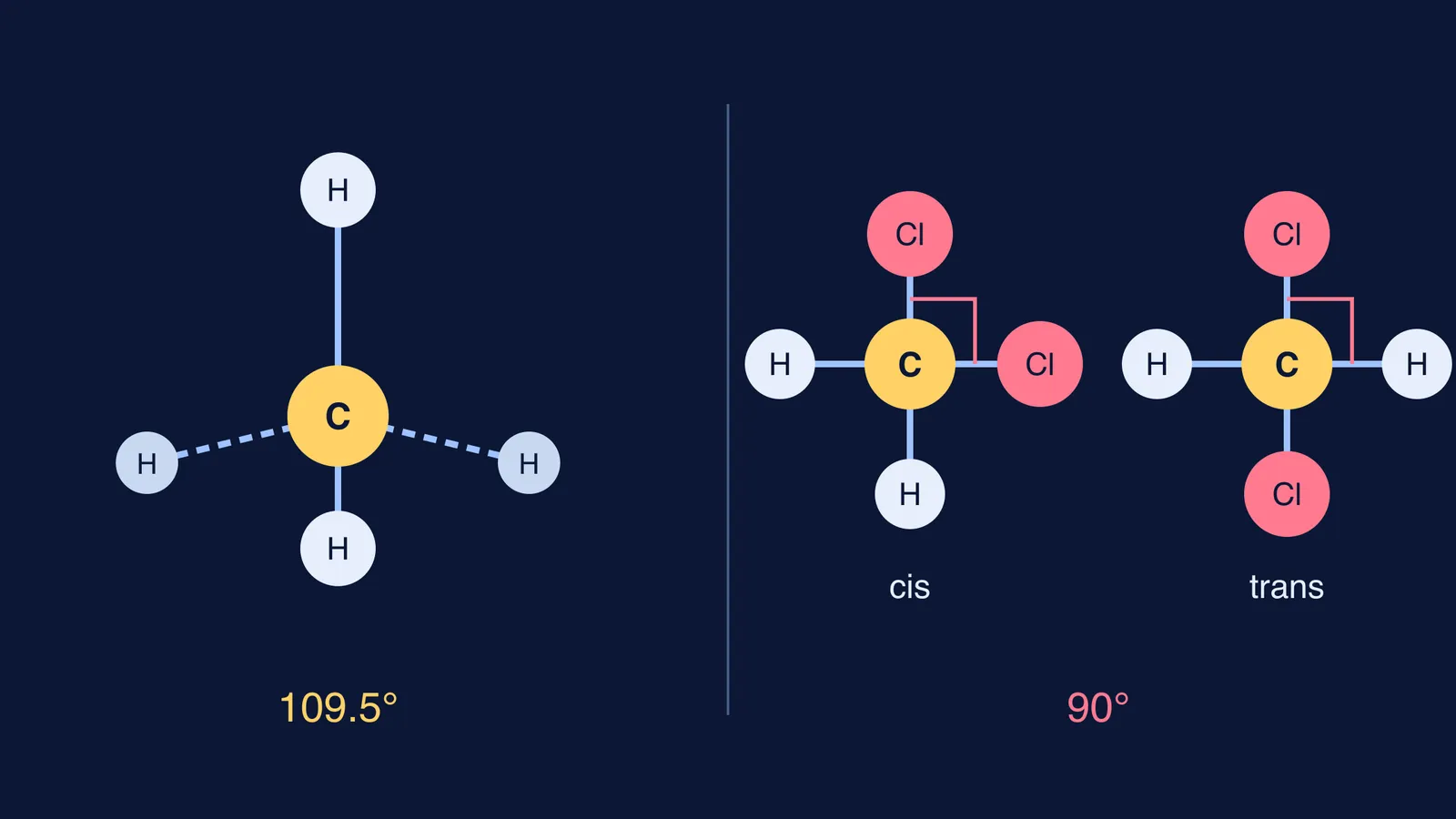
Carbon in CH4 has four bonding pairs of electrons and no lone pairs. VSEPR theory says electron groups around a central atom push apart until repulsion is as small as it can be. For four groups, the LibreTexts VSEPR chapter/09%3A_Molecular_Geometry_and_Bonding_Theories/9.02%3A_The_VSEPR_Model) states that repulsions are minimised by placing them at the corners of a tetrahedron, with bond angles of 109.5°.
Measurement agrees. The NIST Computational Chemistry Comparison and Benchmark Database lists methane's experimental H–C–H angle as 109.471° and its C–H bond length as 1.087 Å, with tetrahedral (Td) symmetry (NIST CCCBDB).
Our guide to predicting molecular shapes with VSEPR walks through the four-step method for any molecule.
Why is 109.5° better than 90°?
A square is flat, so its four bonds can only be 90° apart. In three dimensions they can spread further. Redo this in your notebook:
Put carbon at the origin. Point the four bonds along (1, 1, 1), (1, −1, −1), (−1, 1, −1) and (−1, −1, 1). These are four alternate corners of a cube, which form a regular tetrahedron.
Take any two, say (1, 1, 1) and (1, −1, −1). Their dot product is 1 − 1 − 1 = −1. Each has length √3.
So cos θ = −1 / (√3 × √3) = −1/3, and θ = 109.47°. Every pair gives the same answer.
Compare the square: neighbouring bonds sit at 90°, and only the two opposite pairs get 180°.
Now put real sizes in. Using the 1.087 Å C–H bond length listed by NIST CCCBDB, the distance between two hydrogens is 2 × 1.087 × sin(θ/2). In the tetrahedron that is 2 × 1.087 × sin 54.74° ≈ 1.78 Å. In the square, for neighbouring hydrogens, it is 2 × 1.087 × sin 45° ≈ 1.54 Å. The closest pairs are about 15% further apart in 3D, and in the tetrahedron there are no "close" and "far" pairs at all: all six H–H distances are equal.
How does CH2Cl2 prove methane is not square planar?
This argument is older than any X-ray or spectroscopic measurement of molecular shape. Replace two hydrogens of methane with chlorine to get dichloromethane, CH2Cl2.
If carbon were square planar, the two chlorines could sit next to each other (at 90°, a "cis" form) or opposite each other (at 180°, a "trans" form). Those are two different molecules with different properties.
If carbon is tetrahedral, every pair of corners is the same 109.5° apart. Wherever you put the two chlorines, you can rotate the molecule into any other version. There is only one CH2Cl2.
Jacobus van 't Hoff made exactly this point in his September 1874 paper on structural formulas in space. He noted that a flat arrangement predicts two isomers for compounds such as CH2R2' and CH2R'R'', "numbers that are clearly greater than the numbers actually known", and that "the theory is brought into accord with the facts" if carbon's bonds point to the corners of a tetrahedron (van 't Hoff 1874, English translation on ChemTeam). You can read the story behind it in our post on van 't Hoff and the tetrahedral carbon.
If counting isomers on paper keeps tripping you up, the Fermi Concept Library has a lesson for each idea here, from VSEPR to isomerism, with its place in the map so you can see what it builds on.
How should you write this in an exam?
For a 2- or 3-mark "give reasons" question, this five-point structure gives a complete answer:
Count: carbon has 4 bond pairs and 0 lone pairs.
Rule: electron pairs repel and take the arrangement with the least repulsion.
Geometry: in a flat square they are only 90° apart; in a tetrahedron they are 109.5° apart, so repulsion is lower.
Evidence: a square planar carbon would give cis and trans CH2Cl2, but only one CH2Cl2 is known.
Link (if asked): this matches sp3 hybridisation of carbon.
A quick self-check before you move on:
Can you explain why NH3 and H2O are not 109.5° even though they also have four electron pairs? (Hint: lone pairs repel more. See why the CH4, NH3 and H2O bond angles shrink.)
Can you say how many isomers CH3Cl and CHCl3 would have in each shape? (One each, either way. Only the two-and-two case tells the shapes apart.)
If you have a set of shape questions to practise, the Fermi Problem Library has worked problems with a step-by-step solver that explains the reasoning rather than printing an answer, so you can check where your method goes wrong.


