

On this page
The infinite current sheet is the magnetic twin of the infinite charged sheet: both give a field that does not depend on distance. One derivation also covers two parallel sheets and the solenoid.
What is surface current density K?
Surface current density K is the current per unit width of the sheet, measured across a line drawn at right angles to the flow, and its unit is A/m (Ellingson, Electromagnetics I, section 7.8/07%3A_Magnetostatics/7.08%3A_Magnetic_Field_of_an_Infinite_Current_Sheet)).
How do you derive B = μ0K/2 with Ampère's law?
Ampère's law says the line integral of B around a closed loop equals μ0 times the current enclosed by that loop (OpenStax University Physics Volume 2, section 12.5). OpenStax's method is to use symmetry first, find the direction of B, and then pick a loop along which B is constant or zero.
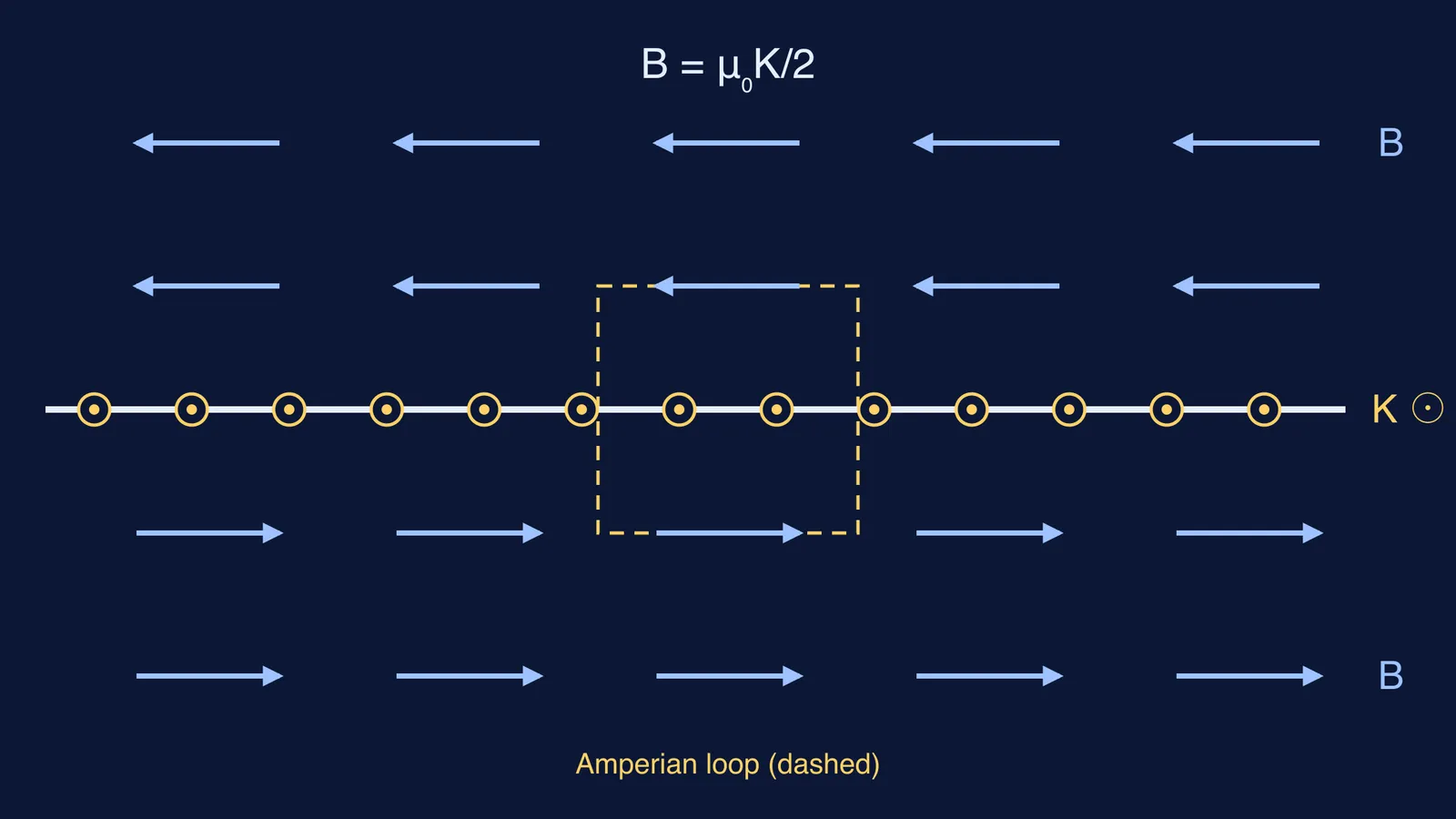
Direction. Split the sheet into thin parallel wires. Each wire's field circles it. Pair any wire with its mirror image on the other side of your point, and the components pointing away from the sheet cancel. What remains is parallel to the sheet and at right angles to the current.
Same everywhere along the sheet. The sheet looks identical from every point at a given height, so B cannot change as you slide along it. By mirror symmetry it has the same size on both sides but points the opposite way.
The loop. Draw a rectangle that cuts through the sheet. Its two long sides, each of length L, run parallel to the sheet, one above and one below, and are lined up with B. Its short sides cross the sheet at right angles to it.
Line integral. The short sides are perpendicular to B, so they add nothing. Each long side gives BL, and because B reverses across the sheet while you also go round the loop in the opposite direction, the two add: total 2BL.
Current enclosed. The loop takes in a width L of the sheet, so I(enclosed) = KL.
Solve. 2BL = μ0KL, so B = μ0K/2.
The length L cancels, and so does the height of the loop. You could have made the rectangle 1 mm tall or 1 km tall and got the same answer. That is the algebra telling you B does not depend on distance from the sheet.
Why doesn't the field get weaker with distance?
A single wire's field falls off as you move away from it. With a sheet, moving farther away puts you farther from the nearest wires, but brings a wider band of the sheet into view at a useful angle. For an infinite sheet those two effects cancel exactly. A real sheet is finite, so treat B = μ0K/2 as accurate when you are much closer to the sheet than to its edges.
Worked example: how big is the field?
A wide, thin copper strip carries 50 A spread evenly across a 10 cm width. Find B close to the middle of the strip.
K = 50 A ÷ 0.10 m = 500 A/m.
μ0 = 1.25663706127 × 10⁻⁶ N A⁻² (NIST, CODATA 2022 value).
B = μ0K/2 = (1.2566 × 10⁻⁶ × 500) / 2 ≈ 3.14 × 10⁻⁴ T, about 0.31 mT.
You get about 0.31 mT at 1 mm or 2 mm above the middle, since both points are far closer to the strip than to its edges. The field points the opposite way underneath.
What happens with two parallel current sheets?
Add the two single-sheet fields region by region, each μ0K/2 in size:
Opposite currents: between the sheets the fields point the same way, so B = μ0K. Outside, they cancel and B = 0.
Same direction: between the sheets they cancel and B = 0. Outside, they add to μ0K, pointing opposite ways on the two sides.
The opposite-current case is a quick check on the solenoid. A long solenoid has field μ0nI inside and zero outside, where n is turns per unit length (OpenStax, section 12.6). The windings act like two sheets carrying opposite currents with K = nI, so μ0K = μ0nI. For more Ampère's law practice with symmetric shapes, see our posts on the magnetic field inside a toroid and the magnetic field of a coaxial cable, region by region.
A 60-second check before you move on
Can you say what K means and give its unit?
Can you draw the rectangle and explain why the short sides add nothing?
Can you show where the 2 in 2BL comes from?
Can you find B between and outside two sheets for both current directions?
If you get stuck on question 3 or 4, the Fermi Problem Library has worked problems with a step-by-step solver that explains the reasoning rather than printing an answer. If K or Ampère's law itself still feels shaky, the Fermi Concept Library gives each physics concept its own lesson and shows where it sits in the map.


