

On this page
A coaxial cable is a solid inner wire of radius a, wrapped in insulation, inside a hollow metal sheath that runs from radius b to radius c. In the usual exam problem, a current I flows along the core and returns through the sheath. The question asks for B everywhere, and the whole answer comes from one law applied four times.
What does Ampère's law say for a coaxial cable?
Ampère's law says that the line integral of B around any closed path equals μ0 times the current passing through that path, as stated in OpenStax University Physics Volume 2. By symmetry the field circles the axis and depends only on r. With a circular Amperian loop of radius r, the left side is B × 2πr, so:
B = μ0 I_enclosed / (2πr)
The four regions differ only in how much current the loop encloses. The EMPossible coaxial-line derivation uses the same plan: work out each region separately, then stitch the answers together.
How does the field change in each of the four regions?
Assume the current is spread evenly over each conductor's cross-section. The EMPossible notes say this is valid for steady currents but a poor approximation at high frequency because of the skin effect.
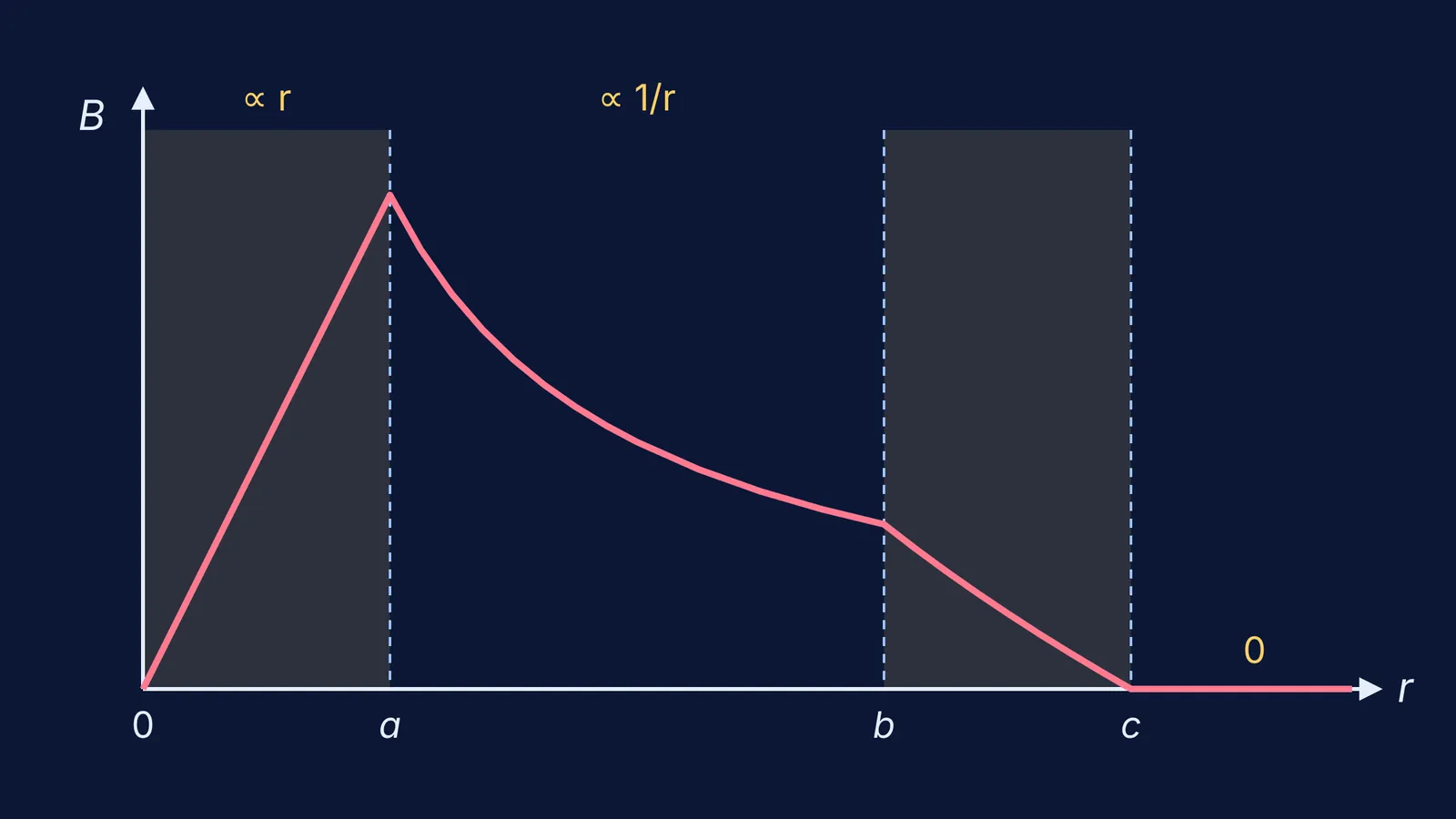
Inside the core (r < a). The loop encloses the fraction r²/a² of the current, so B = μ0 I r / (2πa²). The field rises in a straight line from zero at the axis. OpenStax derives the same result for a single thick wire.
Between the conductors (a < r < b). The loop encloses all of I, so B = μ0 I / (2πr). This is the thin-wire field, falling as 1/r.
Inside the sheath (b < r < c). The return current starts to cancel the core current. The enclosed current is I(c² − r²)/(c² − b²), so B = μ0 I (c² − r²) / [2πr(c² − b²)], which falls to zero at r = c.
Outside the cable (r > c). The enclosed current is I − I = 0, so B = 0. The Georgia Tech Physics Book concludes that the coax produces no magnetic field outside as long as the two currents are equal in magnitude and opposite in direction.
EMPossible writes c² − b² as t² + 2bt, where t = c − b. It is the same expression.
Worked example: a coax carrying 2 A
Take a = 1 mm, b = 3 mm, c = 4 mm and I = 2 A. The vacuum permeability μ0 is 1.25663706127 × 10⁻⁶ N A⁻² according to NIST's CODATA value, so μ0/2π is 2.0 × 10⁻⁷ T m/A to two significant figures.
r = 0.5 mm (core): B = 2 × 10⁻⁷ × 2 × 0.5 × 10⁻³ / (1 × 10⁻³)² = 0.2 mT.
r = 1 mm (core surface): B = 2 × 10⁻⁷ × 2 / 10⁻³ = 0.4 mT, which is the largest value anywhere.
r = 2 mm (gap): B = 0.2 mT, half the surface value because r has doubled.
r = 3.5 mm (sheath): enclosed current = 2 × (16 − 12.25)/(16 − 9) ≈ 1.07 A, so B ≈ 0.061 mT.
r = 5 mm (outside): enclosed current = 0, so B = 0.
The field peaks at the surface of the core, not at the centre. Graph questions often test exactly this.
Why is the field outside a coaxial cable zero?
Each conductor on its own makes a field outside, but the two fields are equal and opposite, so they cancel. OpenStax makes the same point about electrical cords: when the same current goes out and comes back, a loop around both wires encloses zero net current. If the currents are unequal, say I₁ out and I₂ back, the field outside becomes μ0(I₁ − I₂)/(2πr).
How do you practise coaxial cable problems for JEE?
The coaxial cable uses the same idea as other Ampère's law problems: pick a loop that matches the symmetry, then count the enclosed current. Try it on the magnetic field inside a toroid using Ampère's law, read why the field at the end of a solenoid is half, then use your B values to find stored energy with energy density in a magnetic field, u = B²/2μ0.
If you keep getting the sheath region wrong, the Fermi Problem Library has worked problems with a step-by-step solver that explains the reasoning rather than printing an answer. If the gap is with Ampère's law itself, the Fermi Concept Library gives each physics concept its own lesson and its place in the map.
Start with the sketch, then add the numbers.


