

On this page
Finding a liquid's refractive index does not require an expensive refractometer. A classic practical from physics laboratory manuals uses only a concave mirror, a retort stand, and an optical needle. By comparing where the needle tip coincides with its inverted image before and after pouring a thin liquid layer into the mirror, you can determine the refractive index μ from a simple distance ratio.
Why does a liquid layer shift the coincidence point in a concave mirror?
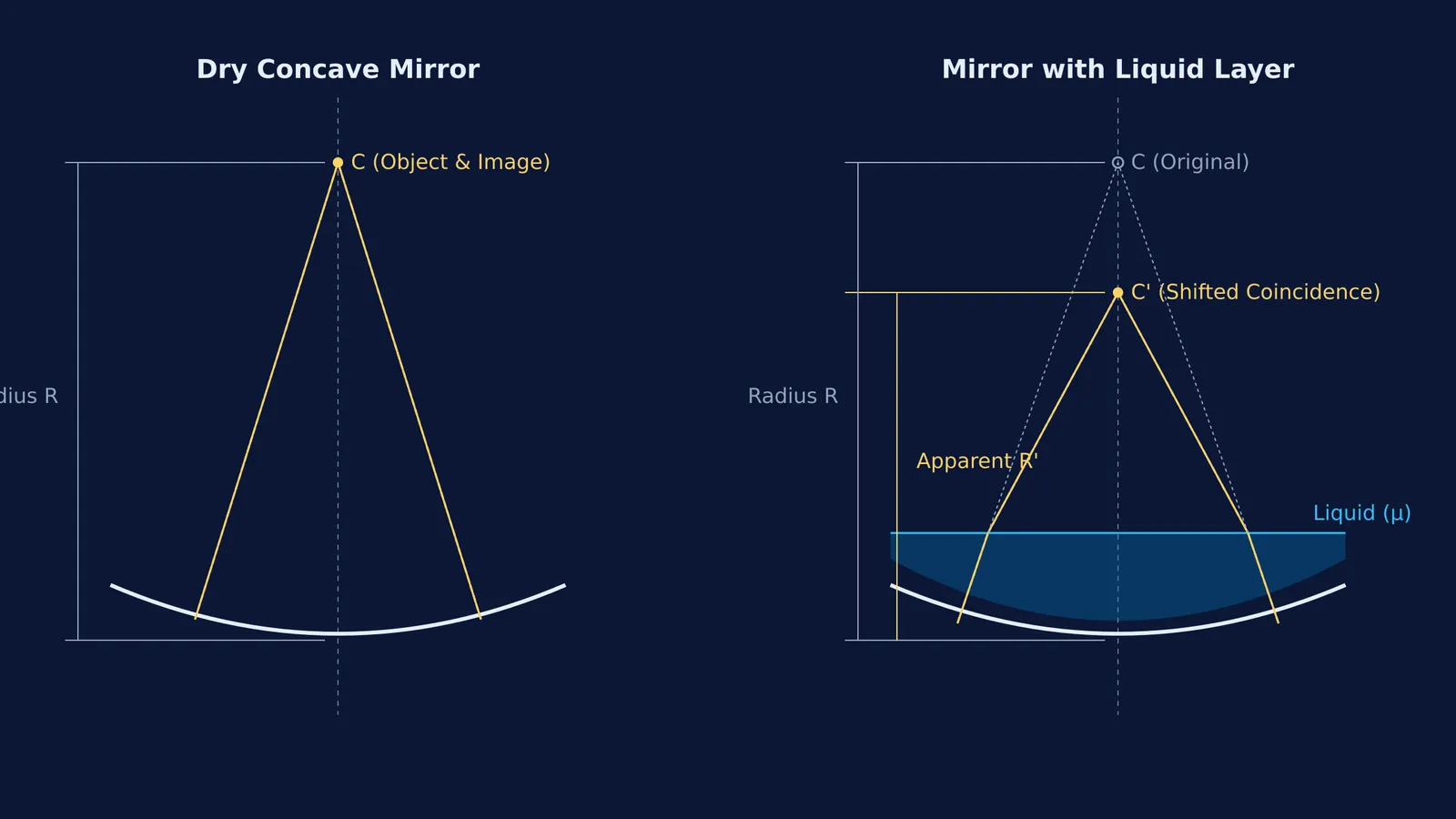
In an empty concave mirror resting horizontally, an optical needle at the centre of curvature C sends rays that strike the mirror at normal incidence (0°). The rays reflect back along their incident paths to form an inverted image at C without parallax, as seen in the derivation of the mirror formula. The vertical distance from the mirror pole to the needle tip is the true radius of curvature R.
Pouring a thin layer of liquid into the mirror creates a flat horizontal surface. Rays from the needle refract at this interface, bending toward the normal before hitting the spherical mirror. For reflected rays to retrace their path to the needle tip, they must strike the mirror normally, meaning they travel along radial lines toward the original centre of curvature C. Because refraction bends the rays inward, the needle must be lowered to a closer height C' (at distance R') to align the refracted rays with C.
How do you derive μ = R / R' from Snell's law and lens combinations?
The relationship can be derived through two complementary optical frameworks. The first uses apparent depth at a plane interface. For paraxial rays, Snell's law shows that an object at real depth R appears at an apparent depth of R / μ when viewed from air. Because rays inside the liquid must converge toward the mirror's centre of curvature at depth R to strike normally, the conjugate needle position in air sits at the apparent distance R' = R / μ. Rearranging this gives μ = R / R'. In *Physics Education*, researchers Amitabh Joshi and Juan D. Serna confirmed this paraxial derivation and its experimental accuracy across common liquids (Joshi and Serna, 2012).
The system can also be viewed as a silvered plano-convex lens, similar to finding the focal length of a lens with a mirror. The liquid layer forms a lens of focal length f_L with radii R₁ = ∞ and R₂ = −R, so 1 / f_L = (μ − 1) / R. The mirror behind it has focal length f_m = R / 2. Light passes through the lens twice and reflects once, giving net power 1 / F = 2 / f_L + 1 / f_m = 2(μ − 1) / R + 2 / R = 2μ / R. The effective centre of curvature where image and object coincide is 2F = R / μ, confirming μ = R / R'.
For tracing how paraxial rays bend across media interfaces, the Fermi Concept Library maps every concept in physics, chemistry, biology, mathematics and computing, each with its own lesson and its place in the map.
How is the experiment performed in the physics laboratory?
The procedure demonstrated by Joshi and Serna follows five steps:
Level the mirror horizontally on a stable bench using a spirit level so its principal axis is vertical.
Mount the optical needle horizontally above the pole, adjusting its height until the needle tip coincides with its inverted image without parallax. Measure this distance as the dry radius R.
Pour a small volume of liquid into the mirror cavity to form a thin, clean pool.
Lower the needle until the tip again coincides with the new inverted image without parallax. Measure the distance from the liquid surface to the needle tip as R'.
Compute the refractive index using μ = R / R'.
What does a worked calculation look like for water?
In a trial reported by Joshi and Serna (2012), a concave mirror has a dry radius R = 20.0 cm. Adding a thin water layer restores coincidence at an apparent height R' = 15.0 cm.
Calculating the refractive index yields: μ = R / R' = 20.0 cm / 15.0 cm = 1.33.
This matches the accepted refractive index of water (1.33). For glycerine, with a refractive index of 1.47, coincidence shifts down to R' = 20.0 cm / 1.47 = 13.6 cm (Joshi and Serna, 2012).
When tackling multi-surface optics problems where students struggle to combine refraction and reflection, the Fermi Problem Library provides worked problems with a step-by-step solver that explains the reasoning rather than printing an answer.
What precautions prevent errors in the coincidence method?
Three precautions ensure reliable measurements, sharing principles with refraction through parallel layers. First, keep the liquid film thin: deep liquid forms a curved meniscus that causes spherical aberration and makes pole-versus-surface measurement ambiguous. Second, remove parallax thoroughly by sighting sideways across the needle tip until image and pin move together. Finally, ensure the needle stays horizontal and centered over the mirror pole.


