

On this page
The derivation of the mirror formula is a standard question in Class 12 board exams that tests your understanding of ray optics. It relies on a few fundamental geometry rules and the careful application of Cartesian sign conventions. Once you draw the ray diagram correctly and identify the geometry, the mathematical steps flow naturally from the properties of similar triangles.
What is the paraxial approximation?
Before deriving the formula, it is important to understand the paraxial approximation. This principle assumes that the mirror has a small aperture and the light rays we consider are "paraxial"—meaning they strike the mirror very close to the principal axis and at very shallow angles.
Under this approximation, the mirror's curved surface near the pole behaves essentially like a flat vertical plane. This ensures that all rays from a point on the object converge to a single sharp point on the image. It also gives us the crucial relationship that the focal length f is exactly half the radius of curvature R (f = R/2).
How to draw the ray diagram for the derivation?
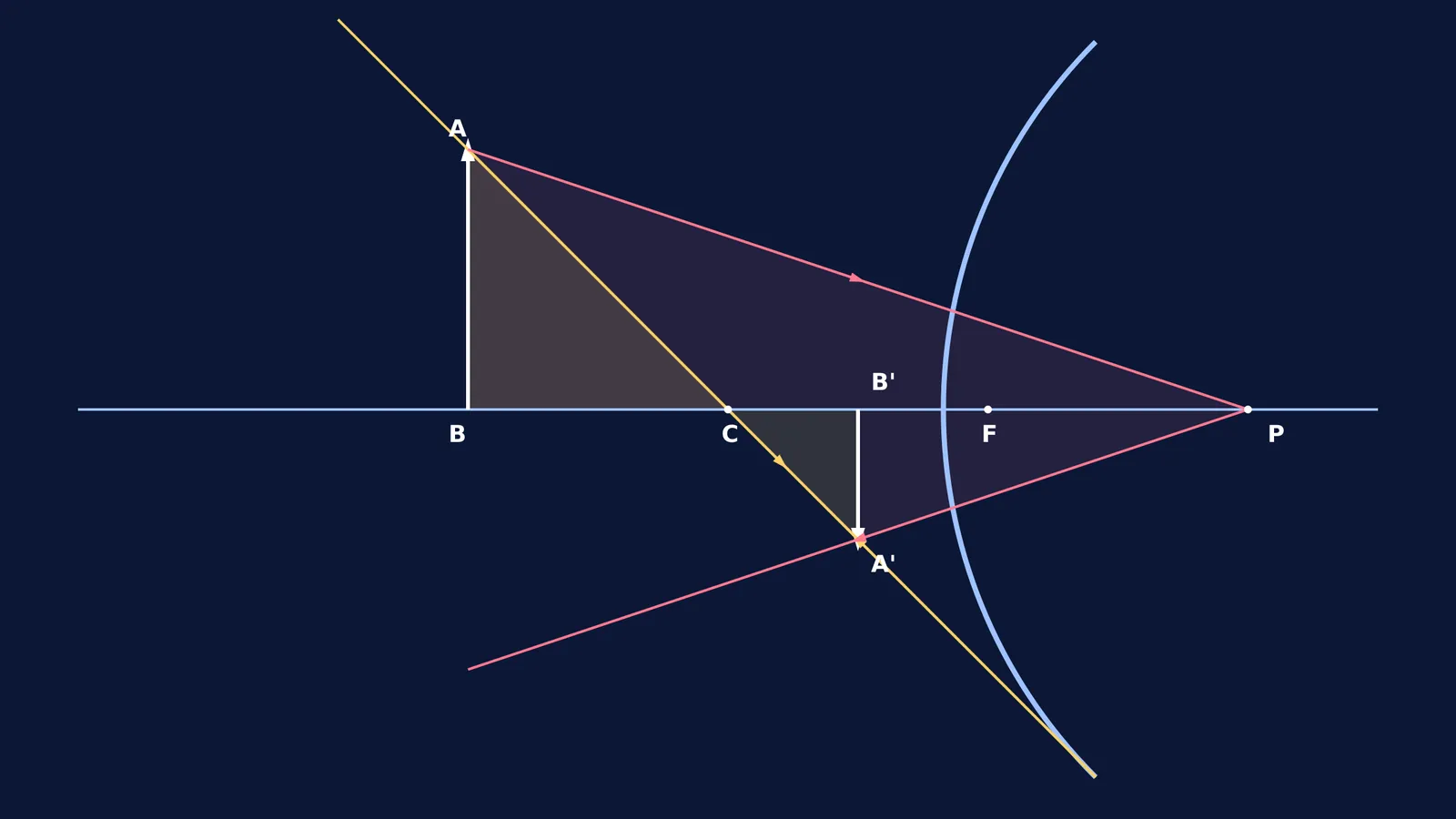
To derive the formula, we set up a complete ray diagram for a concave mirror forming a real, inverted image.
We place an object AB on the principal axis beyond the centre of curvature C.
A real, inverted image A'B' forms between C and the principal focus F. (If you are unsure why the image forms in this specific region, review Concave mirror images for all six object positions.)
We trace two specific incident rays from the top of the object (A) to locate the top of the image (A'):
Ray through the centre of curvature: A ray from A passes directly through C. Because it strikes the mirror's surface at a right angle (normal incidence), it reflects back along the exact same path.
Ray to the pole: A ray from A strikes the mirror exactly at the pole P. By the law of reflection, the angle of incidence equals the angle of reflection (∠APB = ∠A'PB').
If you are asked about Drawing ray diagrams in the CBSE Class 12 physics paper, always remember to draw arrows on your lines to indicate the direction of the light.
Step-by-step derivation of the mirror formula
With the ray diagram drawn, we use the geometry of similar triangles to link the object distance, the image distance, and the radius of curvature.
Step 1: Use the first pair of similar triangles Look at the diagram and identify △ABC and △A'B'C. Both are right-angled (at B and B'), and the angles at C are vertically opposite. Because they share all three interior angles, they are similar triangles. Therefore, the ratio of their heights equals the ratio of their bases:
A'B' / AB = CB' / CB
Step 2: Use the second pair of similar triangles Now identify △ABP and △A'B'P. Both are right-angled, and the law of reflection tells us that the incident and reflected angles at the pole P are perfectly equal (∠APB = ∠A'PB'). Thus, these two triangles are also similar.
A'B' / AB = PB' / PB
Step 3: Equate and apply the sign convention Equating the right-hand sides of the above equations gives:
CB' / CB = PB' / PB
Following the correct Ray optics sign conventions is the most critical step of this derivation. We measure all distances from the pole P in the direction opposite to the incident light, meaning they are given a negative sign:
Object distance, PB = −u
Image distance, PB' = −v
Radius of curvature, PC = −R
We can write the base segments CB and CB' in terms of these standard distances:
CB = PB − PC = −u − (−R) = −u + R
CB' = PC − PB' = −R − (−v) = −R + v
Substitute these back into our ratio:
(−R + v) / (−u + R) = −v / −u (v − R) / (R − u) = v / u
If you get stuck assigning positive and negative values for an optical instrument, the Fermi Concept Library has a lesson on the sign convention to help you fill any concept gaps.
Step 4: Algebraic simplification Cross-multiply to remove the fractions from the equation:
u(v − R) = v(R − u) uv − uR = vR − uv
Group the terms on either side:
2uv = vR + uR
Divide the entire equation by uvR:
2 / R = 1/u + 1/v
Because of the paraxial approximation, the focal length is half the radius of curvature (R = 2f), meaning 2/R = 1/f. Substituting this yields the final mirror formula:
1/f = 1/v + 1/u
How to find linear magnification?
The linear magnification (m) is defined as the ratio of the image height (h') to the object height (h). Using the second pair of similar triangles (△ABP and △A'B'P) from earlier, we already established that A'B' / AB = PB' / PB.
By the standard sign convention, an upright object has a positive height (AB = h), and a real inverted image has a negative height (A'B' = −h').
−h' / h = −v / −u m = h' / h = −v / u
A negative magnification calculation confirms that the image is real and inverted. If you ever calculate a positive magnification for a spherical mirror, it means the resulting image is virtual and erect.


