On this page
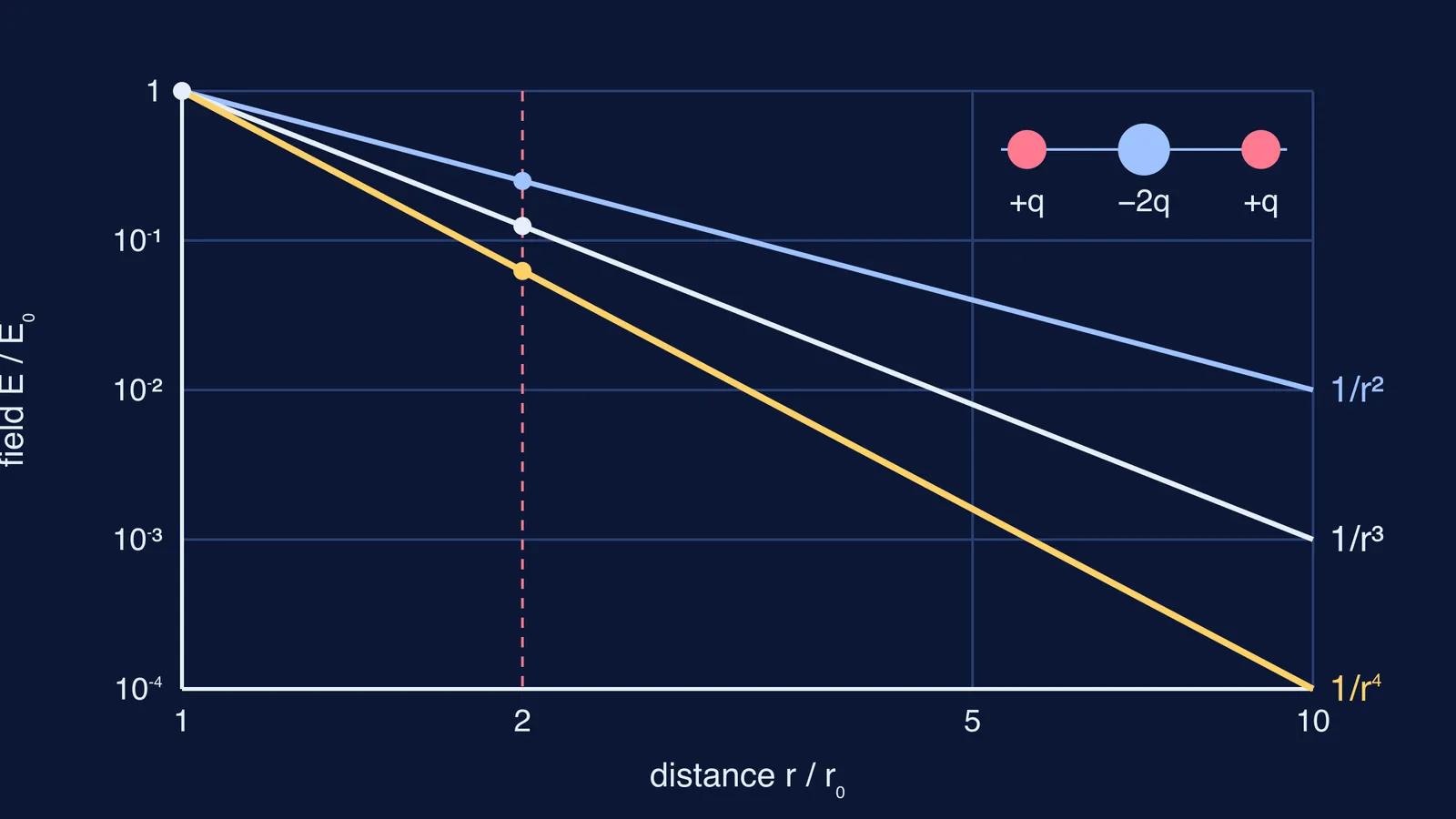
You already know two distance laws. The field of a point charge falls as 1/r², and the far field of a dipole falls as 1/r³, as OpenStax University Physics Volume 2 shows in its worked example of two equal and opposite charges. Put two dipoles back to back and you reach the next step: a linear quadrupole, whose field falls as 1/r⁴.
What is a linear quadrupole?
Start with a dipole: +q at x = −a and −q at x = 0. Now add a second, identical dipole pointing the opposite way: −q at x = 0 and +q at x = +a. The two −q charges sit on top of each other, so the arrangement is +q, −2q, +q in a straight line, with equal gaps a.
Two things cancel. The total charge is zero, so there is no 1/r² term. The two dipole moments, each p = qa, point opposite ways, so there is no 1/r³ term either. Wikipedia's quadrupole article writes the quadrupole contribution to the potential with the cube of distance in the denominator, so the field, one derivative later, falls as 1/r⁴.
How do you find the field on the axis of a linear quadrupole?
Put a point P on the axis at distance r from the middle charge, with r greater than a. All three fields at P lie along the axis, so add them with signs (k = 1/4πε₀):
E = kq/(r − a)² − 2kq/r² + kq/(r + a)²
Combining the terms over a common denominator gives the exact result:
E = 2kqa²(3r² − a²) / [r²(r² − a²)²]
Now let r be much larger than a. Then 3r² − a² is close to 3r², and (r² − a²)² is close to r⁴, so:
E ≈ 6kqa²/r⁴
The answer is positive, so the field points away along the axis: the nearer +q wins narrowly.
Why does the field fall as 1/r⁴ at large distance?
The right dipole (−q at 0, +q at a) points along +x and has its centre at a/2, so its axial field at P is 2kp/(r − a/2)³ along +x. The left dipole points along −x and has its centre at −a/2, so its field at P is 2kp/(r + a/2)³ along −x.
So E = 2kp[1/(r − a/2)³ − 1/(r + a/2)³]. For r much larger than a, the binomial approximation gives 1/(r ∓ a/2)³ ≈ (1/r³)(1 ± 3a/2r), and the bracket becomes 3a/r⁴. That gives E ≈ 6kpa/r⁴ = 6kqa²/r⁴, the same result.
The two dipole fields almost cancel; what is left is roughly the separation a times the rate at which a 1/r³ field changes with distance, and that rate goes as 1/r⁴. The same step takes a charge (1/r²) to a dipole (1/r³), as we show in why a dipole's field varies as 1/r³. The Physlets illustration of a monopole, dipole and quadrupole states the same pattern for the force on a test charge: 1/r² for a single charge, 1/r³ for a dipole and 1/r⁴ for a quadrupole (its quadrupole uses four charges). The same 1/r⁴ shows up for a different reason in the force between two electric dipoles.
Worked example: charge, dipole and quadrupole at 10 cm and 20 cm
Take q = 1 nC and a = 1 cm. The NIST value of the vacuum permittivity is ε₀ = 8.8541878188 × 10⁻¹² F m⁻¹, which gives k = 1/4πε₀ ≈ 8.99 × 10⁹ N m² C⁻², so kq ≈ 8.99 N m² C⁻¹. Use the axial far-field formulas (the dipole one is derived in our post on a dipole's axial and equatorial fields):
Point charge q: E = kq/r²
Dipole, +q and −q a distance a apart: E ≈ 2kqa/r³
Linear quadrupole, +q, −2q, +q with spacing a: E ≈ 6kqa²/r⁴
At r = 10 cm:
Charge: 8.99/0.01 ≈ 899 N/C
Dipole: 2 × 8.99 × 0.01/0.001 ≈ 180 N/C
Quadrupole: 6 × 8.99 × 0.0001/0.0001 ≈ 53.9 N/C
At r = 20 cm:
Charge: about 225 N/C, down 4 times
Dipole: about 22.5 N/C, down 8 times
Quadrupole: about 3.37 N/C, down 16 times
The exact formula at r = 10 cm gives about 54.8 N/C, so the approximation is less than 2% low once r is ten times a.
How do you spot the distance law in an exam question?
Add up the charges. If the total is not zero, the far field goes as 1/r².
If the total is zero, find the dipole moment. If that is not zero, the far field goes as 1/r³.
If both are zero, as for +q, −2q, +q, expect 1/r⁴ or faster.
Use a far-field formula only when r is much larger than the spacing; otherwise add the charges' fields exactly.
If the binomial step is where you lose marks, the Fermi Problem Library has worked problems with a step-by-step solver that explains the reasoning rather than printing an answer. If the gap is the dipole itself, the Fermi Concept Library gives each concept its own lesson and its place in the map.