On this page
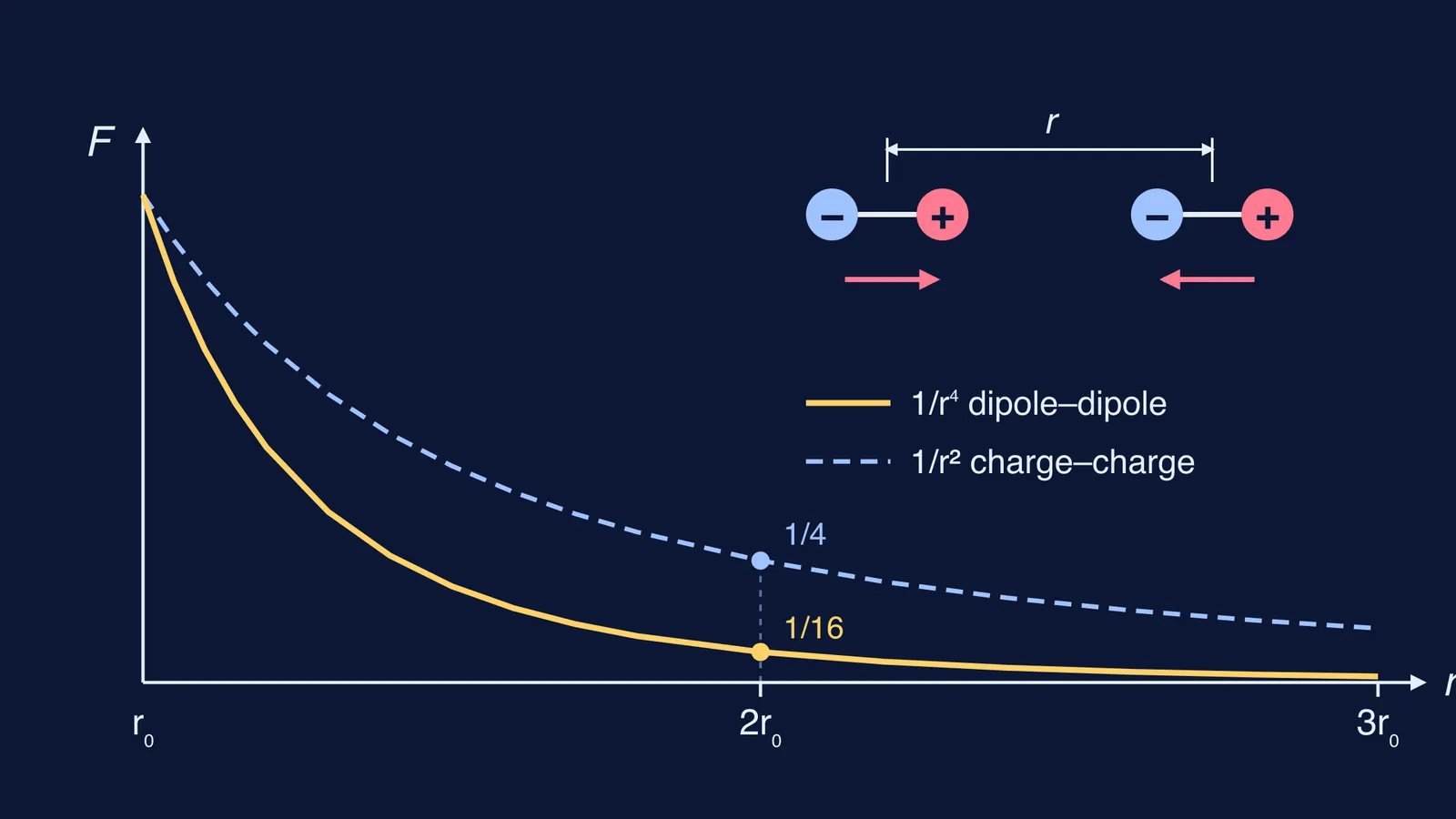
Two charges pull on each other with a force that falls as 1/r². Put two dipoles in a line, head to tail, and the force falls much faster, as 1/r⁴. With two standard formulas you can derive it in three lines. Here is the derivation, a numerical, and two quick checks that catch a wrong answer.
How does the force between two electric dipoles depend on distance?
An electric dipole is a charge +q and a charge −q separated by a distance d, and its dipole moment is p = qd, measured in coulomb-metres (Wikipedia: Electric dipole moment; OpenStax University Physics, Vol. 2, section 5.7).
Far from a dipole, its field falls as 1/r³, faster than the 1/r² of a single charge (OpenStax, section 5.7). Seen from far away, the fields of the two opposite charges nearly cancel. The general far-field formula is E = k[3(p·r̂)r̂ − p]/r³ (Wikipedia). On the axis, p·r̂ = p, so the axial field is E = 2kp/r³, where k = 1/(4πε₀). If the 1/r³ part feels shaky, start with our post on why a dipole's field falls as 1/r³.
For two short dipoles p₁ and p₂ on a common axis with centres a distance r apart (and r much larger than either length), the force is F = 6kp₁p₂/r⁴.
How do you derive the 1/r⁴ force step by step?
Place dipole 1 at the origin pointing along +x, and dipole 2 at distance x, also pointing along +x.
Field of dipole 1 at dipole 2: E(x) = 2kp₁/x³, along +x.
Energy of dipole 2 in that field: U = −p·E (Wikipedia), so U = −2kp₁p₂/x³.
Force: F = −dU/dx = −6kp₁p₂/x⁴.
The minus sign means the force on dipole 2 points towards dipole 1: aligned head to tail, the dipoles attract. Turn one of them round and U changes sign, so they repel with the same magnitude.
You can also see it charge by charge. The two charges of dipole 2 sit where the field of dipole 1 differs slightly, so the pushes almost cancel, leaving p₂ × dE/dx. In a uniform field dE/dx is zero and the net force vanishes, which is the idea behind our post on the force on a dipole in a non-uniform field.
A worked numerical: how big is the force?
Take ε₀ = 8.854 × 10⁻¹² F/m (NIST CODATA 2022), so k = 1/(4πε₀) ≈ 8.99 × 10⁹ N m² C⁻².
Each dipole has q = 1 nC and d = 2 mm, so p = 2 × 10⁻¹² C m. The centres are r = 10 cm apart, so d/r = 0.02 and the short-dipole formula applies.
p₁p₂ = 4 × 10⁻²⁴ C² m²
r⁴ = 10⁻⁴ m⁴
F = 6 × 8.99 × 10⁹ × 4 × 10⁻²⁴ / 10⁻⁴ ≈ 2.16 × 10⁻⁹ N, attractive
As a check, we added up all four charge-pair Coulomb forces exactly: kq²[2/r² − 1/(r + d)² − 1/(r − d)²] gives 2.158 × 10⁻⁹ N, within 0.1% of the formula.
Compare two single 1 nC charges 10 cm apart: kq²/r² ≈ 9.0 × 10⁻⁷ N. The dipole force is about 420 times smaller: by the formula, the ratio is 6(d/r)² = 0.0024. Move the dipoles to 20 cm and the force drops 16-fold, to about 1.35 × 10⁻¹⁰ N.
How can you check the dipole force formula by dimensions?
Write p = qd and regroup: kp₁p₂/r⁴ = (kq²/r²) × (d/r)². The first bracket is Coulomb's force, so it has the dimensions of force, and d/r is a pure number. So the whole expression is a force, [M L T⁻²], as it must be. Write kp₁p₂/r³ instead and an extra length is left over: that is an energy, which is what U is.
Dimensions cannot give you the 6, and our guide to checking answers with dimensional analysis explains why. For the number, there is a cross-check: two coaxial magnetic dipoles feel F = 3μ₀m₁m₂/(2πz⁴) (Wikipedia: Magnetic dipole–dipole interaction). Write 3/(2π) as 6/(4π) and it is 6 × (μ₀/4π) × m₁m₂/z⁴: the same 6 and the same 1/r⁴.
What mistakes cost marks on this question?
Writing 1/r³ for the force. That is the field and the energy, not the force.
Using 2 instead of 6. The 2 belongs to the axial field; the derivative multiplies it by 3.
Missing the direction. Head to tail attract; head to head repel.
Using the formula when the dipoles are close. If d is not much smaller than r, add the four Coulomb forces instead.
If you get the right formula but lose marks on the steps, the Fermi Problem Library has worked problems with a step-by-step solver that explains the reasoning rather than printing an answer. If the dipole field itself is the gap, the Fermi Concept Library gives each physics concept its own lesson and its place in the map.
Next time, run the regrouping trick first: (kq²/r²)(d/r)² gives you the power of r before any calculus.