

On this page
Line-and-plane questions in 3D come down to one move: turn the line into a single moving point, then ask when that point satisfies the plane's equation.
How do you find the point where a line intersects a plane?
A line and a plane in 3D meet in one of three ways: at a single point, not at all, or along the whole line (Wikipedia: line–plane intersection). You find out which by writing the line in parametric form, x = x₀ + λa, y = y₀ + λb, z = z₀ + λc, where (x₀, y₀, z₀) is a point on the line and (a, b, c) is its direction (OpenStax Calculus via LibreTexts/12%3A_Vectors_in_Space/12.05%3A_Equations_of_Lines_and_Planes_in_Space)).
Every value of λ gives one point on the line. The method:
Set the symmetric form of the line equal to λ.
Write the general point (x, y, z) in terms of λ.
Substitute it into the plane's equation.
Solve the resulting equation for λ.
Put that λ back into the general point.
Check the point in both the line and the plane.
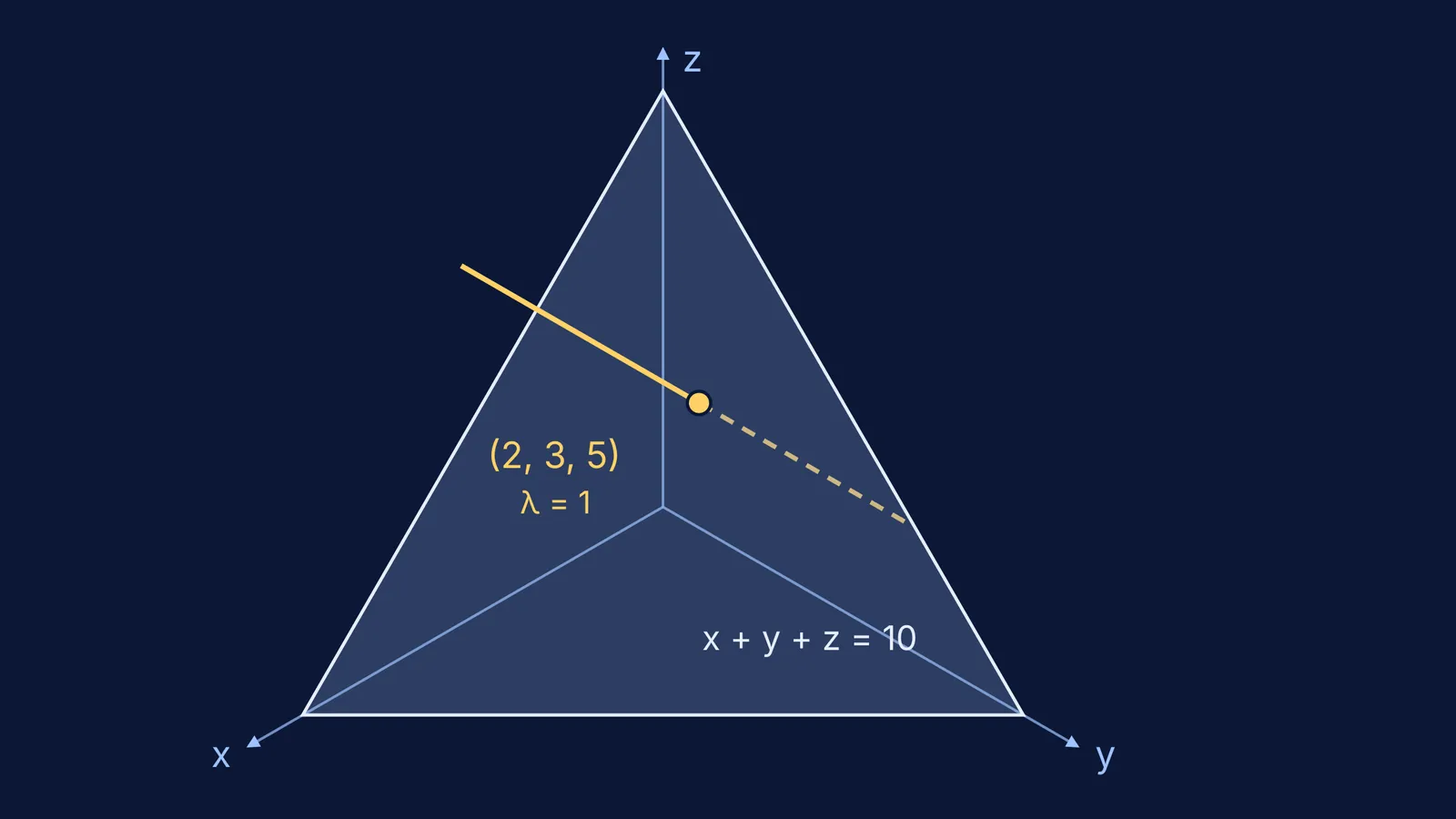
Worked example: where does x/2 = (y − 4)/(−1) = (z − 3)/2 meet x + y + z = 10?
Step 1. Set each fraction equal to λ.
Step 2. The general point is (2λ, 4 − λ, 3 + 2λ). The minus sign under y makes the y-part 4 − λ, not 4 + λ.
Step 3. Substitute into the plane: 2λ + (4 − λ) + (3 + 2λ) = 10.
Step 4. Collect terms: 7 + 3λ = 10, so λ = 1.
Step 5. Put λ = 1 back: the point is (2, 3, 5).
Step 6. Check. In the plane: 2 + 3 + 5 = 10. On the line: 2/2 = 1, (3 − 4)/(−1) = 1 and (5 − 3)/2 = 1. All three ratios agree.
What if the line is parallel to the plane or lies in it?
Sometimes λ cancels out in step 4. That happens when the line's direction is perpendicular to the plane's normal, meaning their dot product is zero, and then the line is parallel to the plane (Wikipedia: line–plane intersection). The same source covers the two possibilities: if a point of the line also satisfies the plane, the whole line lies in the plane; if not, they never meet.
Try the line (x − 1)/1 = (y − 2)/(−2) = (z − 3)/1. Its general point is (1 + λ, 2 − 2λ, 3 + λ). Substitute into x + y + z = 10:
The λ terms give λ − 2λ + λ = 0, so you are left with 6 = 10.
That is false for every λ, so the line never meets the plane. It is parallel to it.
Change the plane to x + y + z = 6 and you get 6 = 6, true for every λ: the line lies in the plane.
Spot this early: the normal (1, 1, 1) dotted with the direction (1, −2, 1) is 0. Then test one point, (1, 2, 3), to decide which case you have.
Is there a formula for λ?
Yes, but it is just the method above written once in general. For the plane ax + by + cz = d and a line through (x₁, y₁, z₁) with direction ratios (l, m, n):
λ = (d − (ax₁ + by₁ + cz₁)) / (al + bm + cn)
In vector form, for the line r = a + λb and the plane r · n = d, it reads λ = (d − a · n) / (b · n). The denominator is the direction dotted with the normal, so zero means the parallel case. For the worked example, λ = (10 − 7) / 3 = 1.
The same quantity al + bm + cn appears in the angle between a line and a plane; see why the line–plane angle uses sin, not cos.
Which mistakes cost marks most often?
Reading direction ratios from a form like (1 − x)/3. Rewrite it as (x − 1)/(−3) first; our post on direction ratios and the reversed symmetric form shows the trap.
Dropping a bracket in step 3, so a minus sign reaches only one term.
Stopping at λ. The question asks for a point, so finish step 5.
Treating 0 = 0 as an error. It means the line lies in the plane.
The same general point also finds the foot of a perpendicular, a mirror image in a plane, or points on a 3D line at a given distance.
For practice, the Fermi Problem Library has worked problems with a step-by-step solver that explains the reasoning rather than printing an answer, so you can compare your step 2 with a correct one. If normals and direction ratios feel shaky, rebuild them in the Fermi Concept Library.
Next time you see a line and a plane, write the general point first.


