

On this page
When studying the fundamentals of biology, size helps us understand function. The physical dimensions of cells span a vast range — from microscopic bacteria that can multiply inside our bodies to the massive single cells that form bird eggs. The NCERT Class 11 biology textbook sets out benchmark sizes that frequently appear in exams to help you grasp this scale.
What are the largest and smallest cell examples?
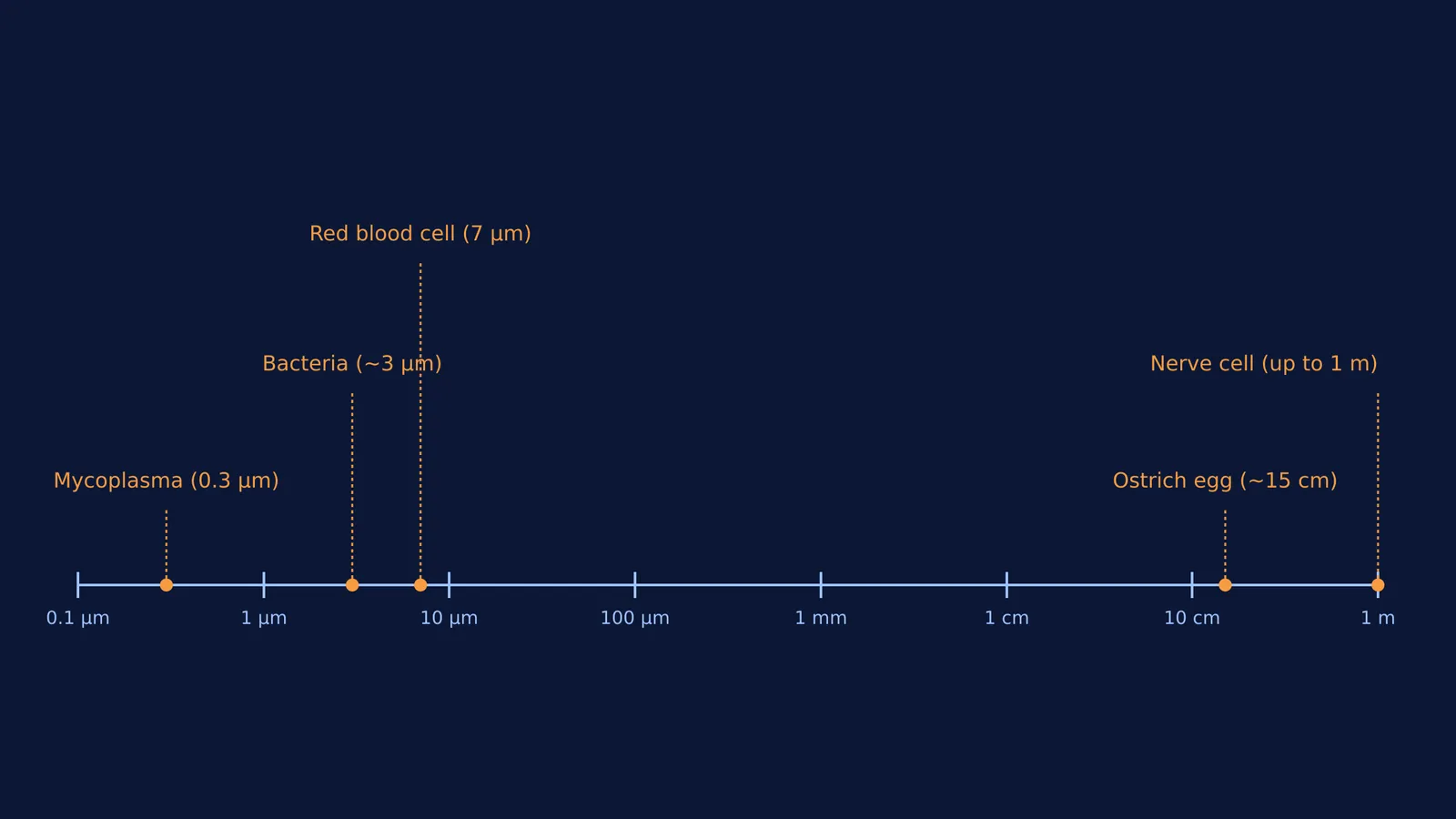
At the extreme lower end of the scale is Mycoplasma. It holds the record as the smallest cell, measuring only 0.3 μm in length [NCERT]. A defining feature of Mycoplasma is that it completely lacks a cell wall. This absence makes it pleomorphic — meaning it can change its shape — and naturally resistant to common antibiotics like penicillin, which work by targeting cell wall synthesis. When comparing the smallest life forms in biological classification, Mycoplasma is a true functioning cell, distinguishing it from non-cellular entities like viruses, viroids and lichens.
At the other end of the scale, the ostrich egg is the largest isolated single cell known [NCERT]. This massive size is necessary because the egg must store all the nutrients, in the form of yolk, that a growing macroscopic embryo will need before hatching outside the mother's body.
If we measure by length rather than volume, nerve cells take the prize. Nerve cells, or neurons, are some of the longest cells in the human body [NCERT]. Their elongated axons allow for rapid transmission of electrical impulses from the spinal cord to the toes. Without this length, a signal would have to cross thousands of small cells, slowing down your reflexes significantly.
How big are bacteria and human cells?
Between these extremes lie the cells we encounter most often in diagrams and microscopic slides, ranging from human tissues to the photosynthetic structures found across the three algae classes.
Typical bacteria range in size from 3 to 5 μm [NCERT]. This makes them significantly larger than Mycoplasma but still much smaller than eukaryotic cells. Their small size provides a high surface-area-to-volume ratio, enabling rapid nutrient uptake and fast replication rates.
Among multicellular organisms, human red blood cells are a standard reference point. They measure about 7.0 μm in diameter [NCERT]. Their round and biconcave shape is not just a structural detail; it is perfectly adapted for squeezing through narrow capillaries and maximizing the surface area available for oxygen diffusion.
How are cell sizes asked in exams?
Examiners use these numbers to test your memory and your ability to compare scales. You will rarely be asked simply to write down a number in a vacuum. Instead, questions often require you to arrange cells in ascending or descending order, or to spot an incorrect statement hidden in a list of facts.
A classic multiple-choice question format tests both size and structural facts simultaneously.
Worked Example: Spotting the Outlier
Which of the following statements is incorrect?
Mycoplasma is the smallest cell and is only 0.3 μm in length.
The largest isolated single cell is the egg of an ostrich.
Nerve cells are some of the longest cells.
Human red blood cells are about 7.0 mm in diameter.
*Solution:* Option 4 is the incorrect statement. You must read the units carefully in biology exams. Human red blood cells are about 7.0 μm (micrometres) in diameter, not 7.0 mm (millimetres). A 7-millimetre cell would be visible to the naked eye. The other three statements are exactly as stated in the textbook.
When revising the unit of life chapter, you can use the Fermi Concept Library to explore the structures and functions of these cells in greater depth. If you are struggling with how different organelles fit into these scales, or if you need help connecting these isolated facts to other chapters, Fermi's AI tutor can work out what you already know and build a plan for the session.
By linking these standard sizes to their biological functions — the long reach of a nerve cell, the oxygen-carrying shape of a red blood cell, or the missing wall of a Mycoplasma — you turn simple numbers into concepts that are easier to recall on exam day.


