

On this page
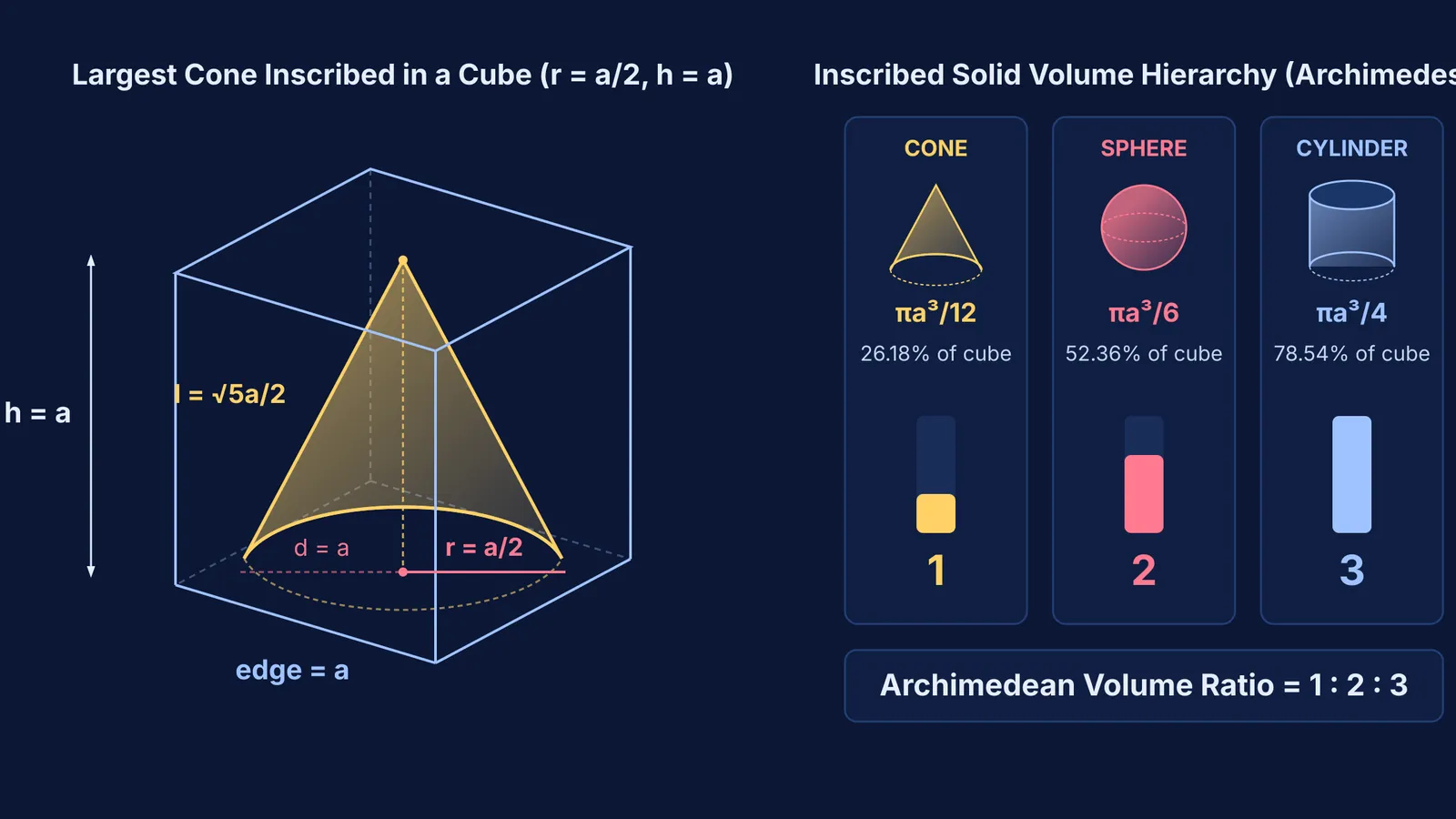
When carving a right circular cone from a solid cube of edge a, two geometric constraints define its dimensions. First, the circular base must fit inside one square face: the largest circle inscribed in a square of side a has diameter d = a, giving radius r = a/2. Second, to maximize height without penetrating the boundary, the apex must touch the opposite face, giving perpendicular height h = a.
Under the CBSE Class 10 Mathematics curriculum, this problem tests how 2D constraints translate into 3D volume. Before tackling combined solids, students master individual formulas in surface area and volume formulas in Class 9. Setting base diameter and height equal to edge a ensures the cone utilizes the cube's full vertical and lateral span.
What is the largest cone that can be cut from a cube?
Because a cube has six identical square faces of edge a, choosing any face as the base yields the same maximum dimensions. Placing the circular base on a face fixes base diameter d = a (radius r = a/2). If diameter exceeded a, the base would spill outside the square boundary; if height exceeded a, the apex would puncture the opposite face. Therefore, the maximal right circular cone has r = a/2 and height h = a.
How do you calculate the volume and surface area of the carved cone?
The volume of a right circular cone is V = (1/3)πr²h. Substituting r = a/2 and h = a gives:
V_cone = (1/3)π(a/2)²(a) = πa³/12.
Since the cube has volume V_cube = a³, the cone occupies (πa³/12) / a³ = π/12 of the cube. Taking π ≈ 3.14159, the cone fills approximately 26.18% of the cube's volume, leaving 73.82% as waste material, a benchmark documented in NCERT Exemplar Class 10 Mathematics Chapter 12.
The slant height follows from the Pythagorean theorem: l = √(r² + h²) = √((a/2)² + a²) = (√5/2)a ≈ 1.118a. The curved surface area is CSA = πrl = (√5/4)πa², and total cone surface area is TSA = (πa²/4)(1 + √5).
For the remaining solid, subtracting the circular base from the cube's six faces and adding the conical cavity yields total surface area 6a² − π(a/2)² + π(a/2)l = 6a² + (πa²/4)(√5 − 1). For a cube with a = 14 cm, the remaining surface area is 1366.35 cm², exceeding the original cube's 1176 cm² area.
How do the carved cone, cylinder, and sphere compare?
Inscribing standard curved solids into the same cube of edge a reveals a volume hierarchy documented since Archimedes' *On the Sphere and Cylinder*:
Inscribed cylinder: With radius r = a/2 and height h = a, V_cylinder = π(a/2)²a = πa³/4 ≈ 0.7854a³, filling 78.54% of the cube.
Inscribed sphere: Touching all six faces with radius r = a/2, V_sphere = (4/3)π(a/2)³ = πa³/6 ≈ 0.5236a³, filling 52.36% of the cube.
Carved cone: With radius r = a/2 and height h = a, V_cone = πa³/12 ≈ 0.2618a³, filling 26.18% of the cube.
Comparing these inscribed volumes yields an exact integer ratio:
V_cone : V_sphere : V_cylinder = (πa³/12) : (πa³/6) : (πa³/4) = 1 : 2 : 3.
As Archimedes proved, any right cylinder, sphere, and cone sharing the same height and diameter follow this 1 : 2 : 3 proportion. Connecting this ratio to combined solids in Class 10 grounds spatial intuition. When visualizing these intersecting 3D geometries feels challenging, the Fermi Simulation Lab provides interactive simulations for the ideas that are easier to see than to read.
What is a worked example with numbers from NCERT?
Sample Question 1 in Chapter 12 of the NCERT Exemplar Class 10 Mathematics examines the largest cone carved from a wooden cube of edge 14 cm, using π = 22/7:
Dimensions: Edge a = 14 cm, base radius r = 7 cm, and height h = 14 cm.
Cone volume: V_cone = (1/3) × (22/7) × 7² × 14 = 2156 / 3 ≈ 718.67 cm³.
Waste volume: Cube volume V_cube = 14³ = 2744 cm³, leaving waste volume 2744 − 718.67 = 2025.33 cm³.
Surface area of remaining block: Slant height l = √(7² + 14²) = 7√5 ≈ 15.652 cm. Remaining surface area is 6(14)² − (22/7)(7)² + (22/7)(7)(15.652) = 1176 − 154 + 344.35 = 1366.35 cm².
For a smaller cube of edge 4.2 cm from the same exemplar, radius r = 2.1 cm and height h = 4.2 cm yield a cone volume of 19.404 cm³. These circular base calculations build on areas related to circles in Class 10.
How should you tackle carved solid problems in exams?
When solving mensuration problems on CBSE exams or JEE Main, apply this systematic approach:
Identify boundary limits: Confirm that the base rests on a face so diameter d = a (radius r = a/2) and height h = a.
Separate volume and area logic: Volume is subtractive (V_remaining = V_cube − V_cone), while surface area of a carved cavity is additive (SA_remaining = SA_outer − SA_base + CSA_cavity).
Factor out π: Keeping expressions in terms of πa³ prevents decimal rounding errors during intermediate steps.
Verify with the Archimedean ratio: Confirm that your cone volume is roughly 26% of the cube volume, and that your cylinder and cone answers satisfy the 3 : 1 ratio confirmed in the CBSE Class 10 Mathematics curriculum.
If you hit multi-step algebra roadblocks, the Fermi Problem Library has worked problems with a step-by-step solver that explains the reasoning rather than printing an answer. For reviewing the definitions that connect 2D cross-sections to 3D volumes, the Fermi Concept Library covers every concept in physics, chemistry, biology, mathematics and computing, each with its own lesson and its place in the map.


