

On this page
In Class 12 you learn that transition metal ions are coloured because electrons jump between split d orbitals. Then you meet KMnO4. Manganese has the configuration 3d⁵ 4s², and in permanganate it is in the +7 state, so all seven of those electrons are gone. With no d electrons there can be no d-d jump, yet the solution is a deep purple. The colour comes from a different process, which also explains chromate and dichromate.
Why is KMnO4 purple if manganese has no d electrons?
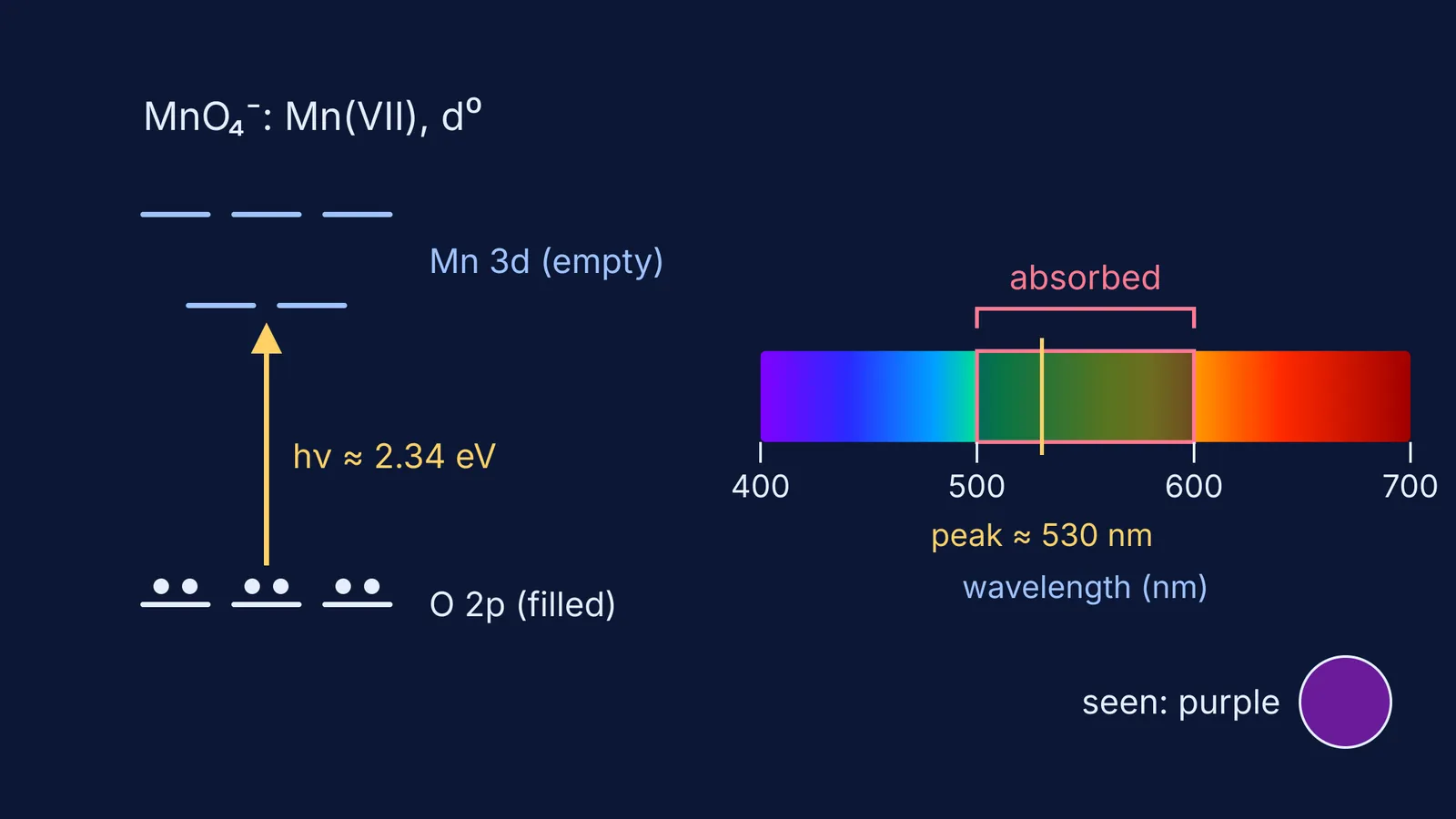
The d-d picture from crystal field splitting and colour needs at least one d electron to move up, and Mn(VII) has none. Instead, permanganate has a highly charged metal with empty d orbitals, surrounded by four electron-rich oxide ions.
In ligand-to-metal charge transfer (LMCT), light moves an electron from orbitals on the ligands into empty metal d orbitals, as explained in LibreTexts' chapter on charge-transfer spectra/11%3A_Coordination_Chemistry_III_-_Electronic_Spectra/11.03%3A_Electronic_Spectra_of_Coordination_Compounds/11.3.07%3A_Charge-Transfer_Spectra). The same source says very high metal oxidation states favour LMCT, and it uses permanganate as its example: Mn is in the +7 state and the ligands are oxo groups with a 2− charge. For the d⁰ tetraoxide ions of the first-row metals, the charge-transfer band article on Wikipedia says they are often deeply coloured, and assigns the colour to LMCT.
Which light does permanganate absorb?
The visible absorption band of KMnO4 stretches from 500 to 600 nm, with its maximum near 530 nm, according to course notes from the College of Saint Benedict and Saint John's University. That is the green-yellow middle of the spectrum. What gets through is the red end and the blue-violet end, and together your eye sees them as purple.
A 530 nm photon carries about 2.34 eV (E = 1240/λ, with λ in nm). That is the energy needed to shift one electron from oxygen onto manganese.
Why is charge-transfer colour so intense?
Two selection rules, the spin rule and the Laporte rule, decide how strongly light is absorbed. Charge-transfer transitions are usually allowed by both rules, so when they occur the colour is often very intense (LibreTexts/11%3A_Coordination_Chemistry_III_-_Electronic_Spectra/11.03%3A_Electronic_Spectra_of_Coordination_Compounds/11.3.07%3A_Charge-Transfer_Spectra)). In octahedral complexes, d-d transitions break the Laporte rule, so they are weak, with molar absorptivities of 100 M⁻¹ cm⁻¹ or less (LibreTexts, selection rules/11%3A_Coordination_Chemistry_III_-_Electronic_Spectra/11.03%3A_Electronic_Spectra_of_Coordination_Compounds/11.3.01%3A_Selection_Rules)). The permanganate peak at 530 nm has a molar absorptivity of about 2,200 L mol⁻¹ cm⁻¹ (CSB/SJU notes).
Worked example: how much light gets through?
Use the Beer-Lambert law, A = εcl, with the values above, for a 0.001 M solution in a 1 cm cuvette.
Permanganate at 530 nm: A = 2,200 × 0.001 × 1 = 2.2. Transmitted fraction = 10^−2.2 ≈ 0.006, so under 1% of the green light gets through.
An octahedral d-d band at the top of its range, ε = 100: A = 100 × 0.001 × 1 = 0.1. Transmitted fraction = 10^−0.1 ≈ 0.79, so about 79% gets through and the colour is pale.
That is why a little KMnO4 colours a lot of water.
Why are dichromate and chromate coloured for the same reason?
Chromium in chromate (CrO₄²⁻) and dichromate (Cr₂O₇²⁻) is in the +6 state. Chromium is 3d⁵ 4s¹, so Cr(VI) is d⁰ too, and again there is nothing for a d-d jump. The orange of sodium dichromate comes from LMCT bands, where an electron moves from an oxide-dominated state to a metal-dominated one (Wikipedia, charge-transfer band).
The two ions absorb different light. Chromate absorbs strongly in the violet and looks yellow, while dichromate absorbs in the blue and looks orange (Doc Brown's chemistry notes). The oxidation state is the same, but the chromium's electronic environment changes, so the spectra differ. Adding acid turns yellow chromate orange, and adding alkali turns it back (Chemguide). Our post on how pH swaps chromate and dichromate works through that equilibrium.
Why does permanganate absorb lower-energy green light while chromate absorbs violet? LibreTexts/11%3A_Coordination_Chemistry_III_-_Electronic_Spectra/11.03%3A_Electronic_Spectra_of_Coordination_Compounds/11.3.07%3A_Charge-Transfer_Spectra) notes that metal d orbitals drop in energy as the metal's charge rises, which narrows the gap to the ligand orbitals. Mn(VII) carries more charge than Cr(VI), which is consistent with that trend.
How do you tell charge transfer from d-d colour?
Run this check on any coloured species.
Work out the oxidation state and count the d electrons.
If the ion is d⁰ (or d¹⁰), d-d transitions are impossible. Any colour must come from charge transfer.
Look for a high-oxidation-state metal bonded to electron-rich ligands such as O²⁻ or halides. That pairing favours LMCT.
Ask how intense the colour is. A deep colour from a dilute solution points to an allowed transition. A pale colour points to d-d.
KMnO4, K₂CrO₄ and K₂Cr₂O₇ all stop at step 2. For manganate and MnO₂, see our guide to the colours of manganese compounds.
If selection rules or the Laporte rule still feel shaky, the Fermi Concept Library gives each chemistry concept its own lesson and shows its place in the map. When you want to practise reasoning like the worked example, the Fermi Problem Library has a step-by-step solver that explains the reasoning rather than printing an answer.


