

On this page
A pressure gauge on a closed flask reads the total pressure of every gas inside. The first-order rate equation needs how much reactant is left. This guide bridges that gap, then works through an NCERT exercise to get k, the half-life and the rate.
Why can't you put total pressure straight into the first-order equation?
The integrated first-order equation is k = (2.303/t) log([R]0/[R]), and both concentrations in it belong to the reactant alone (NCERT Class 12 Chemistry, Chemical Kinetics, equation 3.15). For a gas at constant temperature, partial pressure is proportional to concentration. That is why the same chapter lets you write rates in terms of partial pressure. So you can use the reactant's partial pressure in place of [R].
Total pressure is a different thing. As the reactant breaks up, the products add their own pressure, so total pressure rises while the reactant's pressure falls. Plug it in directly and the logarithm turns negative, giving a negative k.
For the equation itself, see deriving the first-order integrated rate equation.
How do you express reactant pressure in terms of total pressure?
Write a pressure table. For A(g) → B(g) + C(g), NCERT lets the reactant's pressure fall by x atm. At t = 0 the pressures are pi, 0 and 0. At time t they are (pi − x), x and x (NCERT Chemical Kinetics, equation 3.16). Adding these gives pt = pi + x, so x = pt − pi and pA = 2pi − pt.
The same idea works for any decomposition. Suppose one mole of gaseous reactant gives n moles of gaseous products in total. Then pt = p0 + (n − 1)x, and the reactant's pressure is:
pA = (n·p0 − pt)/(n − 1)
For n = 2 this becomes 2p0 − pt. You can check it against NCERT Example 3.6, the decomposition 2N2O5(g) → 2N2O4(g) + O2(g) starting at 0.5 atm. One mole of N2O5 gives 1.5 moles of gas, so n = 1.5 and pA = 1.5 − 2pt. That matches the textbook, which finds pA = 0.476 atm at 100 s and k = 4.98 × 10^-4 s^-1 (NCERT Example 3.6).
Worked example: SO2Cl2 decomposition from NCERT
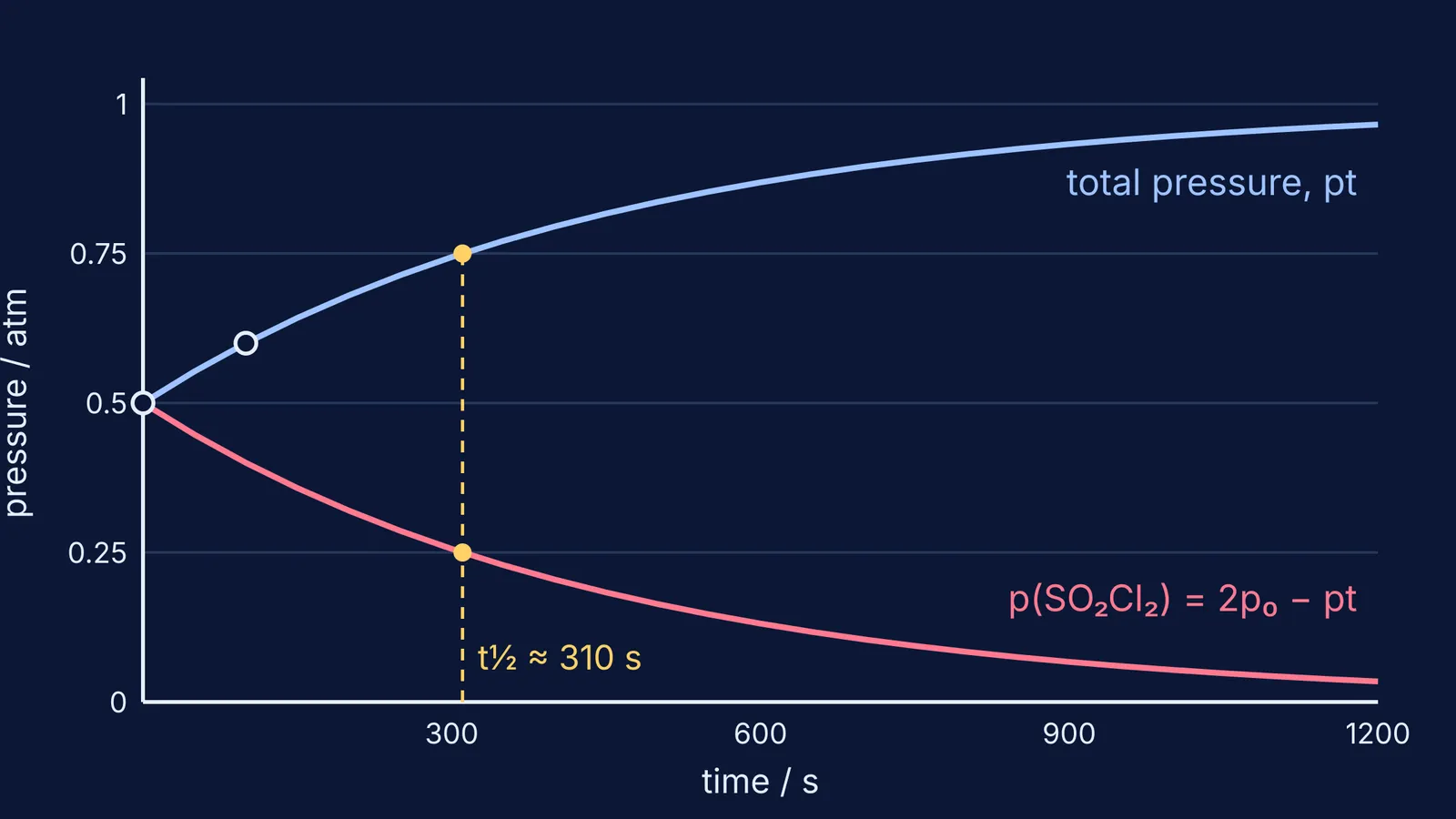
NCERT Exercise 3.21 describes the first-order decomposition SO2Cl2(g) → SO2(g) + Cl2(g) at constant volume. The total pressure is 0.5 atm at 0 s and 0.6 atm at 100 s. The exercise asks for the rate when the total pressure reaches 0.65 atm (NCERT Chemical Kinetics, Exercises).
Count the gas moles: one SO2Cl2 gives two, so n = 2 and pA = 2p0 − pt.
At 100 s: pA = 2(0.5) − 0.6 = 0.4 atm.
Rate constant: k = (2.303/100 s) × log(0.5/0.4) = 0.02303 × 0.0969 = 2.23 × 10^-3 s^-1.
Half-life: t½ = 0.693/k = 0.693/(2.23 × 10^-3 s^-1) ≈ 310 s.
At pt = 0.65 atm: pA = 1.0 − 0.65 = 0.35 atm, so rate = k × pA = 2.23 × 10^-3 × 0.35 ≈ 7.8 × 10^-4 atm s^-1.
Sense check: after one half-life, pA, SO2 and Cl2 are 0.25 atm each, so the total is 0.75 atm, halfway between 0.5 and 1.0 atm.
How do you get the half-life once you have k?
For a first-order reaction, t½ = 0.693/k. This is NCERT equation 3.17, which comes from putting [R] = [R]0/2 into the integrated equation (NCERT Chemical Kinetics, section 3.3.3). No initial pressure appears in it, so the reactant's pressure halves in the same time whether the flask starts at 0.5 atm or 5 atm.
Our post on the time for 99 percent completion of a first-order reaction uses it to show why 99% takes twice as long as 90%.
A five-step checklist for any total-pressure question
Write the balanced equation and mark the gases; only they add to the pressure.
Work out n, the moles of gaseous product formed per mole of reactant.
Write the t = 0 and time-t rows of the pressure table in terms of x.
Solve for x using pt, then write pA. Check that pA is positive and that pt would reach n·p0 at completion.
Use k = (2.303/t) log(p0/pA), then t½ = 0.693/k.
For practice, try NCERT Exercise 3.20. Azoisopropane decomposes to hexane and nitrogen at 543 K, and the pressure is 35.0, 54.0 and 63.0 mm Hg at 0, 360 and 720 s (NCERT Exercises). Here n = 2. You should get k ≈ 2.17 × 10^-3 s^-1 from the 360 s reading and 2.24 × 10^-3 s^-1 from the 720 s reading. Near-equal values confirm first order.
If step 3 is where you get stuck, the Fermi Problem Library has worked problems with a step-by-step solver that explains the reasoning rather than printing an answer. If the idea of partial pressure itself is shaky, start with its lesson in the Fermi Concept Library.
Next time you see a column headed "total pressure", write the pressure table before you touch a logarithm.


