

On this page
Picture a copper rod welded to a steel rod, the copper end in boiling water, the steel end in melting ice. Once the temperatures stop changing, what is the temperature at the weld?
The method rests on one sentence. At steady state, with the sides insulated, every joule that enters the copper must leave through the steel. So the rate of heat flow, the heat current, is the same in both rods. OpenStax University Physics, Volume 2 uses exactly this argument in its Example 1.11, where a steel rod welded to an aluminium rod, with ends at 100 °C and 20 °C, gives a junction temperature of 41.3 °C.
How do you find the temperature of the junction of two rods in series?
Start from the conduction equation. The rate of heat flow through a rod is H = kA(T_hot − T_cold)/L, where k is the thermal conductivity, A the cross-section and L the length (OpenStax, Equation 1.9).
Call the junction temperature T. Write H for each rod and set the two equal:
k₁A₁(T₁ − T)/L₁ = k₂A₂(T − T₂)/L₂
Call G = kA/L the conductance of each rod. Solving for T gives:
T = (G₁T₁ + G₂T₂) / (G₁ + G₂)
In words, the junction temperature is a weighted average of the two end temperatures, weighted by each rod's conductance kA/L. The junction sits closer to the far-end temperature of the rod that conducts better.
If you prefer resistances, OpenStax defines the R factor as L/k and notes that thermal resistances simply add when two rods are joined end to end. For a whole rod of cross-section A, use R = L/(kA). Our post on thermal resistance of rods in series and parallel covers that analogy.
Worked example: copper and steel rods joined end to end
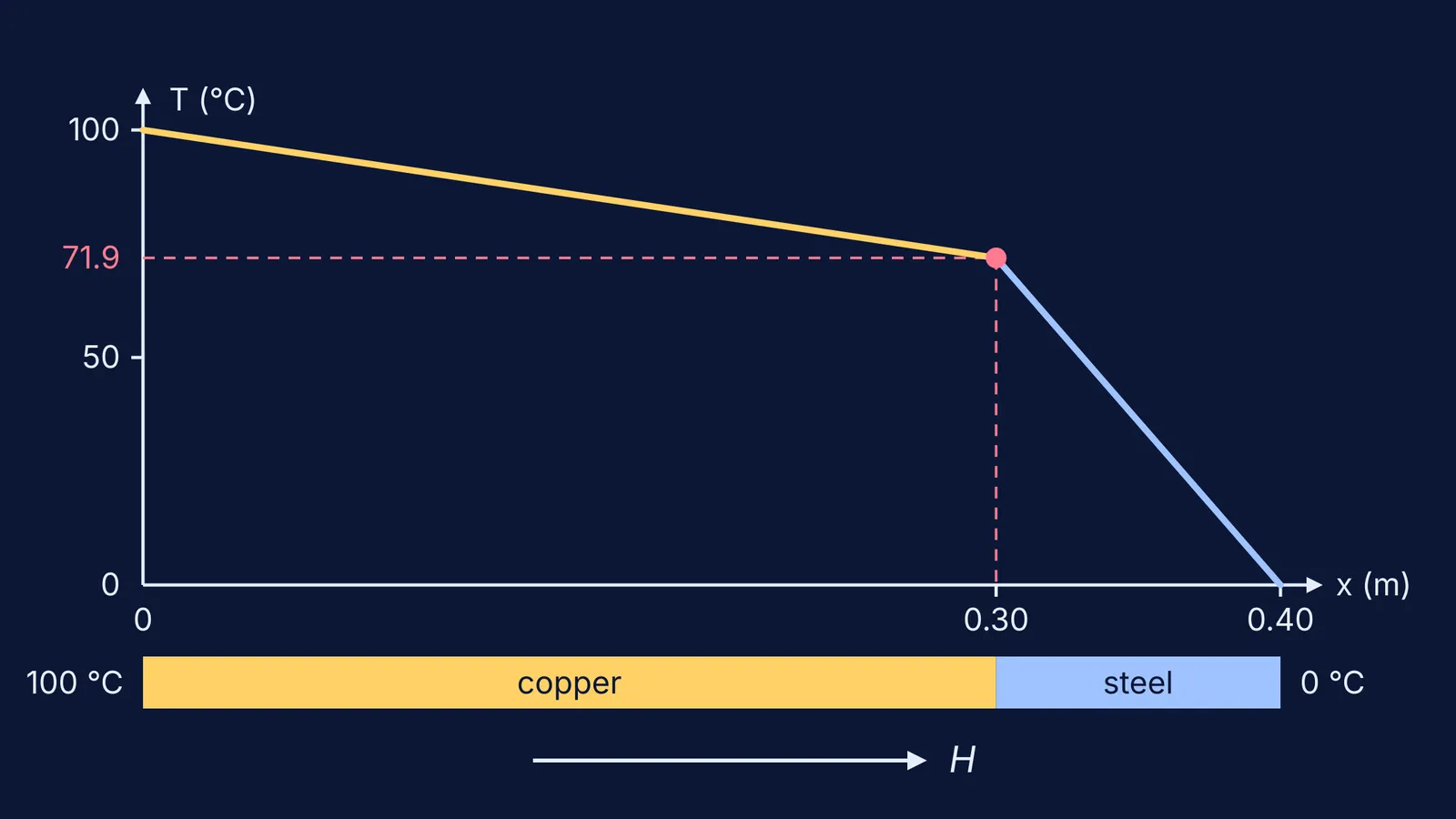
A copper rod 30 cm long and a steel rod 10 cm long, both with a cross-section of 2.0 cm², are joined end to end and insulated along their sides. The free end of the copper is held at 100 °C and the free end of the steel at 0 °C. Find the junction temperature and the heat current. Take k = 385 W/m K for copper and k = 50.2 W/m K for steel, the values in the HyperPhysics thermal conductivity table.
Convert units first: A = 2.0 × 10⁻⁴ m², L₁ = 0.30 m, L₂ = 0.10 m.
Copper conductance: G₁ = 385 × 2.0 × 10⁻⁴ / 0.30 = 0.2567 W/K.
Steel conductance: G₂ = 50.2 × 2.0 × 10⁻⁴ / 0.10 = 0.1004 W/K.
Junction temperature: T = (0.2567 × 100 + 0.1004 × 0) / (0.2567 + 0.1004) = 71.9 °C.
Heat current through the steel: H = 0.1004 × (71.9 − 0) = 7.2 W.
Check it through the copper: H = 0.2567 × (100 − 71.9) = 7.2 W. The two match, as they must.
By resistances: 3.90 K/W (copper) + 9.96 K/W (steel) = 13.86 K/W, so H = 100/13.86 = 7.2 W again.
Why does the shorter steel rod take most of the temperature drop?
The steel is a third as long as the copper, yet 71.9 of the 100 degrees fall across it. With the HyperPhysics values, copper conducts about 7.7 times better than steel (385 ÷ 50.2), and that beats the factor of 3 in length. Because H is the same in both rods, the drop across each rod is proportional to its resistance, so the poorer conductor has the steeper gradient: the kink in the diagram at the top of this post. OpenStax's Example 1.11 shows the same pattern, with the larger drop across its steel rod.
A quick variant to test yourself: make both rods the same length and area. Then T = (k₁T₁ + k₂T₂)/(k₁ + k₂) = 38500/435.2 = 88.5 °C.
A caution: "steel" is not one material. HyperPhysics lists 50.2 W/m K; the OpenStax table gives 80 W/m °C for carbon steel and 14 W/m °C for stainless steel. In an exam, use the value in the question.
What mistakes do students make with junction temperature?
Averaging the end temperatures to get 50 °C. That is only right when both rods have the same kA/L.
Setting the temperature gradients equal instead of the heat currents. The gradients are different; the heat current is shared.
Dropping the area when the rods have different thicknesses. A is inside G, so it matters.
Mixing up which rod touches which bath. Hold the steel end at 100 °C and the copper end at 0 °C, and the junction falls to 28.1 °C, again near the far end of the copper.
Forgetting the assumptions. If heat leaks from the sides, or the rods are still warming up, the heat current is not shared and this method fails.
For three or more rods, write one equation per junction, or find the total resistance and split the drop. For an object cooling over time rather than at steady state, see our spreadsheet model of Newton's law of cooling.
If your answers keep landing in the wrong place, the Fermi Problem Library has worked problems with a step-by-step solver that explains the reasoning rather than printing an answer, so you can see which line went wrong.


