

On this page
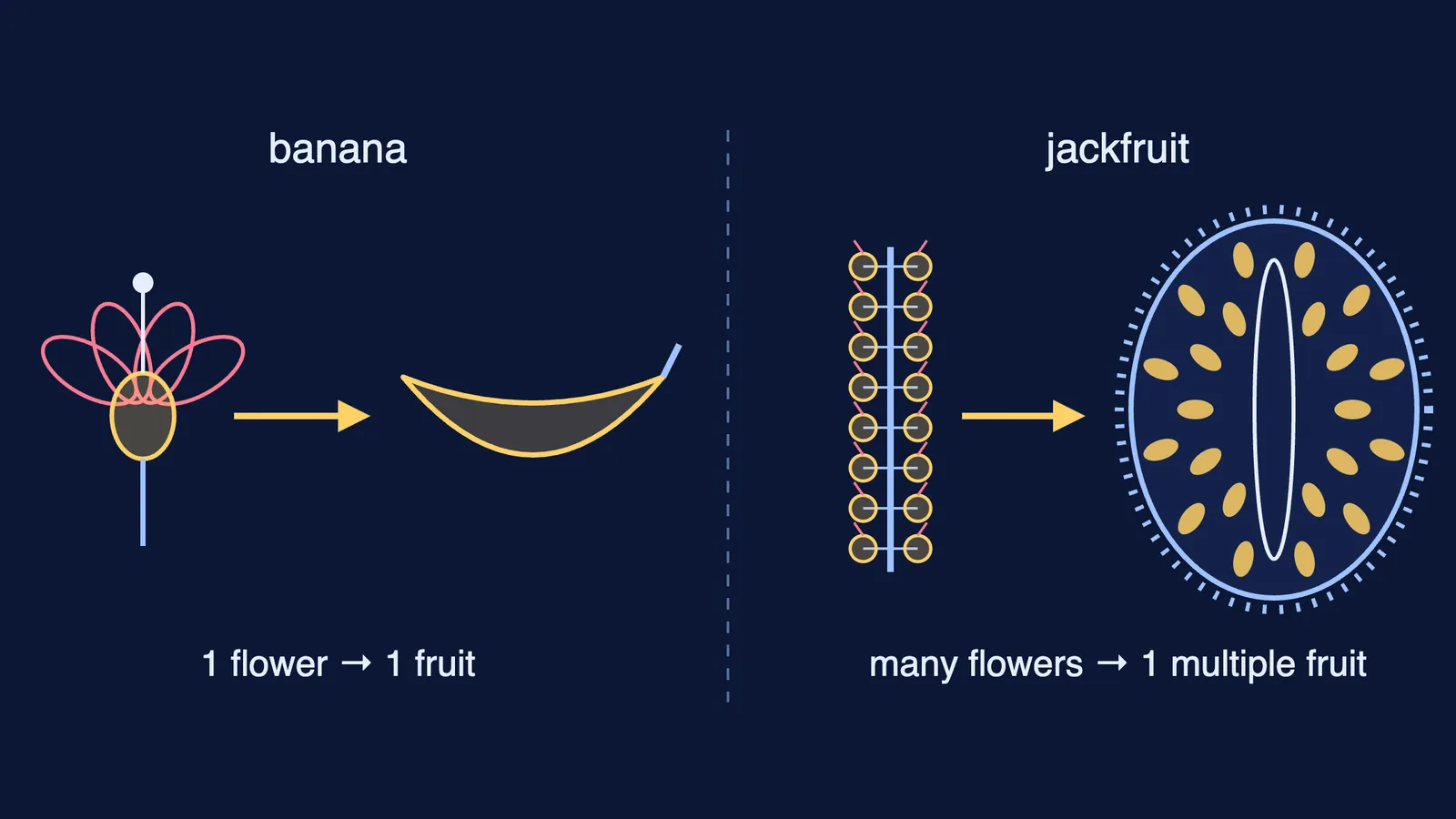
Cut open a ripe jackfruit and you find a mass of yellow bulbs, each wrapped around a seed, packed around a pithy core with stringy strands in between. Botany decides what a fruit is by where it came from in the flower, not by taste or size, and a jackfruit comes from many flowers at once.
What does botany say a fruit is?
NCERT's Class 11 biology textbook gives the definition: a fruit is "a mature or ripened ovary, developed after fertilisation". After fertilisation, the ovules inside the ovary become seeds and the ovary wall becomes the fruit wall, the pericarp.
The same page names the exception: a fruit formed without fertilisation of the ovary is called a parthenocarpic fruit. The Class 12 chapter on sexual reproduction in flowering plants adds a second twist. In apple, strawberry and cashew the thalamus also contributes to the fruit, so these are false fruits; fruits that develop only from the ovary are true fruits.
So "is it a fruit?" splits into smaller questions: how many flowers made it, how many ovaries, which part of the flower made it, and whether fertilisation happened. If ovule, ovary and ovum blur together, start with our guide to what the ovule, ovary and ovum each become.
Is jackfruit one fruit or many fruits?
It is one multiple fruit made of many fruitlets. Julia Morton's Fruits of Warm Climates, hosted by Purdue University, describes the inside: large bulbs that are fully developed perianths, massed among narrow ribbons of thin, tough undeveloped perianths and a central, pithy core. Each bulb encloses one seed, and Morton records 100 or up to 500 seeds in a single fruit.
A perianth belongs to a single flower, so each bulb is one flower that developed, and each stringy ribbon is one that did not. That fits the textbook pattern for a sorosis, which a fruit-morphology note from SIES College describes as a multiple fruit developing from a spike, spadix or catkin, in which the perianth of the flowers becomes fleshy. Its example is pineapple.
That narrower sense of aggregate is the one Wayne's Word uses too: in the aggregate fruit of a blackberry, all the drupelets come from a single flower.
Why is a banana seedless if a fruit needs fertilisation?
Because it is NCERT's example of the exception. The Class 12 chapter names banana as a parthenocarpic fruit and adds that parthenocarpy can also be induced with growth hormones, giving seedless fruit.
A review in Annals of Botany by Heslop-Harrison and Schwarzacher explains the crop side: cultivated bananas and plantains are sterile and parthenocarpic, so the fruit develops without seed. The same review notes that the cultivated kinds are mostly triploid, with 2n = 3x = 33 chromosomes, and that most have been propagated from mutants found in the wild.
A banana is still a simple fruit from one flower's ovary; the SIES note lists it as a berry, alongside tomato and watermelon. It just skipped fertilisation, and the seeds with it. Our explainer covers the steps between pollination and fertilisation.
What kind of fruit are pineapple and fig?
Both are multiple fruits, like jackfruit. Morton's pineapple entry says that as individual fruits develop from the flowers, they join to form one cone-shaped, compound, juicy fruit. If the flowers are pollinated, small hard seeds may form, but usually you find only traces of undeveloped seeds.
A University of Queensland explainer says figs make their flowers inside an enclosure called a syconium, and each syconium can hold tens to thousands of flowers depending on the species. Morton's fig entry adds that the fleshy part is a hollow receptacle, and that in the common fig the flowers are all female and need no pollination. For more on multiple fruits, see our post on why a pineapple is many flowers in one.
How do you classify any fruit in four questions?
Ask these in order:
How many flowers made it? A whole cluster of flowers gives a multiple fruit. One flower: go on.
One ovary, or many separate carpels in one flower? One gives a simple fruit; many separate carpels give an aggregate fruit.
Did only the ovary form the fleshy part? Yes: true fruit. Thalamus too: false fruit.
Did it form after fertilisation? No: parthenocarpic, and usually seedless.
Applied to the fruits above:
Jackfruit: many flowers, so a multiple fruit; seeded, one seed per bulb.
Pineapple: many flowers, so a multiple fruit; usually only traces of seeds.
Fig: many flowers inside a fleshy receptacle, so a multiple fruit; the common fig needs no pollination.
Banana: one flower, one ovary, a simple fruit and a berry; parthenocarpic.
Apple: one flower, but the thalamus forms the flesh, so a false fruit.
Try it on mango, strawberry and custard apple, then check against the NCERT chapters and the SIES note. If a term trips you up, the Fermi Concept Library gives every concept in biology its own lesson and its place in the map.


