

On this page
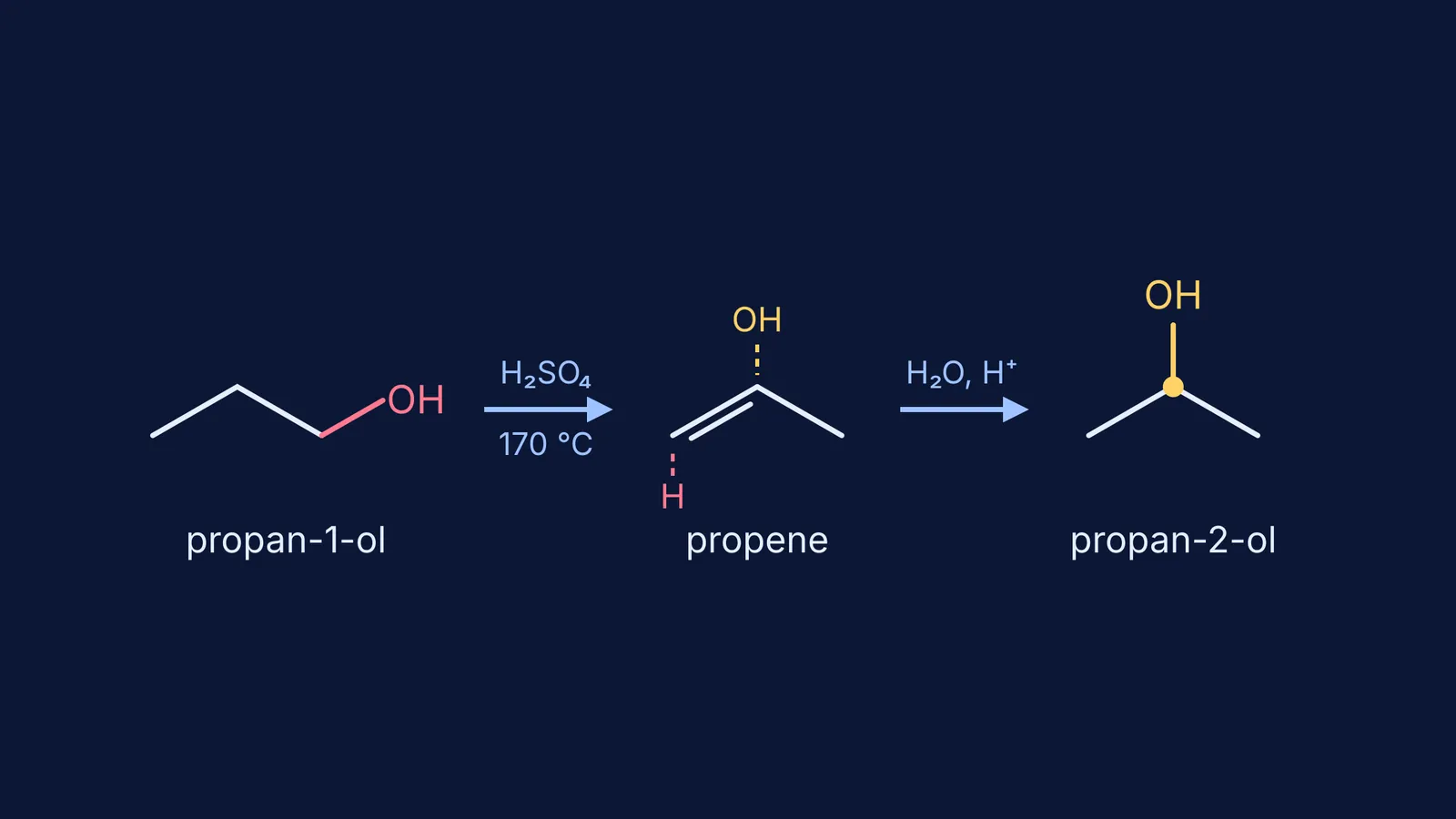
"Convert propan-1-ol into propan-2-ol" is a classic conversion question in school organic chemistry. The trick is that you cannot slide an OH group from one carbon to the next. You take it off, which leaves a double bond, and then you put water back on. The rules of addition decide where the OH lands, and here they send it to the middle carbon.
What are the two steps from propan-1-ol to propan-2-ol?
Dehydration: CH3CH2CH2OH → CH3CH=CH2 + H2O (excess concentrated H2SO4, about 170 °C)
Hydration: CH3CH=CH2 + H2O → CH3CH(OH)CH3 (acid catalyst)
Step 1 needs real heat. LibreTexts' organic chemistry text gives the range for each type of alcohol with sulfuric acid: primary alcohols need 170-180 °C, secondary alcohols 100-140 °C and tertiary alcohols 25-80 °C/09:_Alcohols_Ethers_and_Epoxides/9.16:_Dehydration_of_Alcohols_to_Alkenes). Propan-1-ol is primary, so it sits at the hot end. The same page warns that without enough heat, alcohols react with one another to form ethers instead of alkenes.
Concentrated phosphoric(V) acid works too, and Chemguide explains why some labs prefer it: sulphuric acid oxidises some of the alcohol to carbon dioxide, is itself reduced to sulphur dioxide, and can produce a mass of carbon, while phosphoric(V) acid is not a strong oxidising agent.
Propan-1-ol has only three carbons in a row, so its dehydration can give only one alkene: propene. There is no choice of product to worry about at this stage. For alcohols where there is a choice, see our guide on which alkene forms when an alcohol is dehydrated.
Why does the OH end up on the middle carbon?
Markovnikov's rule, in Chemguide's wording: "When a compound HX is added to an unsymmetrical alkene, the hydrogen becomes attached to the carbon with the most hydrogens attached to it already."
Propene, CH3-CH=CH2, is unsymmetrical. The end carbon (CH2) has two hydrogens and the middle carbon (CH) has one. So H goes to the end carbon and OH goes to the middle one. LibreTexts states it directly: in the propene case you get propan-2-ol rather than propan-1-ol/Alkenes/Reactivity_of_Alkenes/Hydration_of_Alkenes).
The rule predicts; the mechanism explains. An H+ from the acid adds to the end carbon, leaving a positive charge on the middle carbon. That is a secondary carbocation, and a primary carbocation is much less stable than a secondary or tertiary one. Water attacks the positive middle carbon, then loses H+, and the acid is given back.
Some textbooks write this step as two stages. Propene reacts with concentrated sulphuric acid in the cold to give an alkyl hydrogensulphate; diluting with water and distilling then gives the alcohol, with the OH where the HSO4 group was attached. Either way, the product is propan-2-ol.
Does propan-1-ol form a carbocation when it dehydrates?
No, and this is a common slip in mechanism answers. Chemguide explains that for primary alcohols such as ethanol, loss of water and removal of a hydrogen ion happen in one step, which avoids forming an unstable primary carbocation. LibreTexts gives the same picture: primary alcohols eliminate by the E2 pathway, while secondary and tertiary alcohols use E1/09:_Alcohols_Ethers_and_Epoxides/9.16:_Dehydration_of_Alcohols_to_Alkenes).
So the only carbocation in the whole route is the secondary one on the middle carbon during hydration. If your answer draws CH3CH2CH2+ in step 1, check it again.
How do you write this conversion in an exam?
Here is a short answer you can copy into your notes. The temperature comes from the LibreTexts range for primary alcohols/09:_Alcohols_Ethers_and_Epoxides/9.16:_Dehydration_of_Alcohols_to_Alkenes).
Heat propan-1-ol with excess concentrated H2SO4 at about 170 °C. Water is removed and propene forms: CH3CH2CH2OH → CH3CH=CH2 + H2O.
Treat propene with water in the presence of an acid catalyst (or cold concentrated H2SO4, then dilute with water and distil): CH3CH=CH2 + H2O → CH3CH(OH)CH3.
Give the reason in one line: by Markovnikov's rule, H adds to the CH2 end and OH to the middle carbon, through the more stable secondary carbocation.
Before you hand it in, check these:
Step 1 says concentrated acid and heat, not dilute acid.
No primary carbocation appears in step 1.
The step 2 product is drawn with OH on carbon 2, not carbon 1.
Each arrow shows its reagent and conditions.
Want to go the other way? Markovnikov addition will not get you there. Our post on turning 2-bromopropane into 1-bromopropane shows the anti-Markovnikov route. For more on the rule itself, read how Markovnikov's rule decides alkene addition products.
If you want to practise conversions like this one, the Fermi Problem Library has worked problems with a step-by-step solver that explains the reasoning rather than printing an answer. If carbocation stability is still unclear, the Fermi Concept Library gives each chemistry concept its own lesson and its place in the map.


