

On this page
Why can you not shift the bromine atom in one step?
Converting 2-bromopropane into 1-bromopropane is a fundamental problem in Class 12 organic chemistry and competitive exams such as JEE Main and NEET-UG. Students often search for a single reagent that can pluck bromine from carbon-2 and reattach it at carbon-1. In synthetic organic chemistry, however, no one-step reagent can migrate a halogen atom to an adjacent carbon directly.
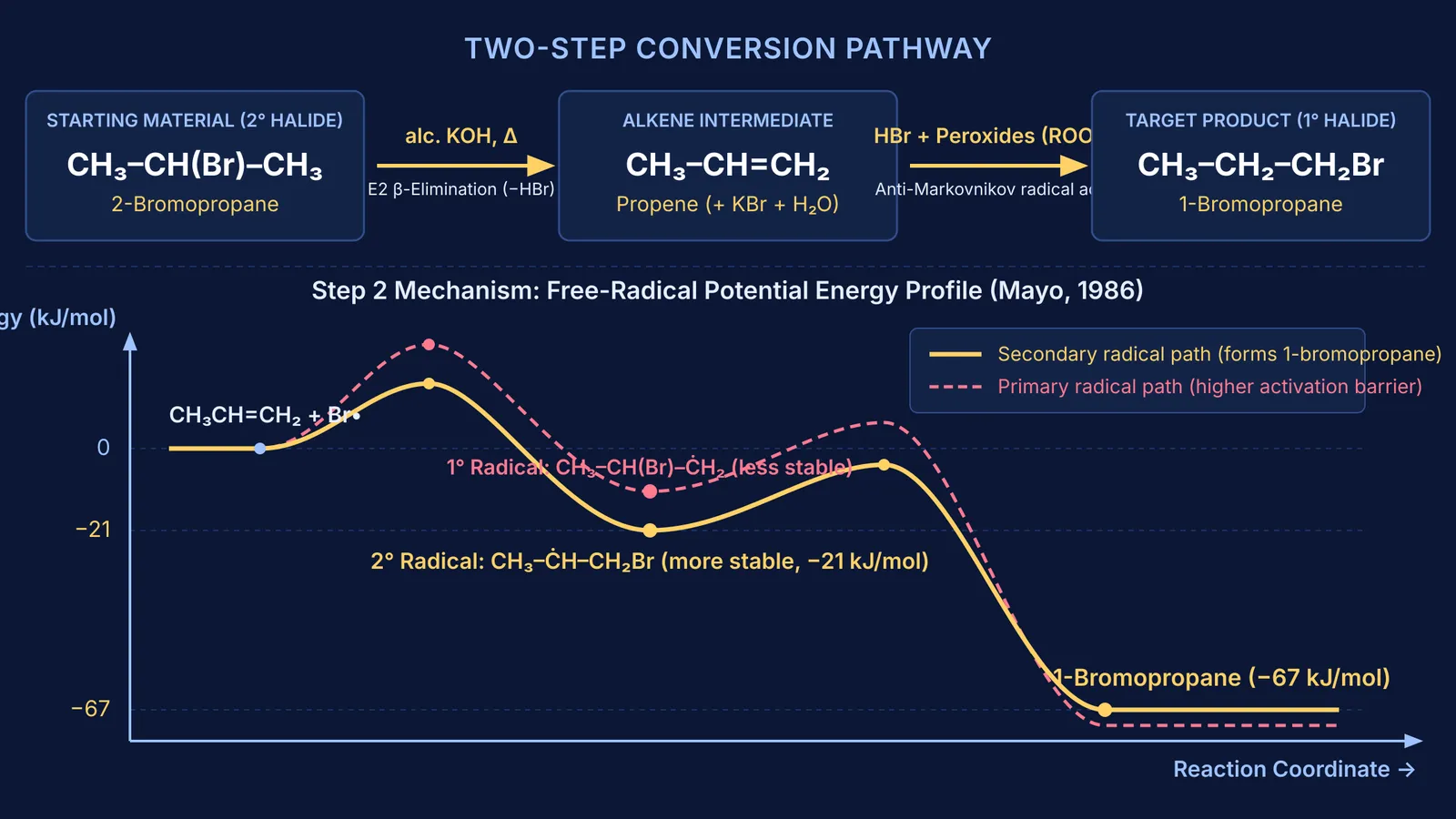
Nucleophilic substitution cannot shift positions along a carbon chain. Treating 2-bromopropane with an aqueous base such as aqueous potassium hydroxide simply replaces bromide with hydroxide, forming propan-2-ol. Similarly, spontaneous carbocation rearrangement fails because secondary carbocations are more stable than primary carbocations. As shown in our guide on SN1 versus SN2 substitution in haloalkanes, carbocations never rearrange toward a less stable primary species. Relocating the halogen therefore requires a two-step sequence: first eliminate hydrogen bromide to create propene, and then add hydrogen bromide back with anti-Markovnikov orientation.
How does alcoholic KOH convert 2-bromopropane to propene?
The first step dehydrohalogenates 2-bromopropane to yield propene. Heating 2-bromopropane with potassium hydroxide dissolved in ethanol (alcoholic KOH) generates ethoxide ions (C₂H₅O⁻). Ethoxide acts as a strong, non-aqueous base that drives bimolecular beta-elimination (E2) rather than nucleophilic substitution.
E. D. Hughes and C. K. Ingold established the concerted mechanism of this elimination in their 1941 studies (Hughes & Ingold, 1941). In a single concerted step, ethoxide abstracts a beta-hydrogen from either methyl carbon while the bromide leaving group departs from the central carbon:
CH₃–CH(Br)–CH₃ + alc. KOH → CH₃–CH=CH₂ + KBr + H₂O
Because both methyl groups are chemically equivalent, elimination yields only propene. The choice of solvent determines the reaction pathway, as detailed in our guide on choosing aqueous versus alcoholic KOH.
Why does HBr with peroxide give 1-bromopropane?
Once propene forms, adding hydrogen bromide without additives follows Markovnikov's rule, regenerating the original 2-bromopropane. To place bromine on the terminal carbon, you must introduce hydrogen bromide alongside an organic peroxide such as benzoyl peroxide.
This regiochemical reversal is the Kharasch effect, discovered in 1933 by Morris S. Kharasch and Frank R. Mayo (Kharasch & Mayo, 1933). Peroxides divert the transformation from an ionic carbocation route into a free-radical chain:
Initiation: Thermal homolysis of the weak oxygen-oxygen peroxide bond generates radicals that abstract hydrogen from HBr, yielding a bromine radical (Br•).
Addition: The bromine radical attacks propene at terminal carbon-1 to form the more stable secondary alkyl radical (CH₃–C•H–CH₂Br). This step is exothermic by approximately 21 kJ/mol (Mayo, 1986).
Hydrogen abstraction: The secondary radical abstracts hydrogen from HBr, forming 1-bromopropane and regenerating Br• with an enthalpy release of approximately 46 kJ/mol (Mayo, 1986).
Because the secondary radical intermediate is favored, 1-bromopropane forms as the major product. Our article on Markovnikov addition to alkenes explores why ionic addition yields the opposite regiochemistry.
How do you apply this two-step logic to other conversion problems?
This two-step sequence provides a template for solving halogen relocation problems in board and entrance examinations:
Diagnose the shift: Moving a halogen from an internal position to a terminal position requires elimination followed by anti-Markovnikov addition.
Eliminate to an alkene: Heat the secondary alkyl halide with alcoholic KOH to generate the alkene intermediate.
Add regioselectively: React the alkene with HBr in the presence of peroxides to place bromine at the terminal carbon.
The logic is reversible. To convert 1-bromopropane into 2-bromopropane, eliminate with alcoholic KOH to propene, then add pure HBr without peroxides so the ionic Markovnikov pathway places bromine at carbon-2.
The Fermi Problem Library provides worked problems with a step-by-step solver that explains the reasoning rather than printing an answer, helping you trace organic reaction pathways without memorising recipes. In parallel, the Fermi Concept Library maps every concept in physics, chemistry, biology, mathematics and computing, each with its own lesson and its place in the map, so you can see how radical stability governs regiochemical outcomes across syllabus units.


