

On this page
Mix silver nitrate and sodium chloride solutions and white silver chloride appears the moment they meet. Pour dilute acid into alkali and the neutralisation is over before you can stir. Here is why, with numbers you can use in board exams and JEE Main.
Why are ionic reactions in solution so fast?
The Class 12 NCERT chapter on chemical kinetics states that "some reactions such as ionic reactions occur very fast, for example, precipitation of silver chloride occurs instantaneously by mixing of aqueous solutions of silver nitrate and sodium chloride" (NCERT Class 12 Chemistry, Unit 3). Two facts explain it.
The ions are already free. A dissolved ionic compound is already split into ions, so Ag⁺ and Cl⁻ break nothing before they meet.
Opposite charges attract. Positive and negative ions pull towards each other.
Molecules are different. The same NCERT chapter explains that H₂ and I₂ react only by forming an unstable activated complex, and the energy needed is the activation energy, Ea. Bonds must stretch and break, and only energetic collisions succeed.
Ions combining face almost no such barrier. In his 1967 Nobel lecture, Manfred Eigen said of neutralisation that "the maximum rate will be determined by the frequency of such encounters or collisions, and this in turn will depend only on the diffusion rate and the mean separation of the reaction partners" (Eigen, Nobel Lecture, 1967). This is a diffusion-controlled reaction: the slow step is the ions finding each other.
How fast is neutralisation, really?
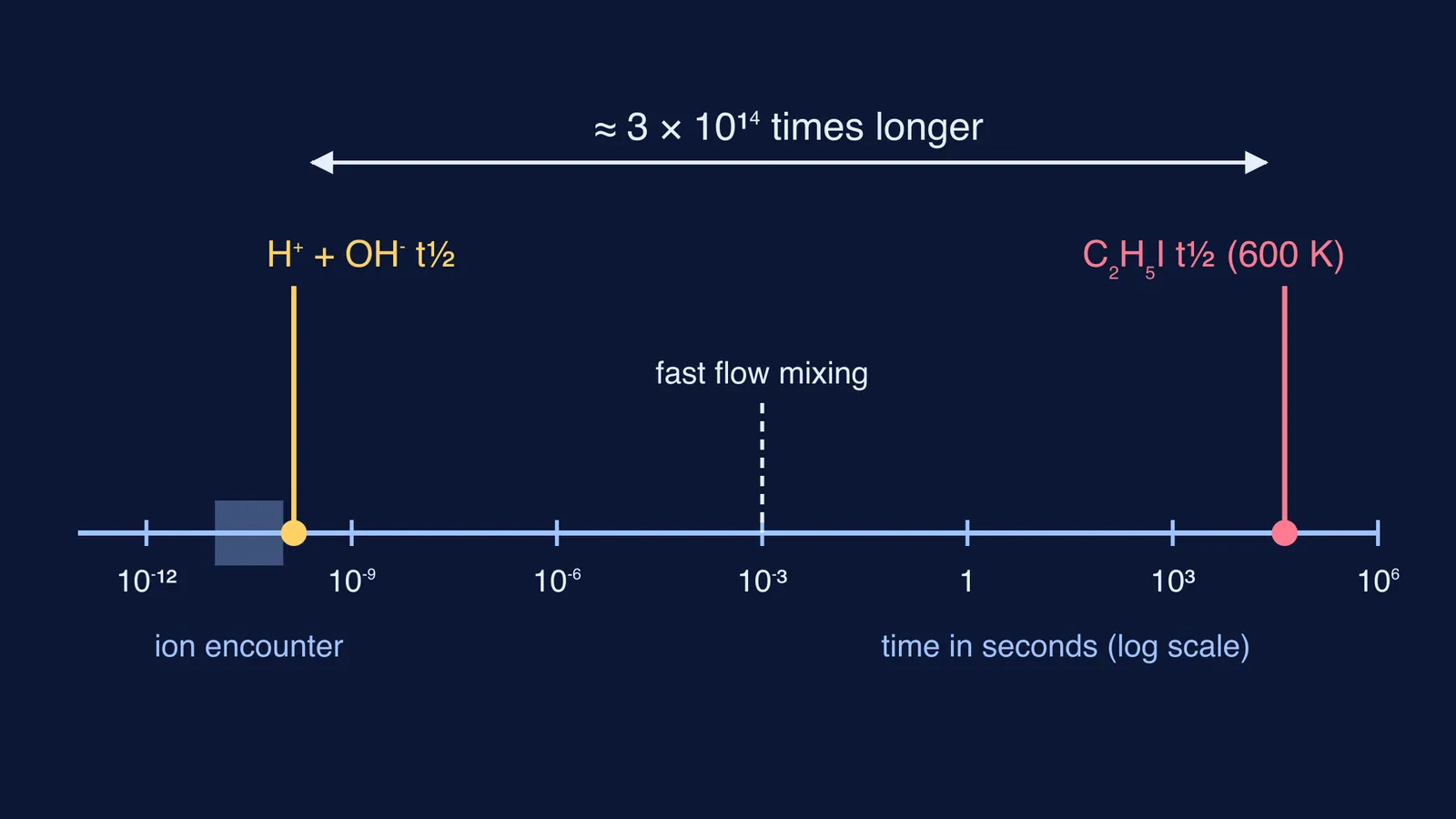
Eigen opened that lecture with a line from Eucken's textbook, which he studied as a student: "The rate of true neutralization reactions has proved to be immeasurably fast" (Eigen, 1967). He calculated that an ion encounter lasts about 10⁻¹⁰ to 10⁻¹¹ seconds, while the flow method of the time mixed solutions within about a thousandth of a second.
The rate constant for H⁺ + OH⁻ → H₂O is 1.4 × 10¹¹ L mol⁻¹ s⁻¹ at 25 °C, and Eigen reported that "every encounter between the solvated ions results in combination" (Eigen, Nobel Lecture, p. 193).
Once the ions are close, a 2011 computer simulation of liquid water found that the key event, a squeeze of the water chain between the ions, takes about 0.5 picoseconds (Hassanali and colleagues, PNAS, 2011).
Worked example: how much faster, in numbers?
Take Eigen's value for neutralisation and Example 3.10 in the NCERT kinetics chapter: ethyl iodide decomposes with k = 1.60 × 10⁻⁵ s⁻¹ at 600 K and Ea = 209 kJ/mol.
Neutralisation: mix equal volumes of 0.1 M HCl and 0.1 M NaOH, so each ion starts at 0.05 M. For a second-order reaction with equal starting concentrations, t½ = 1/(k[A]₀) = 1/(1.4 × 10¹¹ × 0.05) ≈ 1.4 × 10⁻¹⁰ s, on paper.
Bond breaking: ethyl iodide is first order, so t½ = 0.693/k = 0.693/(1.60 × 10⁻⁵) ≈ 4.3 × 10⁴ s, about 12 hours.
Compare: 4.3 × 10⁴ ÷ 1.4 × 10⁻¹⁰ ≈ 3 × 10¹⁴. The ionic half-life is about three hundred trillion times shorter.
See why: in the Arrhenius factor e^(−Ea/RT), Ea/RT = 209000/(8.314 × 600) ≈ 41.9, and e^(−41.9) ≈ 6 × 10⁻¹⁹. Only about that fraction of collisions has enough energy; for H⁺ and OH⁻, almost every encounter counts.
The orders differ, so compare half-lives, not k values with different units.
Are all ionic reactions instant?
Not quite. Eigen's lecture explains that a metal ion in water is wrapped in shells of water molecules, which an incoming ion of opposite charge must replace. Swapping out the innermost shell is the slowest step. For ions with noble-gas electron configurations, a smaller radius and higher charge hold that water more tightly, so the swap is slower (Eigen, 1967). His example was Mg²⁺ pairing with SO₄²⁻ in sea water.
In a school lab, the speed you see is usually limited by mixing; Eigen noted that mixing often takes longer than the whole reaction (Eigen, 1967).
How do you write this answer in a board or JEE Main exam?
Use this three-part frame:
State: ionic compounds are already dissociated into ions in solution, so no bonds break first.
Mechanism: oppositely charged ions attract and nearly every encounter reacts, so diffusion sets the rate.
Example and contrast: AgNO₃ + NaCl gives AgCl instantly, while H₂ and I₂ must form an activated complex and cross an activation energy barrier.
Next, read our guides to net ionic equations and spectator ions, collision theory and how catalysts work and the yellow precipitate from lead nitrate and potassium iodide.
If activation energy itself is the gap, the Fermi Concept Library covers every concept in chemistry, each with its own lesson and its place in the map. To practise half-life arithmetic like the example above, the Fermi Problem Library has worked problems with a step-by-step solver that explains the reasoning rather than printing an answer.


