

On this page
If you have met the line "ionic bonds are non-directional, covalent bonds are directional" in Class 11 chemistry, it probably felt like something to memorise. It is really a consequence of two different kinds of attraction.
What does "directional" mean for a chemical bond?
A bond is directional if the atoms it joins prefer particular angles to each other, so that bending away from those angles costs energy. The Wikipedia article on ionic bonding puts it like this: covalent bonding is more directional "in the sense that the energy penalty for not adhering to the optimum bond angles is large, whereas ionic bonding has no such penalty."
Why are ionic bonds non-directional?
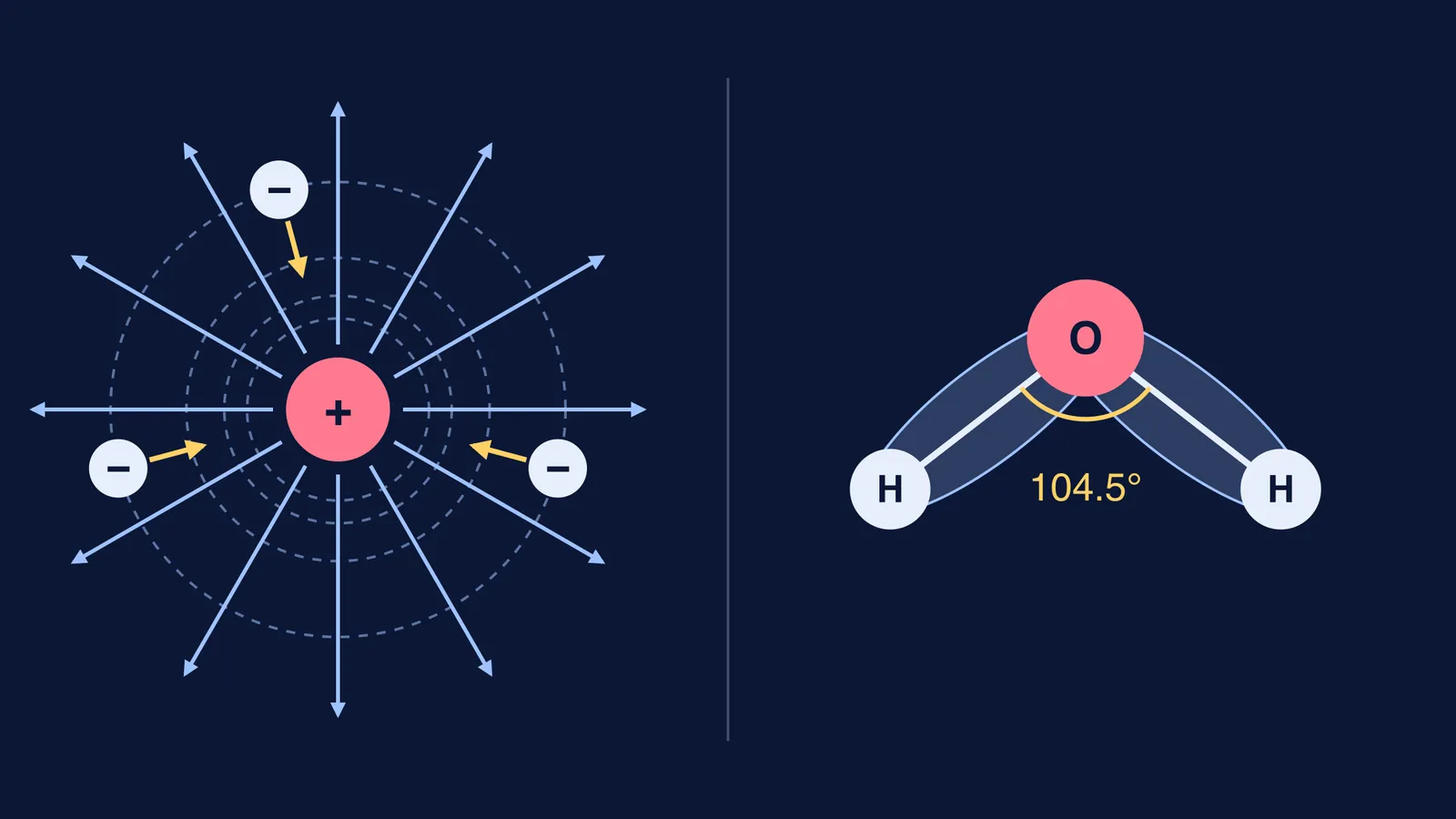
An ionic bond is the electrostatic attraction between a cation and an anion. Coulomb's law says the force between two charges is proportional to the product of the charges and inversely proportional to the square of the distance between them, and it acts along the line joining them. Nothing in that law depends on angle.
Think of Na+ as a small charged sphere. An anion at a given distance feels the same pull whether it sits above, below or beside it, so the ion sets aside no particular direction for a bond. In the diagram at the top, three anions on the same circle get equal arrows.
What decides the arrangement in a solid, then, is packing. With no shared electron pairs to repel each other, ions are simply packed as efficiently as possible, and the lattice depends mainly on their relative charges and sizes (ionic bonding). In rock salt, each ion has six ions of the other kind as its nearest neighbours (LibreTexts, rock salt structure/06%3A_Structures_and_Energetics_of_Metallic_and_Ionic_solids/6.11%3A_Ionic_Lattices/6.11A%3A_Structure_-_Rock_Salt_(NaCl))), with bond angles of 90° (ionic bonding). That geometry comes from how the two sizes of sphere stack, not from Na+ having six bonding "arms". Charge and size also set how strongly the lattice holds together, which our post on how ion charge and size change lattice energy works through.
Why are covalent bonds directional?
A covalent bond forms when orbitals on two atoms overlap and the atoms share a pair of electrons. That electron density builds up between two particular nuclei, not all around the atom.
Orbitals have shapes. Apart from s orbitals, atomic orbitals have specific directional properties, which is why there are different types of covalent bond (covalent bond). A sigma bond comes from head-on overlap of orbitals on two atoms. Bonds form where overlap is greatest, so the way the orbitals point decides the way the bonds point. Our explainer on how sigma and pi bonds come from orbital overlap goes through the overlap step by step.
That is why covalent molecules have definite angles. In methane the H-C-H angle is 109.5°, in ammonia it is about 107°, and in water it is 104.5° (University of Texas VSEPR tutorial). Lone pairs squeeze the angle in ammonia and water, which our guide to predicting molecular shapes with VSEPR explains.
How do you write this answer in an exam?
"Give reasons: covalent bonds are directional while ionic bonds are non-directional" is a typical short-answer question. Here is a three-step answer you can adapt.
Ionic: an ionic bond is the electrostatic attraction between oppositely charged ions. The field of an ion acts equally in all directions, so each ion attracts as many oppositely charged ions as can pack around it. Hence ionic bonds are non-directional.
Covalent: a covalent bond forms by overlap of atomic orbitals. Except for s orbitals, these orbitals point along definite axes, and the shared pair sits in the overlap region between two nuclei. Hence covalent bonds are directional.
Consequence: covalent molecules have definite shapes and bond angles (H2O is bent), while ionic compounds form crystal lattices decided by the charges and sizes of the ions.
Before you hand it in, check:
Did you name the force behind each bond (electrostatic attraction versus orbital overlap)?
Did you say why direction does or does not matter?
Did you give one example of a molecular shape or a lattice?
Did you avoid saying ionic compounds have "no structure"?
Where can you practise this reasoning?
This question links electrostatics, orbital shapes and molecular geometry. If one is shaky, the Fermi Concept Library has a lesson for every concept in chemistry, each with its place in the map. When you want to test yourself, the Fermi Problem Library has worked problems with a step-by-step solver that explains the reasoning rather than printing an answer.
Next time you see a bond angle, ask what fixed it. If the answer is orbitals, the bond is covalent and directional. If the answer is packing, you are looking at an ionic lattice.


