On this page
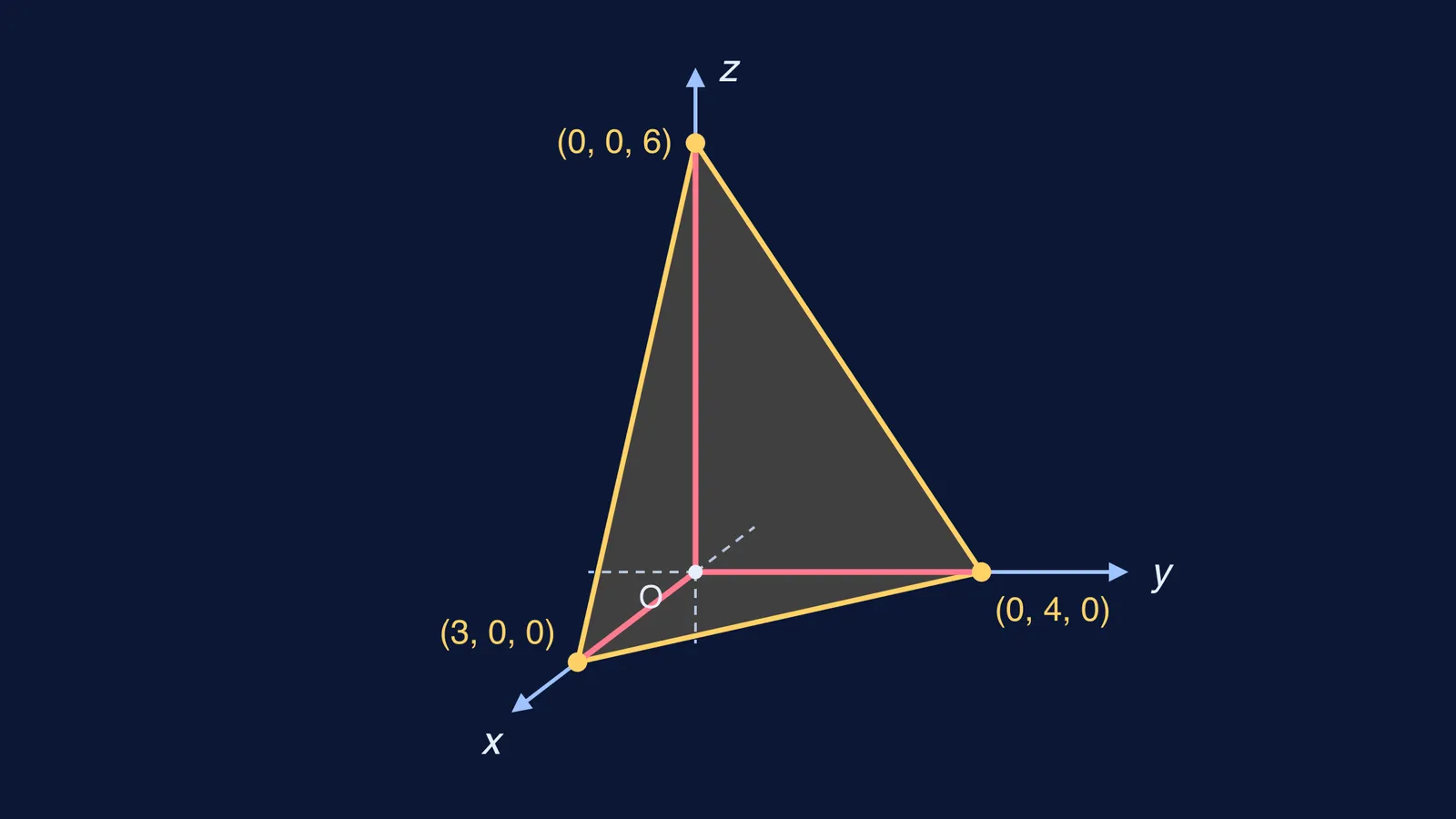
Take the plane 4x + 3y + 2z = 12. Where is it? Rewrite it as x/3 + y/4 + z/6 = 1 and the picture appears: it cuts the x-axis at 3, the y-axis at 4 and the z-axis at 6. That rewrite is the intercept form.
What is the intercept form of the equation of a plane?
According to Wolfram MathWorld, a plane passing through the points (a, 0, 0), (0, b, 0) and (0, 0, c) is given by x/a + y/b + z/c = 1.
Here a, b and c are the intercepts: the signed coordinates where the plane crosses each axis. The sign matters. An x-intercept of −4 means the plane crosses the negative x-axis, four units from the origin.
You can check the form in seconds. Put y = 0 and z = 0, and you are left with x/a = 1, so x = a. The same trick gives y = b and z = c.
How do you convert ax + by + cz = d to intercept form?
Any plane can be written in the general form Ax + By + Cz + D = 0, where (A, B, C) is a normal vector to the plane, as OpenStax Calculus Volume 3 sets out. From there, four steps:
Move the constant to the right so the equation reads Ax + By + Cz = k.
Divide every term by k, so the right side becomes 1.
Rewrite each term as x, y or z over a number: Ax/k becomes x/(k/A).
Read off the intercepts: k/A, k/B and k/C.
Worked example 1: 4x + 3y + 2z − 12 = 0.
Move the constant: 4x + 3y + 2z = 12.
Divide by 12 and rewrite: x/3 + y/4 + z/6 = 1.
Intercepts: (3, 0, 0), (0, 4, 0) and (0, 0, 6), the triangle in the diagram above.
Worked example 2 (watch the signs): 3x − 4y + 2z + 12 = 0.
Move the constant: 3x − 4y + 2z = −12.
Divide by −12: x/(−4) + y/3 + z/(−6) = 1.
Intercepts: x = −4, y = 3, z = −6.
A common slip is dividing by +12 here, which flips every sign. Divide by the constant exactly as it sits on the right, sign included.
What if the plane passes through the origin or is parallel to an axis?
The constant is zero, as in x + 2y − z = 0. The plane passes through the origin, so you cannot divide by k. There is no intercept form.
A coefficient is zero, as in 2x + 3y = 6. There is no z term, so the plane never meets the z-axis; it runs parallel to it. Write x/3 + y/2 = 1 and say the plane has no z-intercept.
How do you find the plane through three points on the axes?
Suppose the plane passes through (2, 0, 0), (0, −3, 0) and (0, 0, 4).
Read off a = 2, b = −3 and c = 4.
Write x/2 + y/(−3) + z/4 = 1.
Multiply by 12, the LCM of 2, 3 and 4: 6x − 4y + 3z = 12.
To cross-check, use the general method in OpenStax: the cross product of two vectors in the plane is a normal. From (2, 0, 0), the vectors to the other points are (−2, −3, 0) and (−2, 0, 4). Their cross product is (−12, 8, −6), which is −2 times (6, −4, 3). Same normal, and 6 × 2 = 12 gives the same constant.
If the three points are not all on the axes, use the cross product, or the three-point determinant form that MathWorld lists.
What else can the intercepts tell you?
Volume of the tetrahedron cut off by the plane and the coordinate planes. Its base is a right triangle of area |ab|/2 and its height is |c|, so its volume is one third of base times height: |abc|/6. For x/3 + y/4 + z/6 = 1, that is 72/6 = 12 cubic units.
Distance from the origin to the plane. Apply the point-to-plane distance formula in OpenStax to x/a + y/b + z/c − 1 = 0 and you get 1/p² = 1/a² + 1/b² + 1/c². For our plane, 1/9 + 1/16 + 1/36 = 29/144, so p = 12/√29, the same as 12/√(16 + 9 + 4) from the original equation.
For more practice, the Fermi Problem Library has worked problems with a step-by-step solver that explains the reasoning rather than printing an answer, so you can see exactly where a sign slipped. If normal vectors still feel shaky, the Fermi Concept Library gives every mathematics concept its own lesson and its place in the map, so you can go back a step first.