

On this page
Integration by parts says ∫u dv = uv − ∫v du, as stated in OpenStax Calculus Volume 2 by Gilbert Strang and Edwin Herman. With x²eˣ you apply it again and again, and each round flips a sign. The tabular method, often called the DI method, writes every round into one table so the signs take care of themselves.
What is the tabular method for integration by parts?
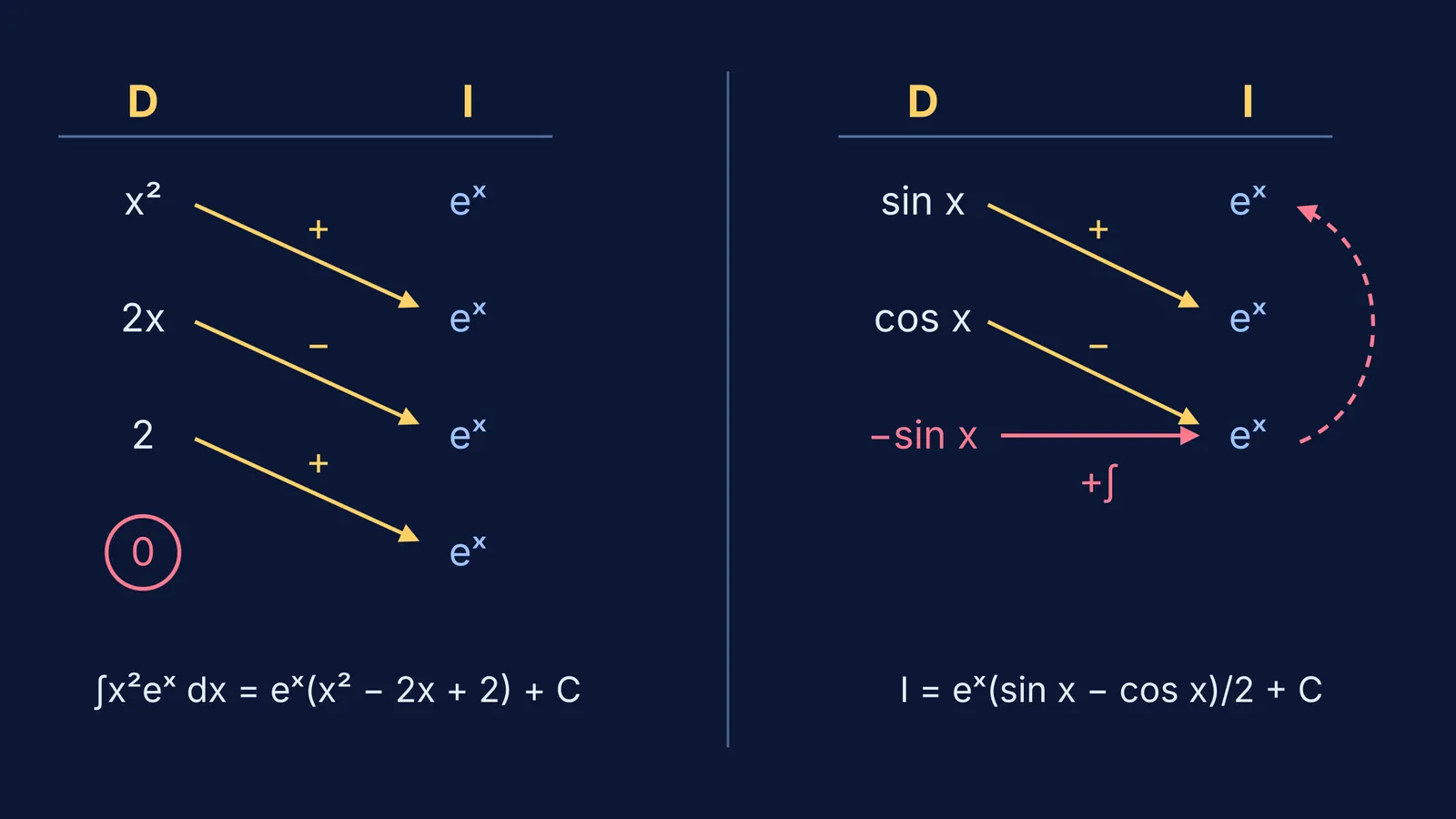
It is repeated integration by parts written as two columns. The D column holds the factor you differentiate; the I column holds the factor you integrate. You multiply each D entry by the I entry one row below it, and the signs alternate +, −, +, −.
The Wikipedia article on integration by parts works ∫x³ cos x dx this way and gets x³ sin x + 3x² cos x − 6x sin x − 6 cos x + C from a single table.
The idea is not new. David Horowitz wrote it up as Tabular Integration by Parts in The College Mathematics Journal in 1990, and Sameen Ahmed Khan returned to it under the same title in the journal Resonance in 2022.
To choose which factor goes in D, use the LIATE order from OpenStax: logarithmic, inverse trigonometric, algebraic, trigonometric, exponential. The type that comes first goes in D.
How do you fill in a DI table?
Take ∫x²e³ˣ dx. The polynomial goes in D because it differentiates down to zero; e³ˣ goes in I because it integrates easily, again and again.
Write the signs +, −, +, − down the left.
D column: x², 2x, 2, 0.
I column: e³ˣ, e³ˣ/3, e³ˣ/9, e³ˣ/27.
Multiply along the diagonals: +x²·e³ˣ/3, then −2x·e³ˣ/9, then +2·e³ˣ/27.
Stop at the row where D is 0.
So ∫x²e³ˣ dx = e³ˣ(9x² − 6x + 2)/27 + C. To check, differentiate: the product rule gives e³ˣ(27x² − 18x + 6 + 18x − 6)/27, which is x²e³ˣ.
When does the DI table stop?
A DI table can end in three ways.
A zero in D. Polynomial times eᵃˣ, sin ax or cos ax. Stop at the 0; nothing is left to integrate.
The original integral comes back. eᵃˣ times sin bx or cos bx. Neither column ever reaches zero, but after two rows the D entry is a constant multiple of the first. Stop there, take that last row straight across as an integral with its sign, and solve for it.
A row you can integrate directly. A log or inverse trig factor times a polynomial, such as ∫x² ln x dx. Put ln x in D. After one row D is 1/x, and the straight-across product (1/x)(x³/3) = x²/3 is easy, so the answer is (x³ ln x)/3 − x³/9 + C.
How does the cycling trick work for eˣ times sin or cos?
Call the integral I = ∫e²ˣ cos 3x dx. D column: cos 3x, −3 sin 3x, −9 cos 3x. I column: e²ˣ, e²ˣ/2, e²ˣ/4.
The diagonals give +(cos 3x)(e²ˣ/2) and −(−3 sin 3x)(e²ˣ/4). Row three, −9 cos 3x, is a multiple of the starting factor, so stop and take it across with its + sign: +∫(−9 cos 3x)(e²ˣ/4) dx, which is −(9/4)I.
So I = e²ˣ cos 3x/2 + 3e²ˣ sin 3x/4 − (9/4)I. Collect the I terms: (13/4)I = e²ˣ(2 cos 3x + 3 sin 3x)/4, so I = e²ˣ(2 cos 3x + 3 sin 3x)/13 + C. The 13 is 2² + 3², which makes a quick sanity check.
OpenStax uses the same move for ∫sin(ln x) dx, solving 2I and dividing. You'll see it again in the integral of sec³x and its loop trick.
Why does the cycling trick sometimes give 0 = 0?
Because the roles were swapped halfway. Do one round with cos 3x in D, then a fresh round differentiating e²ˣ instead, and the second round undoes the first: I = I. A single DI table prevents this, because each factor stays in its column from top to bottom.
How should you practise the DI method before an exam?
Use this checklist:
Before writing anything, name the ending: zero, cycle or direct.
Write the signs first, then the two columns.
Stop at the first D entry that is 0, a multiple of the start, or easy to integrate straight across.
Differentiate your answer, using the habits in how to check an integral by differentiating.
For definite integrals, put the limits into the whole bracket once, as shown in definite integration by parts with limits.
If a sign slips and you can't see where, the Fermi Problem Library has worked problems with a step-by-step solver that explains the reasoning rather than printing an answer. If the product rule underneath it feels shaky, the Fermi Concept Library gives each concept its own lesson.
Pick three integrals tonight, one for each ending, and fill in the tables before you look anything up.


