

On this page
Push a soft iron core into a coil and its inductance jumps by a large factor. Nothing about the wire has changed: same turns, same length, same area. What changes is the material the magnetic field has to pass through, and the formula tells you exactly how much that matters.
What does an iron core actually do inside a coil?
A current in the coil sets up a magnetising field. Iron is ferromagnetic, so that field lines up the iron's own magnetic domains, and the magnetised iron adds its field to the coil's. The Wikipedia article on inductors puts it plainly: the magnetising field from the coil induces magnetisation in the core material, and the high permeability of a ferromagnetic core increases the field and so the inductance.
More field means more flux through each turn for the same current. Since self-inductance is flux linkage per unit current (L = NΦ/I), more flux per amp is simply more inductance. If the difference between dia-, para- and ferromagnetic materials is hazy, our explainer on dia-, para- and ferromagnetism with hysteresis loops covers why iron is so different from copper.
Why does inductance scale with relative permeability?
For a long solenoid, HyperPhysics gives the inductance as L = μ0μrN²A/l, where N is the number of turns, A the cross-sectional area, l the length and μr the relative permeability of the core.
Swap the core and only μr changes, so the ratio is clean:
L with core ÷ L with air = μr (air has μr very close to 1)
Double μr and you double L
Turns matter more per change: doubling N quadruples L, because N appears squared
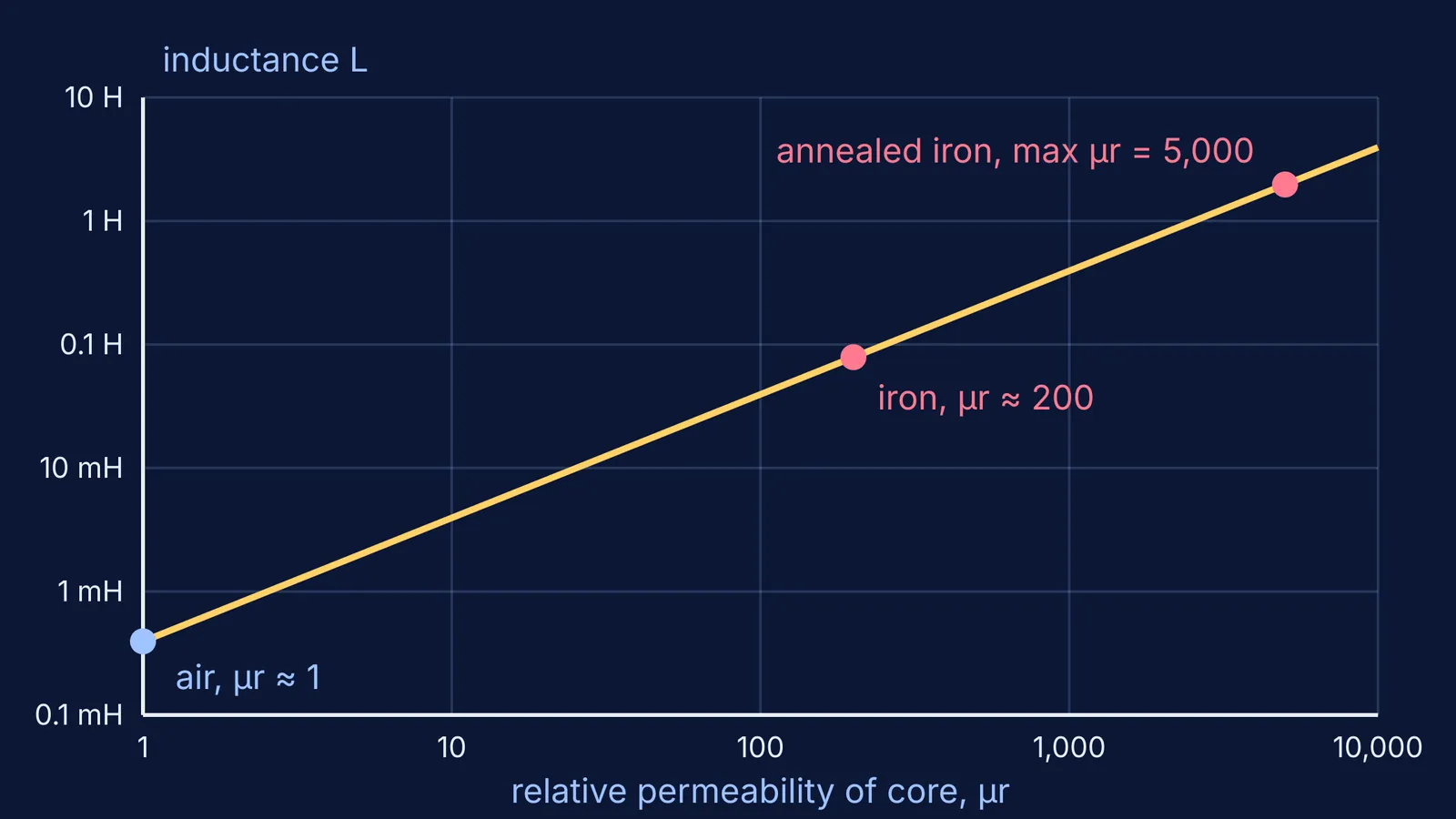
The same HyperPhysics page notes that the relative permeability of magnetic iron is around 200, and that small inductors for electronics may use air cores while larger inductances and transformers use iron.
Worked example: how many times bigger does L get?
Take a coil of 500 turns, 25 cm long, with radius 1 cm. Use μ0 = 4π × 10⁻⁷ H/m.
Area: A = π(0.01)² = 3.14 × 10⁻⁴ m².
Air core: L = (4π × 10⁻⁷)(500²)(3.14 × 10⁻⁴) ÷ 0.25 ≈ 3.9 × 10⁻⁴ H, about 0.39 mH.
Magnetic iron, μr ≈ 200 (the HyperPhysics figure): L ≈ 200 × 0.39 mH ≈ 79 mH.
Annealed 99.8% pure iron, maximum μr = 5,000 in the HyperPhysics table of magnetic properties: L ≈ 5,000 × 0.39 mH ≈ 2.0 H.
So the same piece of wire goes from under half a millihenry to tens of millihenries, and at iron's maximum permeability to about two henries. You never recalculate the coil; you just multiply by μr. If the next step is the energy stored, ½LI², it scales by the same factor at fixed current, which our post on energy in an inductor and LR growth works through.
Why isn't the boost always a neat factor of μr?
For iron, μr is not a single fixed number. The HyperPhysics table lists 99.8% pure annealed iron with an initial relative permeability of 150 and a maximum of 5,000, and quenched 0.9% carbon steel at only 50 to 100. How the metal is treated matters as much as which metal it is. The formula also assumes the core fills a long coil, the long-solenoid approximation HyperPhysics uses; a short rod or a gapped core falls short of the full factor.
Two more limits, both described in the Wikipedia article on inductors:
Saturation. If the current is high enough to saturate the core, inductance falls and current can rise sharply.
Eddy currents. A changing field induces currents in a solid metal core that waste energy as heat, so many cores are built from insulated laminations that shrink the current loops and cut the losses.
In a board exam or JEE numerical, assume a linear core unless the question says otherwise: treat μr as a constant and multiply.
How do exam questions test the iron-core effect?
Write L = μ0μrN²A/l and circle what changes. Usually only μr does.
Take the ratio rather than recomputing: L₂/L₁ = μr₂/μr₁.
If N or l change too, put each change into the ratio separately.
Follow the knock-on effects: reactance X = ωL rises by μr, so AC current in a purely inductive circuit falls; the LR time constant L/R rises by μr.
For coils in combination, find each L first, then combine, as in our guide to inductors in series and parallel.
To practise this exact move, the Fermi Problem Library has worked problems with a step-by-step solver that explains the reasoning rather than printing an answer. If permeability still feels abstract, the Fermi Concept Library gives each physics concept its own lesson and its place in the map.
Next time a question slides an iron core into a solenoid, find μr, multiply, and then check whether anything else in the formula moved.


