

On this page
A nearly empty rocket booster falls back from the edge of space, fires its engines one last time, and stops on its legs. It is really three ideas from Class 9 and 11 physics working together: thrust, momentum and Newton's laws.
How does a booster get back to the landing pad?
After the booster separates from the upper stage, it is still moving fast and away from home. SpaceX's Falcon 9 used a three-burn descent: a boostback burn to limit how far downrange the booster travels, a reentry burn at roughly 70 to 40 km altitude, and a landing burn that takes it from terminal velocity to zero at touchdown.
Between burns, the engines are off and the air does the steering. Grid fins, lattice-shaped control panels, unfold during reentry and tilt to turn it, much like rudders. The same page says adding grid fins was projected to improve landing accuracy to about 10 metres, against the roughly 10 km of the four earlier test flights.
The first orbital-class booster to land upright did so on 21 December 2015 at Cape Canaveral. The first landing on a ship at sea followed on 8 April 2016, on a drone ship about 300 km from Florida.
Why can't the rocket just hover down slowly?
Lars Blackmore, a SpaceX engineer, wrote in a 2016 National Academy of Engineering symposium paper that "for large rocket engines, throttling down to a hover is technically challenging and inefficient."
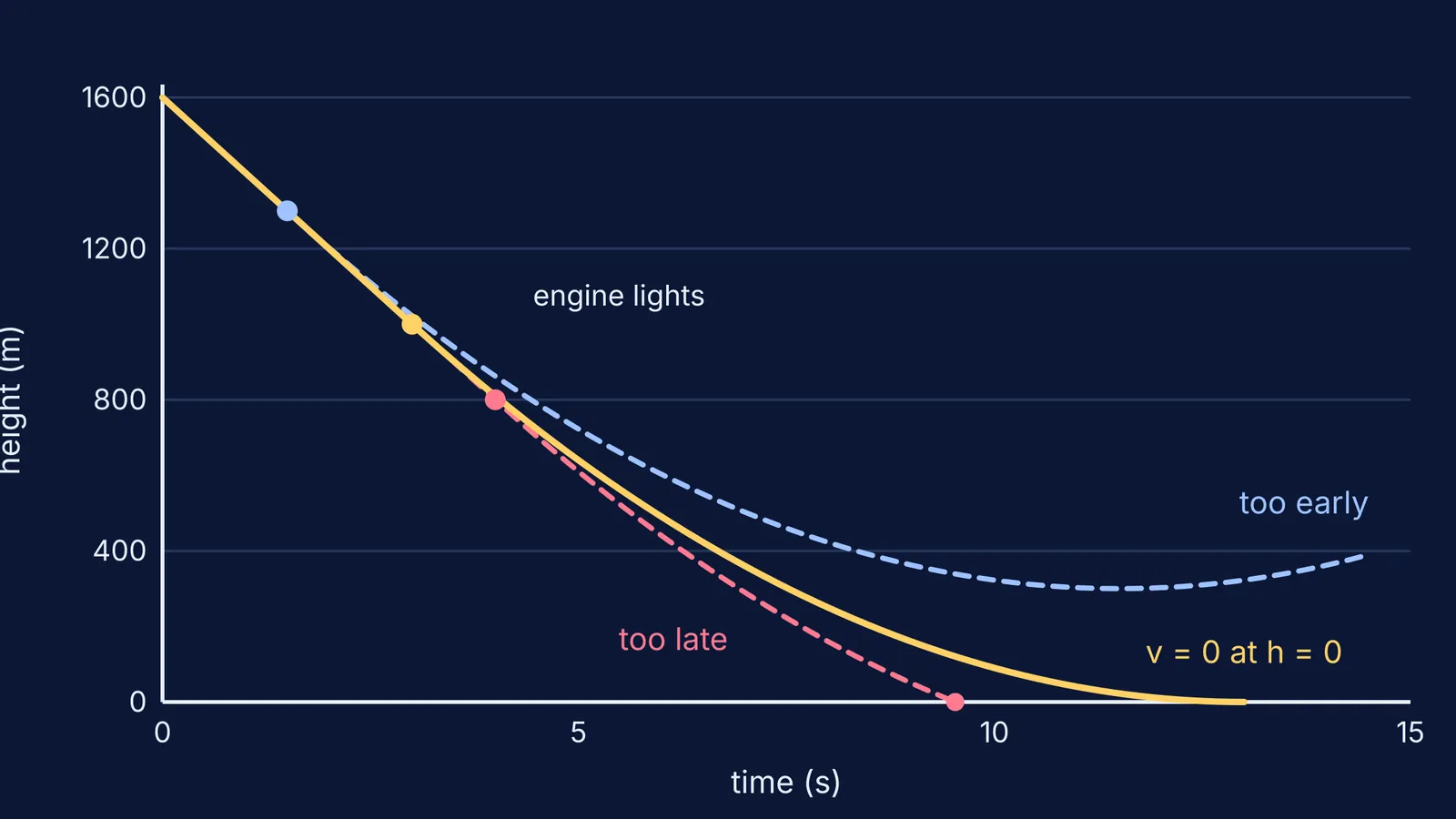
So, he writes, the rocket "has to hit zero velocity at exactly zero altitude." Stop too low and it crashes. Stop too high and, because thrust is now more than weight, it starts going back up, and cutting the engines and falling is then the only option. The same paper says the reusable Falcon 9 booster weighs about 35 metric tons and feels a peak deceleration of six times Earth's gravity on reentry. It sets landing targets of 10 metres or better on a drone ship and 30 metres or better at Cape Canaveral.
Which of Newton's laws keep it upright?
Third law: the engine pushes exhaust gas down at high speed, and the gas pushes the rocket up. If action-reaction pairs still feel slippery, our guide on how to identify action-reaction pairs has four quick checks.
Second law: net upward force equals mass times deceleration. The size of the thrust comes from how fast mass leaves the nozzle, which is the subject of our explainer on rocket thrust in variable mass systems.
Momentum: the burn must remove all the booster's downward momentum. Impulse, force times time, equals that change, the same idea as in why a cushion stops an egg breaking.
Torque: grid fins and a swivelling (gimballed) engine push off-centre, turning the booster so it stays pointed engines-down.
Worked example: when should the landing burn start?
These are round numbers for practice, not SpaceX flight data. Ignore drag during the burn and the fuel used up.
The booster falls at a steady 200 m/s. Its engine gives a net upward deceleration of 20 m/s².
Stopping distance: v² = 2as, so s = 200² / (2 × 20) = 1,000 m. Light the engine at 1,000 m.
Burn time: t = v / a = 200 / 20 = 10 s.
Thrust needed for a 35-tonne booster: T = m(g + a) = 35,000 × (9.8 + 20) ≈ 1.04 MN. For comparison, one Merlin 1D engine gives 845 kN at sea level, so this practice burn would need more than one engine or a gentler deceleration.
Momentum check: m × v = 35,000 × 200 = 7.0 × 10⁶ kg m/s. Net force × time = (35,000 × 20) × 10 = 7.0 × 10⁶ N s. They match, as they must.
Light it 200 m late, at 800 m: v² = 200² − 2 × 20 × 800 gives about 89 m/s at the ground. Light it 300 m early and the booster stops 300 m up, then climbs.
The diagram at the top of this post plots exactly these three cases. Try changing one number at a time: what deceleration rescues the late burn? (Answer: 25 m/s².)
Is India building a rocket that lands itself?
ISRO is developing a liquid oxygen and methane engine for its Next Generation Launch Vehicle, which uses a reusable booster stage and two expendable upper stages. ISRO's 7 March 2025 update says multiple engine restarts will be essential for booster stage recovery. That is the skill a landing burn needs, though the update does not say how the booster will come down.
If the timing of a landing burn is easier to see than to read, the Fermi Simulation Lab has interactive simulations for ideas like this. For more practice with v² = u² + 2as and impulse, the Fermi Problem Library has worked problems with a step-by-step solver that explains the reasoning rather than printing an answer.


