

On this page
You can see over a wall without climbing it, using two small mirrors and two empty cartons. Below: the ray path, a worked example of a slipped mirror, and a build plan.
How does a periscope work?
The law of reflection says the angle of reflection equals the angle of incidence. Both angles are measured from the normal, the line perpendicular to the mirror at the point where the ray strikes (OpenStax College Physics 2e).
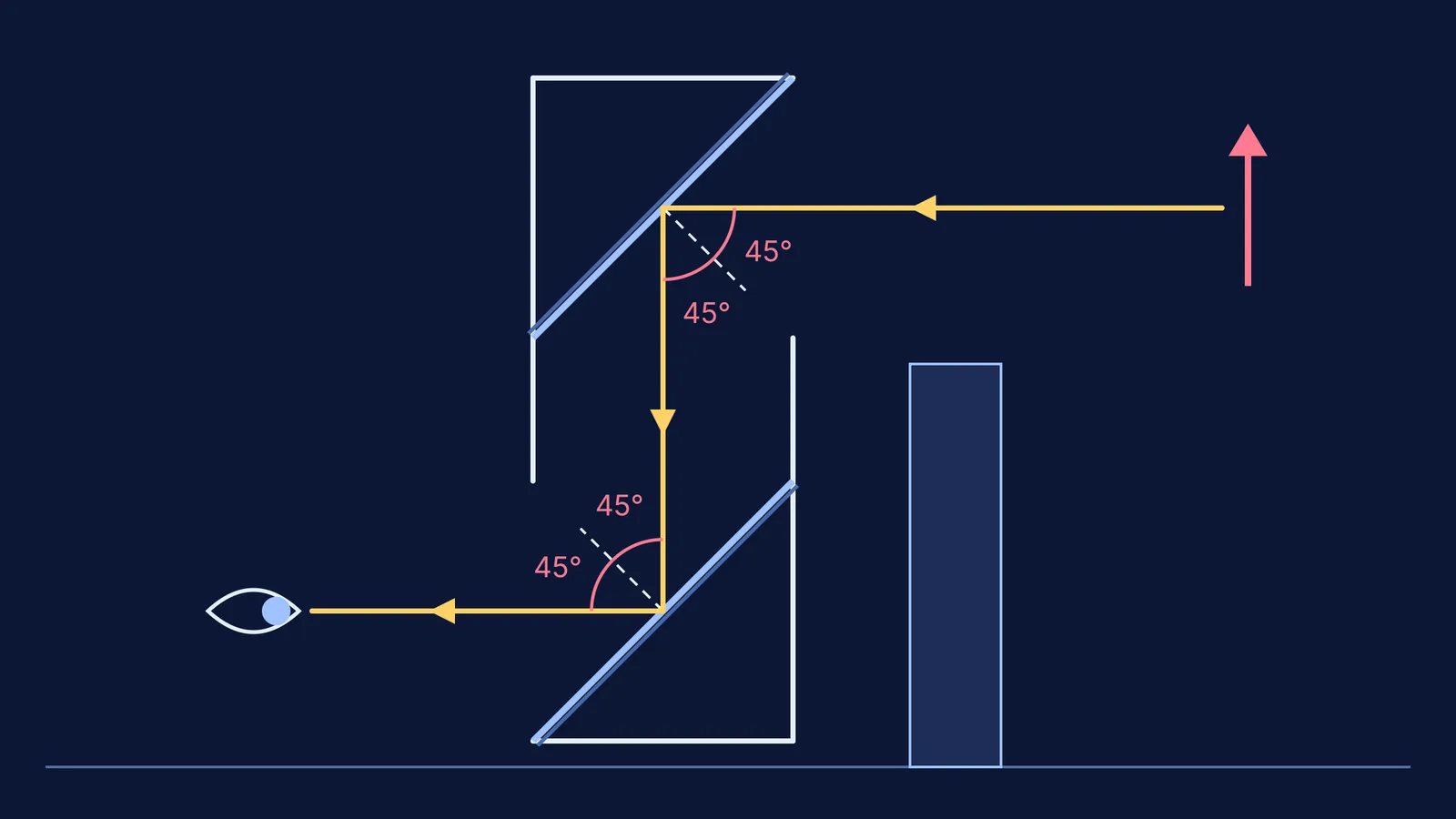
A periscope is a tube with a window at the top facing the object, an opening at the bottom facing you, and a plane mirror at each end. Follow one ray:
Light from the object travels horizontally through the top window and meets the top mirror. The mirror sits at 45° to the ray, so the ray meets the normal at 45° too: the angle of incidence is 45°.
The ray leaves at 45° on the other side of the normal. The incoming and outgoing rays are now 45° + 45° = 90° apart, so the light runs straight down the tube.
The bottom mirror is parallel to the top one, so the same thing happens again: 45° in, 45° out, another 90° turn, this time back to horizontal.
The ray leaves through the bottom opening in its original direction, only lower, by the distance between the two mirrors. Your eye traces it back and sees the object at the height of the top window.
As Science World's periscope activity puts it, "Light from an object strikes the top mirror at 45° and bounces off at the same angle."
Why do the mirrors have to be at 45 degrees?
A ray that hits a plane mirror with angle of incidence i is turned through 180° − 2i, because it reverses direction except for the 2i it keeps between itself and the normal. To turn light through exactly 90°, you need 180° − 2i = 90°, so i = 45°. Our post on the angle of deviation by plane mirrors and two inclined mirrors works through this formula for other angles.
The mirrors must also be parallel: the bottom mirror turns the light back by the same amount the top one turned it, so the exit ray is parallel to the entry ray.
Is the image in a periscope upside down or reversed?
Neither. A single mirror swaps left and right, which is why a plane mirror image is laterally inverted. The second mirror swaps them back, so a poster read through a periscope reads normally. The image is also upright, because light from the top of the object exits above light from its base, and it is virtual.
Worked example: what if a mirror slips?
Say the top mirror slips from 45° to 50°. Turning a mirror by an angle θ turns the reflected ray by 2θ, a rule explained in our post on why the reflected ray turns 2θ when a plane mirror rotates. A 5° slip therefore tilts the downward ray 10° away from vertical.
In a 30 cm tube, by the bottom the ray has drifted sideways by 30 × tan 10° ≈ 30 × 0.176 ≈ 5.3 cm. The carton design from Science World uses small mirrors, less than 9 cm in at least one dimension, so a 5 cm drift can push much of your view off the lower mirror. That is why the 45° mark is worth measuring carefully.
How do you make a periscope from a carton?
Science World lists two 1-litre milk or juice cartons, two small flat mirrors, a ruler, a marker, tape and scissors per student, plus a craft knife for an adult to use (Science World).
Rinse and dry both cartons and cut off the tops.
Cut a square window at the bottom of one face of each.
On both side faces beside the window, mark the 45° line with the square trick and cut a slit.
Slide a mirror into the slits, shiny side facing the window, and tape it loosely so you can still adjust it.
Stand one carton with its window facing you. Turn the other upside down on top of it, window facing away, and tape the joint, as the Exploratorium's milk-carton periscope does.
Look through the bottom window at a clock across the room. If the view is cut off, adjust the top mirror, then tape both firmly.
How do exam questions test the periscope?
Questions usually ask you to draw the ray diagram, state the mirror angle, or predict what a tilted mirror does. In your diagram, check that normals are dashed, every ray has an arrow, each angle is marked 45° and the mirrors are parallel.
If you get stuck on the deviation or rotation step, the Fermi Problem Library has worked problems with a step-by-step solver that explains the reasoning rather than printing an answer. For the reflection basics underneath, the Fermi Concept Library gives each physics concept its own lesson.
Build the periscope first, then draw the diagram from what you saw.


