

On this page
A parrot saying "hello" is doing two jobs at once. It makes a buzz low in its airway, then shapes that buzz until it sounds like a human vowel. Before either job, it has to listen and copy. Here is the physics, the biology, and an exam-style answer you can reuse.
Where does a parrot's voice come from?
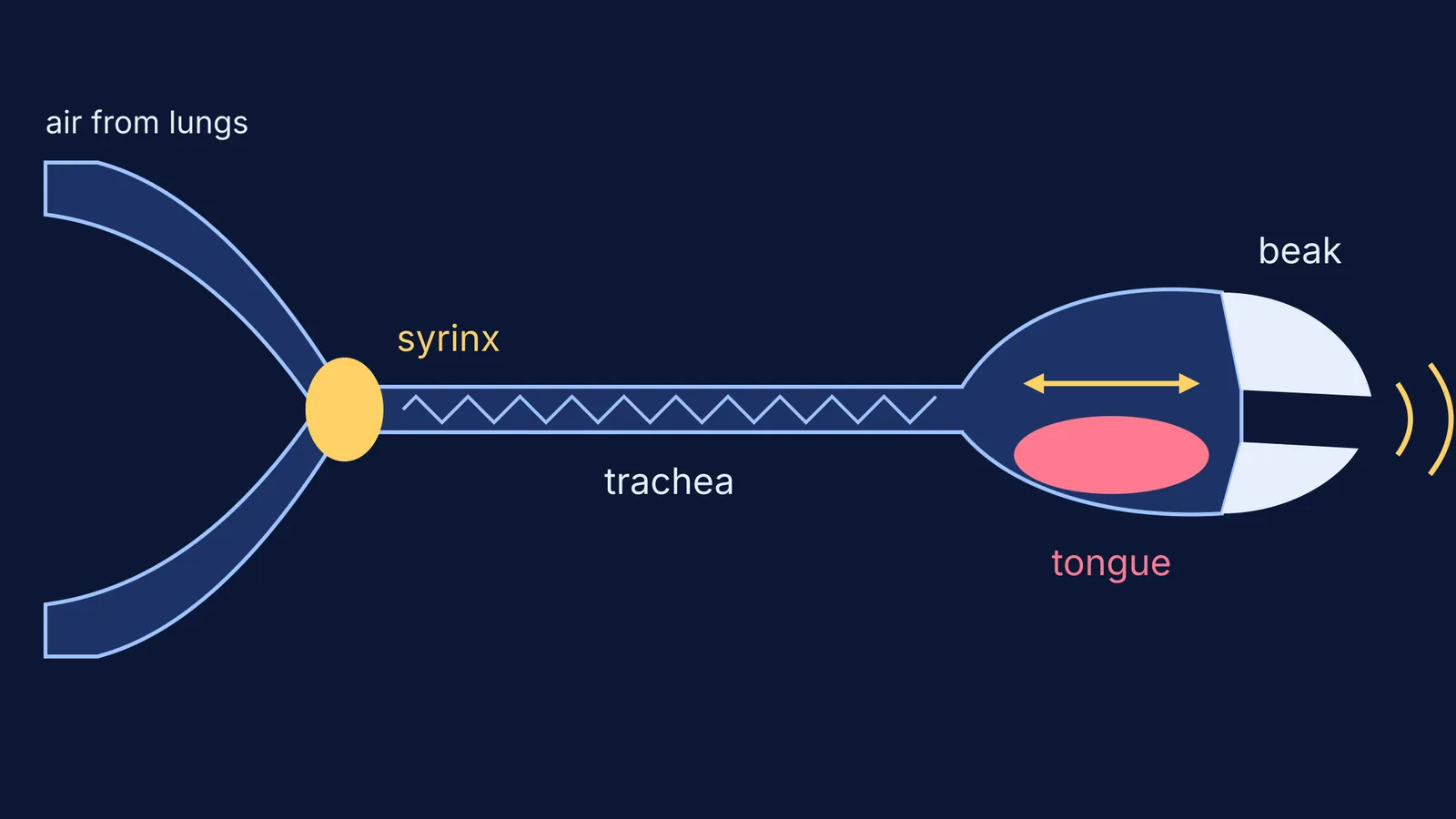
You make voiced sounds in your larynx, at the top of your windpipe. Birds have a larynx too, but it is not their sound source. The syrinx is the bird vocal organ, and it sits at the lower end of the trachea, near where it splits into the two bronchi, while the larynx sits at the upper end (Riede and colleagues, PLoS Biology, 2019).
The way the syrinx vibrates is familiar, though. Filmed at high speed in the lab, the vocal organs of every bird species tested used the myoelastic-aerodynamic mechanism, the same mechanism used to produce human speech (Elemans and colleagues, Nature Communications, 2015). Air from the lungs sets soft tissue vibrating, and muscles adjust it. If you have read about why your recorded voice sounds strange, you have already met the human side of this story.
How does a parrot's tongue shape words?
Scientists who study voices split them into a source and a filter. The source makes a buzz containing many frequencies at once. The filter, the air-filled tube above it, boosts some frequencies and weakens others. The boosted bands are called formants, and they are what make "ee" sound different from "ah" even at the same pitch.
Parrots have a large tongue, and a 2004 study showed that it works as part of the filter. Gabriël Beckers, Brian Nelson and Roderick Suthers put a small speaker in place of the syrinx in five monk parakeets, swept tones from 500 to 11,000 Hz through their vocal tracts, and measured how tongue position changed the sound coming out of the beak (Current Biology, 2004; ScienceDaily summary). A change of a fraction of a millimetre in tongue position could noticeably change the sound, and the team identified four formants in parakeet sounds. "This is the first direct evidence that parrots are able to use their large tongues to change the acoustic properties of their vocalizations," Suthers said, as reported by ScienceDaily.
Why can parrots learn new sounds at all?
Imitating complex sounds is rare: among birds it has been found only in parrots, songbirds and hummingbirds (Chakraborty and colleagues, PLOS ONE, 2015). The same study found that parrot brains have a "core" song system like other vocal learners, plus a "shell" around it found only in parrots. The authors suggest parrots evolved vocal learning systems at least 29 million years ago.
Learning starts in the nest. In a wild population of green-rumped parrotlets in Venezuela, each nestling developed its own contact call, and experiments showed that the features of those calls were learned from both parents caring for it (Berg and colleagues, Proceedings of the Royal Society B, 2011). The same paper notes that in parrots, both sexes commonly keep learning calls throughout life.
Adults copy their partners too. When nine males and nine females that had never met were placed in pairs, every pair developed a shared contact call within an average of 2.1 weeks, and in eight of the nine pairs the male was the one who imitated his mate (Hile, Plummer and Striedter, Animal Behaviour, 2000). The authors concluded that this copying probably helps form and keep the pair bond.
Copying is how parrots fit into a social group, and for a pet parrot, that group includes you. For more on how birdsong links sound and behaviour, read why birds sing so much at dawn.
How would you answer "How do parrots imitate human speech?" in an exam?
A five-point answer for a 5-mark question:
Source: air from the lungs vibrates tissue in the syrinx, at the lower end of the trachea, by the same basic mechanism as the human larynx.
Filter: the trachea, mouth and beak form a resonating tube; its resonant bands are the formants.
Articulation: moving the large tongue shifts the formants, which helps a parrot approach human vowel sounds.
Learning: parrots are vocal learners, copying calls from parents and partners and commonly learning new calls throughout life.
Brain: parrots have a core song system plus a shell region found in no other bird group.
If "resonance" is the weak link, the Fermi Concept Library gives every concept in physics and biology its own lesson.
Try it: hear a filter change in 30 seconds
Hum or sing one steady note.
Without changing that note, slide slowly from "ee" to "ah" to "oo".
Notice that the pitch stays the same while the sound quality changes. That change is your tongue and lips moving the formants, the job a parrot's tongue does.
If pitch and frequency still feel shaky, our Class 8 guide to vibration, pitch and loudness has worked sums, and the Fermi Simulation Lab has interactive simulations for the ideas that are easier to see than to read.


