

On this page
Walk outside before sunrise and songbirds erupt into a synchronized chorus. For decades, naturalists asked why birds concentrate intense singing into this early window rather than spreading it across the day. The answer combines wave physics with behavioral ecology.
Why does sound travel farther in the early morning?
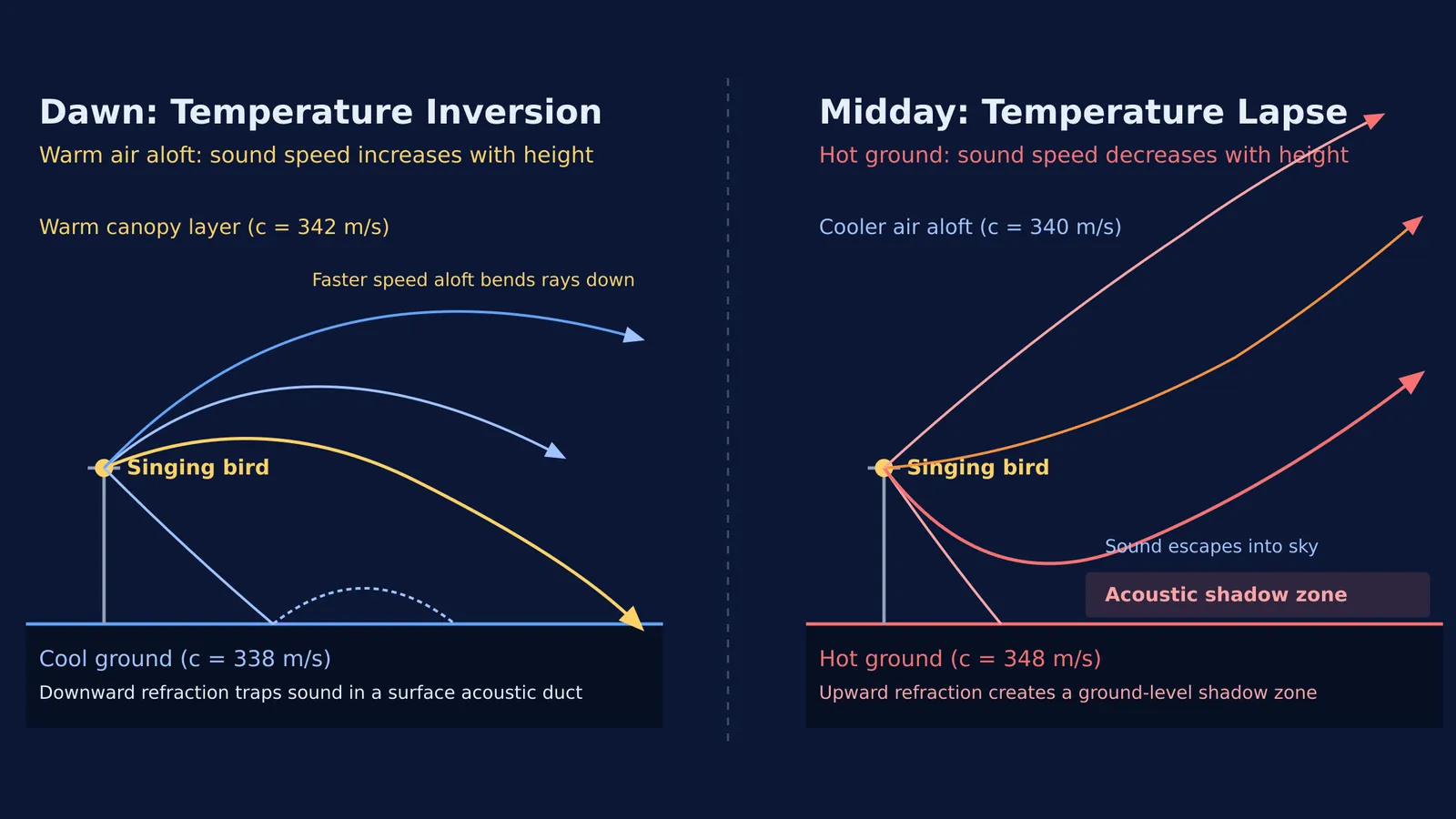
At night, ground radiative cooling chills the surface air while air aloft stays warmer, creating a temperature inversion where air temperature increases with altitude. Because sound speed in air is proportional to the square root of absolute temperature, sound travels faster through warmer air overhead than through cool air near the ground.
As a sound wavefront climbs, its faster upper section outpaces its lower section, refracting the wave downward toward the ground. Instead of escaping into the sky, acoustic energy channels along the surface. In *The American Naturalist*, Kenneth Henwood and Allan Fabrick showed that morning inversions and calm air expand a bird's broadcast area by up to 20 times compared to midday.
Field experiments confirm this acoustic advantage. In a 2003 study in *Ibis*, Timothy J. Brown and Paul Handford broadcast sparrow songs across open grassland and closed forest at dawn and noon. They found that song transmission quality was significantly more consistent at dawn. Midday sun warms the surface, generating rising thermal plumes and air turbulence that scatter sound waves and cause erratic fading.
Understanding how wave mechanics and thermal gradients interact is often easier to see than to read. In the Fermi Simulation Lab, interactive simulations let you adjust temperature profiles and watch sound rays bend toward cooler air in real time.
How does atmospheric temperature bend sound waves?
To see the physics, consider sound speed across a vertical temperature gradient. In air, sound speed c depends on temperature T through Laplace's formula c = √(γ R T / M). Near 15 °C (288.15 K), sound travels at roughly 340 m/s, shifting by about 0.6 m/s for every 1 °C change in temperature as modeled by Owen Cramer in *The Journal of the Acoustical Society of America*.
Suppose morning radiative cooling creates an inversion warming by 2 °C over a 10-metre rise from ground to canopy, giving a gradient of dc/dz ≈ 0.12 s⁻¹. By Snell's law in a stratified atmosphere, the radius of curvature R of a shallow sound ray is R = c / (dc/dz) ≈ (340 m/s) / (0.12 s⁻¹) ≈ 2833 metres.
Because dc/dz is positive, the centre of curvature lies below ground, bending the ray downward in a circular arc of radius 2.8 kilometres. A song launched from a 5-metre perch curves back toward the earth.
At midday, hot ground reverses this gradient (dc/dz < 0), bending rays upward and creating an acoustic shadow zone on the ground. For deeper mechanics, review how Laplace's correction to the speed of sound handles adiabatic gas compressions, and how displacement and pressure waves in sound relate to hearing.
Why do birds sing instead of searching for food at dawn?
Acoustic physics explains why dawn carries sound efficiently, but not why hungry birds choose singing over foraging. After fasting through a cold night, small birds wake up lean.
In *Animal Behaviour*, behavioural ecologist Alejandro Kacelnik90143-X) tested great tits (*Parus major*) under controlled light levels. Insectivorous birds hunt by sight, and pre-dawn light is too dim to spot camouflaged caterpillars or beetles. Cold-blooded insects also sit motionless until warmed by sunlight. Kacelnik found that foraging efficiency drops toward zero in twilight, meaning the opportunity cost of singing—calories lost by not hunting—is negligible before sunrise.
Connecting atmospheric physics to evolutionary ecology requires looking at the broader principles that tie wave motion to living systems. In the Fermi Concept Library, every concept in physics and biology has its own lesson and its place in the map, helping you explore wave properties alongside organismal biology.
How does overnight energy loss influence morning song?
Singing requires rapid breathing and energetic syrinx muscle contractions. In *Behavioral Ecology and Sociobiology*, J. M. McNamara, R. H. Mace, and A. I. Houston modeled avian routines, showing that birds store fat each evening to survive the night. Surplus fat remaining at dawn can be safely spent on territorial defense. Singing loudly announces that a bird survived the night with reserves to spare.
In *Behavioral Ecology and Sociobiology*, Innes C. Cuthill and William A. Macdonald verified this by feeding supplemental mealworms to wild blackbirds (*Turdus merula*). Food-supplemented males started singing earlier and sang significantly longer than unfed controls. Dawn song serves as an honest fitness signal, connecting directly to Niko Tinbergen's four questions of animal behaviour.
Why do different bird species start singing at different times?
The dawn chorus unfolds in a sequence dictated by eye anatomy. In *Proceedings of the Royal Society B*, Robert J. Thomas and colleagues compared passerine eye morphology with song start times:
Large-eyed species (such as robins and thrushes) have wide pupils that capture sparse photons, enabling them to detect predators and sing in deep twilight.
Small-eyed species (such as tits and finches) require more light to navigate safely, joining 20 to 40 minutes later.
Aerial foragers like swallows sing latest, waiting for warm thermals to lift flying insects into the air.


