

On this page
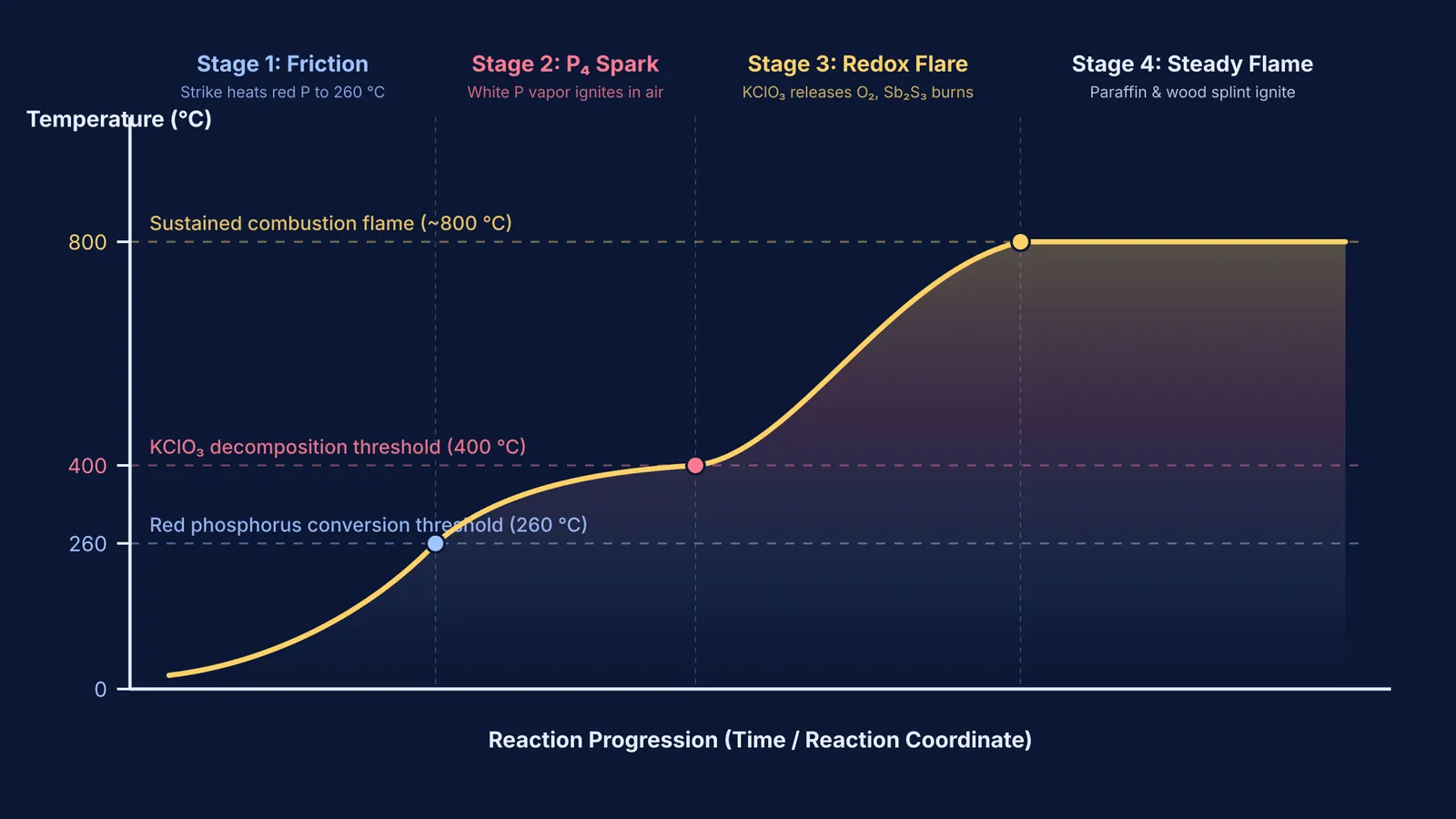
When you strike a matchstick against the dark strip of a matchbox, a flame flares up in less than a tenth of a second. It looks like a single instantaneous event, but the strike actually sets off a tightly choreographed four-stage chemical relay. Each step raises the temperature just enough to reach the next reactant's ignition threshold.
Understanding this relay is central to combustion and flame fundamentals in Class 8. Mechanical energy serves only as the initial trigger for a self-amplifying cascade of allotropic transformation, oxidiser decomposition, and redox combustion.
What happens chemically when you strike a match?
A safety match keeps its fuel and oxidising agent strictly separated until you strike it. If these ingredients were mixed into a single head, the match could ignite from slight rubbing inside a pocket.
As detailed in Compound Interest's chemical analysis of matches, the system divides its reactive chemistry across two surfaces:
The match head: Contains potassium chlorate (KClO₃) as an oxidiser, antimony(III) sulphide (Sb₂S₃) or sulphur as fuel, powdered glass for friction, and a gelatin binder.
The striking strip: Coated on the matchbox with red phosphorus, powdered glass, and a binder.
The wooden splint: Carved from aspen or pine, treated with ammonium phosphate to stop smouldering afterglow, and dipped in paraffin wax near the tip to help the flame spread to the wood.
Under room conditions, neither surface can ignite alone because both sit far below their required ignition temperatures.
Why does friction turn red phosphorus into flame?
The reaction begins when you draw the match head across the striking surface with firm pressure. The powdered glass on both faces grates together, creating sharp microscopic friction. As explored in our guide on how friction converts mechanical work into heat, this friction converts kinetic work into concentrated heat at microscopic contact points.
According to Compound Interest's match breakdown, this flash heating raises local temperatures past the red phosphorus ignition threshold of roughly 260 °C. At this threshold, amorphous red phosphorus breaks its polymeric bonds. A tiny fraction sublimes into white phosphorus vapor (P₄).
White phosphorus has an extraordinarily low ignition temperature of roughly 30 °C to 35 °C. The instant this hot vapor meets ambient oxygen in the air, it catches fire spontaneously:
P₄ + 5O₂ → P₄O₁₀
This microscopic puff of burning phosphorus produces the initial spark you hear as a faint crackle.
How does potassium chlorate sustain the combustion reaction?
Heat from the burning phosphorus concentrates into the contact point, quickly pushing the local temperature past 400 °C. This thermal shock triggers the potassium chlorate in the match head to decompose, as outlined in Compound Interest's combustion breakdown:
2KClO₃ → 2KCl + 3O₂
Rather than relying on ambient air, which contains only about 21% oxygen by volume, the match head floods its reaction zone with pure oxygen gas. In this oxygen-rich environment, antimony(III) sulphide or sulphur burns violently in an intense redox reaction. This electron exchange illustrates the principles behind balancing redox reactions:
2Sb₂S₃ + 9O₂ → 2Sb₂O₃ + 6SO₂
This stage drives the reaction temperature to between 600 °C and 800 °C. That flame surpasses the 200 °C to 250 °C ignition threshold of the paraffin wax on the splint. The melted wax vaporises, feeds the flame, and ignites the wooden stick's cellulose.
Follow this four-stage framework to see how the energy cascades:
Friction heating (ambient to ~260 °C): Glass grit converts mechanical strike work into localized flash heat.
Allotropic shift (~260 °C): Polymeric red phosphorus vaporises into volatile P₄ gas.
Spontaneous spark (~35 °C threshold): P₄ ignites in air, releasing heat that exceeds 400 °C.
Sustained flame (400 °C to 800 °C): KClO₃ releases pure O₂, combusting the fuel and paraffin wax.
Why do safety matches need the box to catch fire?
The safety match solved a major hazard in nineteenth-century chemistry. Early friction matches contained white phosphorus directly in the head alongside an oxidiser. As documented by M. F. Crass, Jr. in the Journal of Chemical Education, these formulations ignited accidentally from friction in pockets and caused chronic phosphorus poisoning ('phossy jaw') among factory workers.
In 1844, Swedish chemist Gustaf Erik Pasch patented the safety match by separating the reactants: he removed phosphorus from the head entirely and placed stable red phosphorus on the box. Dry red phosphorus and potassium chlorate form Armstrong's mixture, a contact explosive that detonates with the slightest tap. By keeping them on separate surfaces, a safety match ensures this volatile mixture forms only in microscopic, fleeting quantities during an intentional strike.
When students struggle to visualise invisible molecular interactions—such as microscopic friction converting kinetic energy into heat or rapid redox cascades—interactive simulations make the hidden mechanism intuitive. The Fermi Simulation Lab offers interactive simulations for ideas that are easier to see than to read.
If you are reviewing combustion mechanisms or thermodynamic thresholds for exams, the Fermi Concept Library maps every concept in physics and chemistry with dedicated lessons connecting molecular models to real-world phenomena.


