On this page
According to the World Health Organization, 830 million people worldwide were living with diabetes in 2022. To manage the condition, they prick their fingers, put a drop of blood on a small plastic strip, and get a number on a screen in seconds. But how does that little plastic strip know how much sugar is in the blood? The secret is a combination of biology and electrochemistry.
How does the meter turn chemistry into numbers?
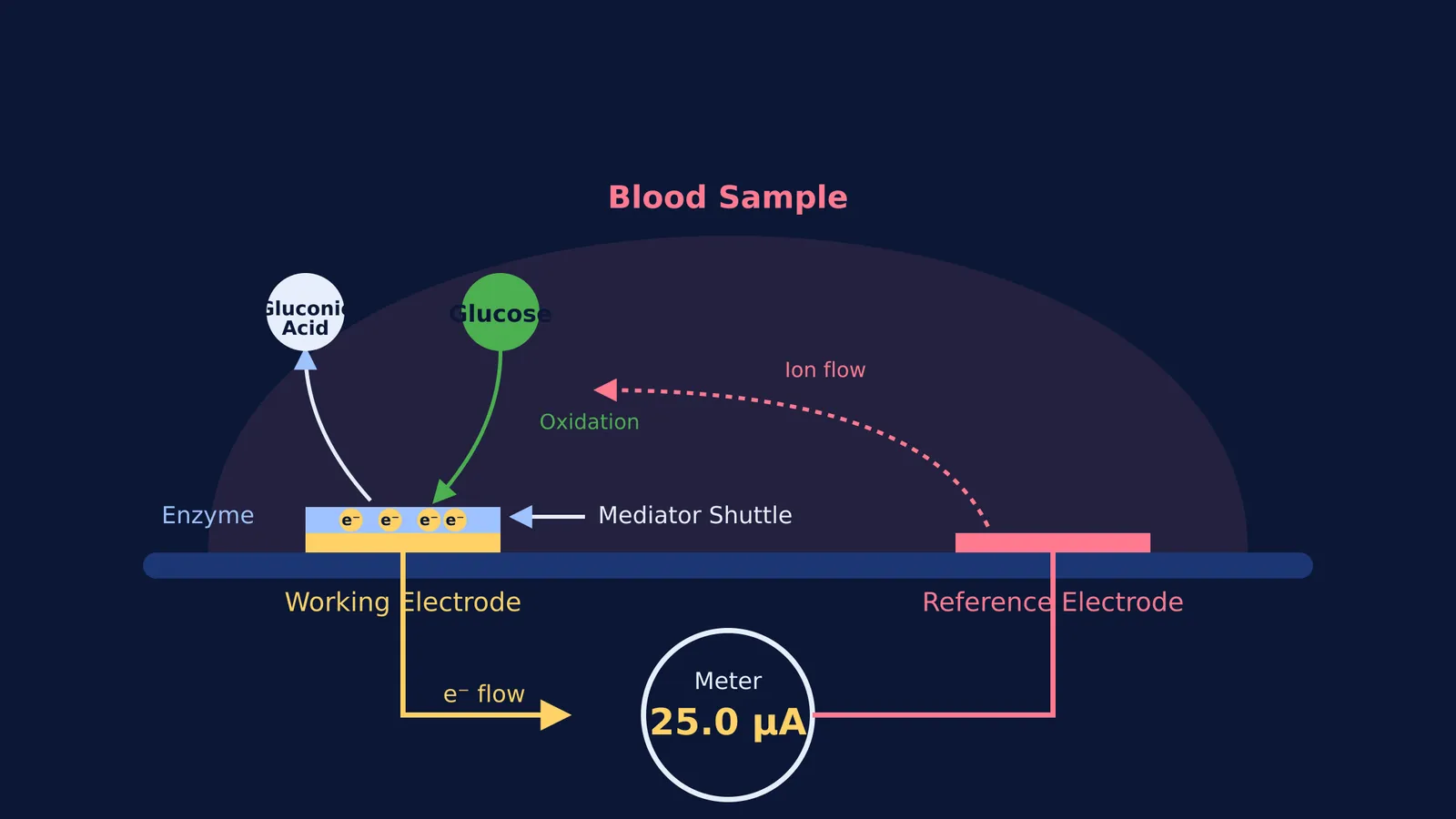
When you insert a test strip into a glucometer, you are completing a tiny electrical circuit. The strip acts as a miniature electrochemical cell. Here is what happens when the blood touches it:
Capillary action: The strip has a narrow channel that draws the blood in automatically.
The enzyme reaction: Inside the channel, the blood mixes with an enzyme, usually glucose oxidase (GOx) or glucose dehydrogenase (GDH). This enzyme specifically targets glucose, oxidising it and stripping away electrons in the process.
The electron shuttle: A chemical mediator picks up these freed electrons and carries them to a microscopic working electrode printed on the strip.
Measuring the current: The meter applies a small voltage between this working electrode and a reference electrode. The flow of electrons creates an electric current.
More glucose in the blood means more electrons are released, which creates a stronger current. The meter's computer uses an algorithm to convert that raw current into the final mg/dL or mmol/L reading you see on the screen.
Which enzyme is on the strip?
Manufacturers generally use one of two enzymes to trigger the oxidation of glucose:
Glucose Oxidase (GOx): This enzyme is highly specific to glucose, meaning it will not accidentally react with other sugars in your blood. However, it requires oxygen to work. If the oxygen levels in a patient's blood are unusually high or low, it can slightly skew the final reading.
Glucose Dehydrogenase (GDH): This enzyme does not rely on oxygen, making it more flexible for different environments. Some early versions of GDH reacted with other sugars like maltose, which led to falsely high readings, but modern strips have largely fixed this issue. If you are curious about how enzymes match with their target molecules like a lock and key, you can explore AI analogies for chemical bonding: are they right?
Why do you need so little blood?
If you used an older glucometer in the 1990s, you had to squeeze a large drop of blood onto the strip. Modern meters require a sample of just 0.3 to 1.0 microliters.
To put that into perspective, a typical single drop of liquid is roughly 50 microliters). This means modern strips use a tiny fraction of a drop. They can do this because the electronics have improved drastically. The analog amplifier inside the meter can precisely measure currents ranging from 10 to 50 microamperes. Because the meter can reliably read a signal that tiny, it only needs a microscopic amount of glucose to generate it.
How does the meter use Faraday's laws?
The way a glucometer calculates your blood sugar is a direct application of Faraday's laws of electrolysis, a topic you study in Class 12 physical chemistry.
When the meter applies a voltage, it measures the electric current (I) over a fixed time (t). By multiplying the current by the time, the meter's microprocessor calculates the total electric charge (Q = I × t) that has flowed through the circuit.
According to Faraday's laws, the total charge is directly proportional to the number of moles of electrons transferred in the reaction. The meter uses Faraday's constant (96,485 coulombs per mole) to find the exact number of electrons. Since the balanced chemical equation dictates how many electrons are released per molecule of glucose, the meter can accurately determine the number of moles of glucose in that tiny blood sample. It then scales this number up to display your concentration.
How can you apply electrochemistry in your studies?
The glucometer is a perfect example of redox reactions in the real world. The glucose is oxidised, the mediator is reduced, and the resulting electron flow is measured as a current.
When you study electrochemistry for board exams or JEE, you will learn about standard electrode potentials and the types of half-cells: metal, gas and redox electrodes. The test strip is essentially a specialised redox half-cell.
If you find it hard to picture how voltage, concentration and current relate, you can test these variables in the Fermi Simulation Lab. Running a simulation lets you see exactly how changing the reactant concentration changes the electrical output, bridging the gap between textbook formulas and real devices.