

On this page
Press the button on a classic electric doorbell and you hear a fast, steady rattle, not a single ding. That rattle comes from a circuit that keeps switching itself off and on. Trace that loop and you also understand electromagnets, open and closed circuits, and a diagram question that turns up in school exams.
How does an electric doorbell ring?
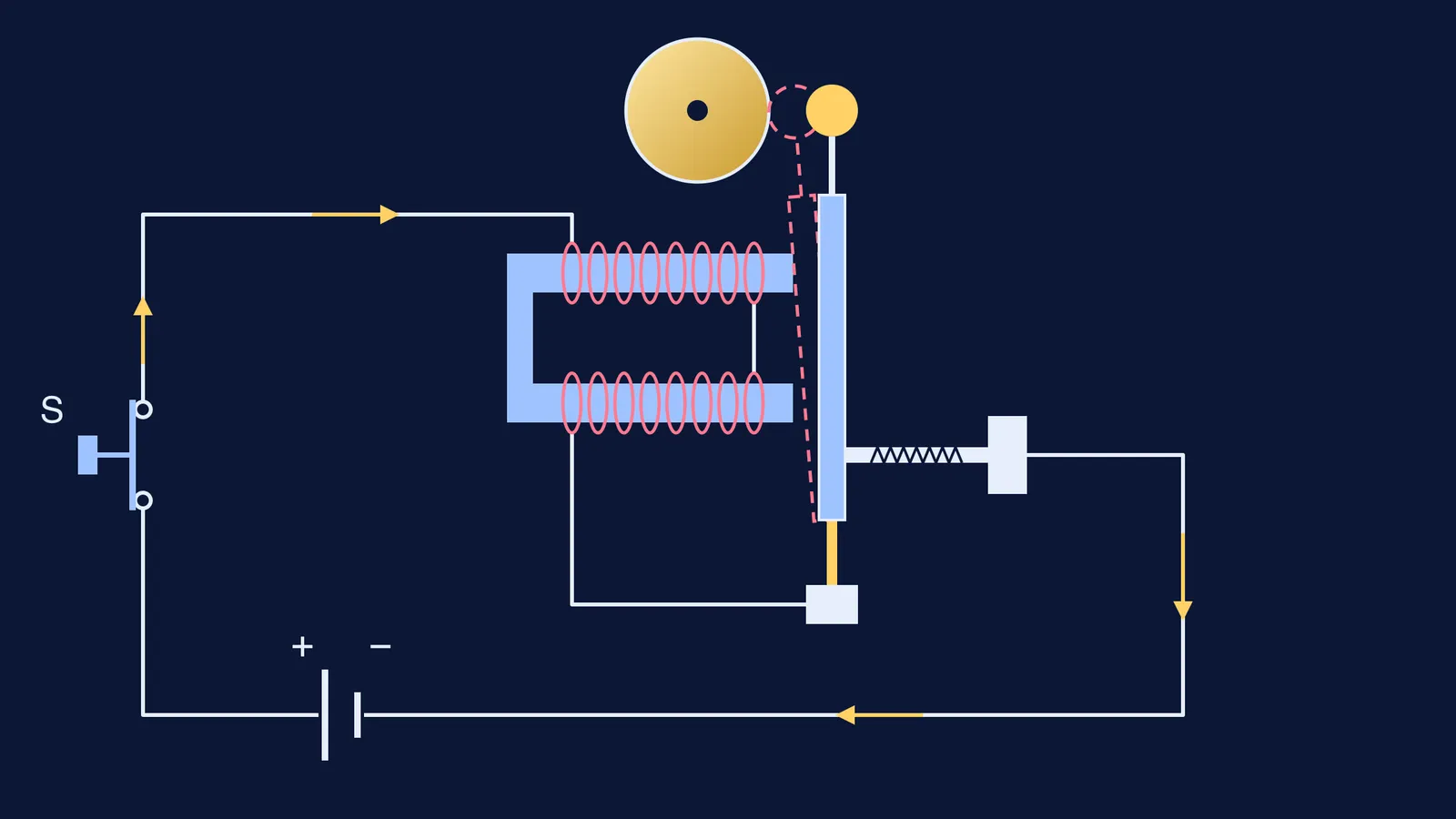
A classic electric bell has a battery, a push switch, an electromagnet, a soft iron armature on a springy strip, a contact screw and a gong. Here is the loop, following the explanation on schoolphysics:
You press the switch. Current flows through the electromagnet's coil, along the spring and armature, through the contacts and the adjusting screw, and back to the battery.
The electromagnet attracts the soft iron armature, and the striker hits the gong once.
As the armature moves, the contacts open and the current stops.
With no current, the electromagnet switches off and the spring pulls the armature back.
The contacts touch again, current flows again, and the loop starts over.
The Wikipedia article on the electric bell describes the same cycle: the moving clapper arm "opens a pair of electrical contacts attached to the clapper arm, interrupting the current to the electromagnet." The cycle repeats rapidly, so you hear continuous ringing.
What does each part of the bell do?
The Wikipedia article on electromagnets gives the two facts the bell depends on.
Electromagnet: a magnet whose magnetic field is produced by an electric current. The field disappears when the current is turned off, and that on-off behaviour is the whole trick.
Iron core: a core can increase the field to thousands of times the strength of the coil alone. That is why the coil is wound on iron.
Spring strip: returns the armature, the iron arm carrying the striker, to rest when the magnet lets go.
Contact screw: the adjustable point the armature touches to complete the circuit. Together they act as an automatic switch.
If switchable versus permanent magnets still feels shaky, read our explainer on electromagnets versus permanent magnets.
Why does the bell keep ringing instead of striking once?
Because the armature is part of the circuit. Without the contact screw, the magnet would pull the armature once and hold it, giving one dull clunk.
The idea is older than the doorbell. Johann Philipp Wagner showed his electromagnetic hammer, a device for automatically opening and closing a battery circuit, in Frankfurt on 25 February 1837, according to the Deutsche Biographie. The electric bell article records that John Mirand added a clapper and gong around 1850, and that a buzzer uses a similar mechanism without the resonant bell. So a buzzer works the same way as a bell; the bell just adds the gong.
Underneath it all is Hans Christian Ørsted's 1820 demonstration that electric currents create magnetic fields (electromagnet article), which you can repeat with a compass: see why a compass needle deflects near a current-carrying wire.
How do you explain the electric bell in an exam?
Think in two states, then write the loop.
State A, contacts touching: circuit closed, current flows, magnet on, armature pulled towards the core.
State B, contacts apart: circuit open, no current, magnet off, spring pulls the armature back, which returns you to State A.
A model answer in five lines:
When the switch is pressed, the circuit is complete and current flows through the electromagnet's coil.
The electromagnet attracts the soft iron armature, so the hammer strikes the gong.
The armature moves away from the contact screw, which breaks the circuit.
The electromagnet loses its magnetism and the spring pulls the armature back against the contact screw.
The circuit is complete again and the process repeats rapidly, so the bell rings continuously.
Then practise the "what if" versions. Swap the iron core for wood: the magnet weakens, so the armature may not move. Tighten the contact screw so it never separates: the armature is pulled once and stays, so you get one strike. Use a permanent magnet: it never switches off, so the armature sticks.
Why does a bell click once or stay silent?
The same two-state logic diagnoses a battery bell kit in the school lab:
No sound, no click: the circuit is open somewhere, such as a loose wire, a flat cell or a contact that does not touch at rest. Check it like any series circuit, as in our guide to telling whether a Class 7 circuit will work.
One click, then nothing: the armature is pulled but the contacts are not breaking or not remaking, so the loop cannot restart. Adjust the contact screw.
A weak, uneven buzz: the contact is barely touching, or the cell is running down.
The hard part is picturing the arm moving and the circuit opening at the same moment. The Fermi Simulation Lab has interactive simulations for ideas that are easier to see than to read, and the Fermi Concept Library gives each physics concept its own lesson.


