

On this page
You light the fuse, there is a hiss, and the rocket leaves its stand in a streak of sparks. Two pieces of physics are at work: one makes the rocket go up, the other makes it go up straight.
What is inside a Diwali rocket?
A skyrocket's motor is a black powder-type fuel pressed into a solid block inside a cardboard tube that is sealed at the top and open at the bottom, according to the Wikipedia entry on skyrockets. Classic black powder is 75% potassium nitrate, 15% charcoal and 10% sulfur by weight (Gunpowder, Wikipedia). Burning releases oxygen from the potassium nitrate, which helps the charcoal and sulfur burn fast. (The coloured burst at the top is a separate charge, explained in why firecrackers burn in colours.)
How does hot gas push a rocket up?
When the fuel is lit from the bottom, hot gas expands in an air gap at the bottom of the tube and is forced out downward, which propels the rocket upward (Skyrocket, Wikipedia). That is Newton's third law: for every action there is an equal and opposite reaction. NASA's Glenn Research Center calls action and reaction "the essence of jet and rocket propulsion" (NASA Glenn, bottle rockets).
The tube pushes the gas down, so the gas pushes the tube up. It does not need the ground or air to push against: NASA notes that a rocket works in space, where there is no surrounding air (NASA Glenn, thrust equation).
The same idea drives a balloon rocket across a table, and our guide to Newton's third law pairs has more practice.
A quick estimate shows the size of the push. NASA writes rocket thrust as F = ṁVe + Ae(pe − p0), where ṁ is the mass of gas leaving per second and Ve its exit speed (NASA Glenn, thrust equation). Dropping the pressure term and using made-up round numbers, not measurements: 0.01 kg of gas per second leaving at 300 m/s gives F = 0.01 × 300 = 3 N. A 33 g rocket weighs 0.033 × 9.8 ≈ 0.32 N, so thrust is about nine times the weight and the rocket speeds up quickly.
Why does a Diwali rocket need a stick?
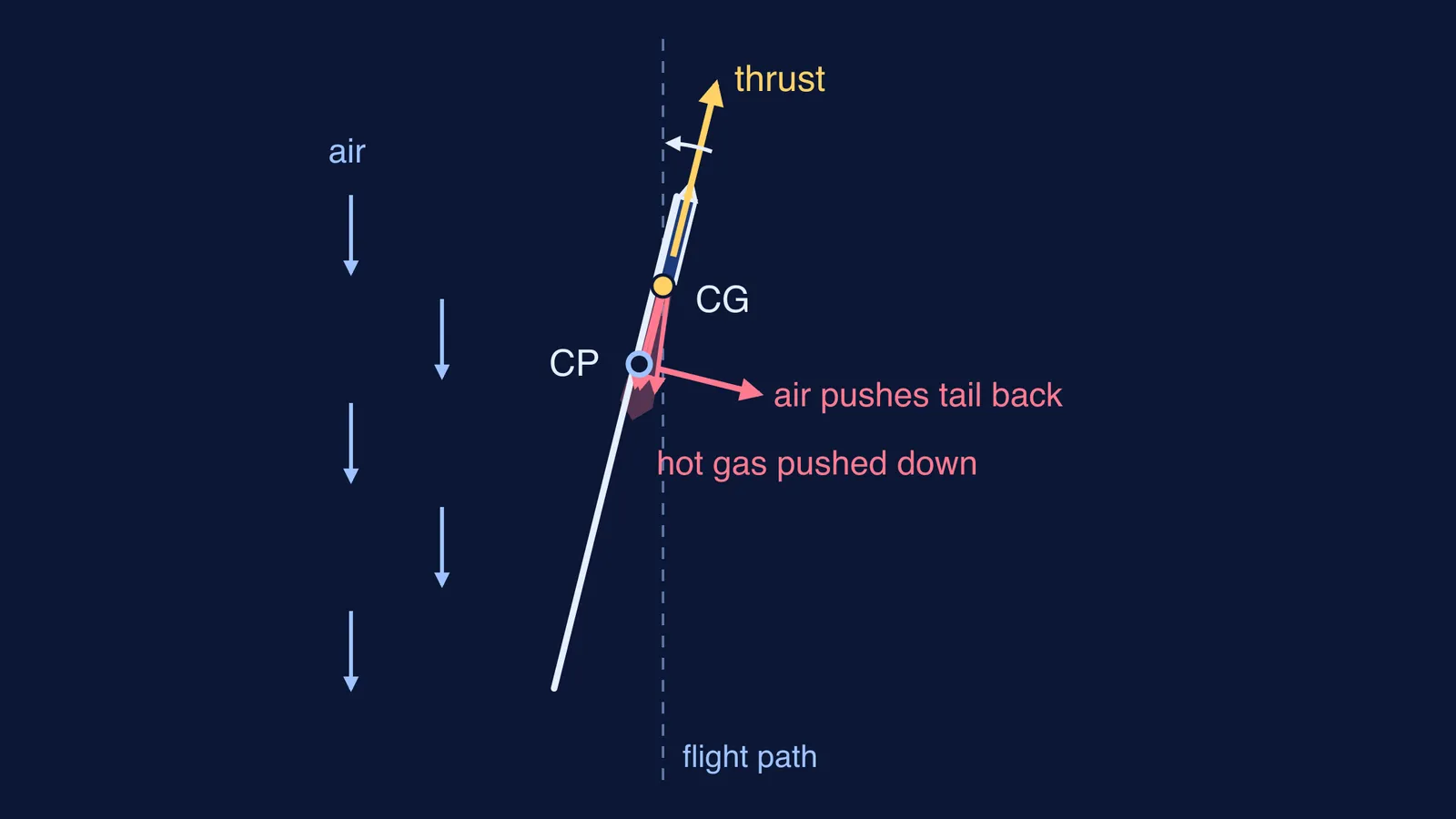
A rocket in flight turns about its centre of gravity (CG), its balance point, while the air's lift and drag act through its centre of pressure (CP) (NASA Glenn, rocket stability). NASA's rule: a rocket is stable when the centre of pressure is below the centre of gravity. Then, if the nose tips, the air pushes it back toward the flight direction: a restoring force. If CP is above CG, a small tilt grows instead.
On a bare tube, CG and CP can sit almost on top of each other, so little straightens it. A long, light stick adds plenty of side area low down but little weight, pulling CP well below CG. The skyrocket entry notes that the stick's length and weight are sized for stability; other rockets use fins or spin.
Worked example: where are CG and CP on a rocket?
NASA gives two recipes: CG is the mass-weighted average of each part's position (NASA Glenn, centre of gravity), and CP is the area-weighted average of each part's side outline (NASA Glenn, centre of pressure). For the illustrative rocket in the diagram, measuring from the nose:
Tube with fuel: 25 g, centred at 6.5 cm. Side area 20 cm² centred at 7 cm, plus a 2 cm² cone at about 1.3 cm.
Stick: 8 g, 60 cm by 0.6 cm, fixed from 2 cm to 62 cm, so centred at 32 cm with 36 cm² of side area.
CG = (25 × 6.5 + 8 × 32) ÷ 33 ≈ 12.7 cm.
CP = (20 × 7 + 2 × 1.3 + 36 × 32) ÷ 58 ≈ 22.3 cm.
CP is about 9.6 cm below CG, so tilts get corrected. Without the stick, both sit near 6.5 cm and nothing does.
To check, balance an unlit rocket on a string or an edge for CG, and hang a cardboard cut-out of its outline from a string to find its balance point for CP (both NASA methods).
How do you launch a rocket safely?
A bent or broken stick moves the CP and weakens the restoring push, so the rocket can go astray. The Doda district administration's 2019 Diwali advisory adds these rules (Doda district advisory):
Fire aerial fireworks in open spaces with a safe landing zone.
Never light fireworks while holding them: put them down, light with a candle or long stick, and walk away.
Children use fireworks only under supervision, never on their own.
Keep a bucket of water or sand, and a blanket, at hand.
Our physics addition: never fire a rocket whose stick is cracked, loose or shortened. For any burn or eye injury, see a doctor straight away.
The Fermi Simulation Lab has interactive simulations for ideas that are easier to see than to read, and the Fermi Concept Library gives every concept in physics its own lesson.


