

On this page
In Class 6 science you sort plants into herbs, shrubs, trees, climbers and creepers using two things you can check by hand: how tall the plant grows and how strong its stem is. Here is the rule, a two-question test, and five garden plants worked through.
What is the difference between herbs, shrubs and trees?
NCERT's Class 6 textbook Curiosity (Chapter 2, Diversity in the Living World) groups plants by height and stem, as set out in this chapter guide to herbs, shrubs and trees. For the rest of the chapter, see our guide to diversity in the living world in Class 6.
Herbs are small plants with a soft, green stem; grass and mint are examples.
Shrubs are medium-height plants with a brown stem that is hard but not as thick as a tree's; rose and lemon are examples.
Trees are very tall plants with a brown, woody stem that is hard and thick; mango and oak are examples.
Height alone can fool you: a young mango sapling is still a tree. Check the stem first and use height to confirm.
What is the difference between climbers and creepers?
Some plants have stems too weak to hold them upright. The same chapter splits these by the direction they grow, as this summary of climbers and creepers explains: climbers have weak stems and need support to grow upwards (money plant, pea), while creepers spread along the ground (pumpkin, watermelon).
Climbers hold on in different ways. The money plant (Epipremnum aureum) climbs using brown aerial roots that grip a support, according to NC State University's plant toolbox, and its trailing and climbing vines can grow as long as 40 feet (about 12 m).
Pumpkin is the interesting case. NC State's pumpkin entry lists it as an annual that can climb structures using tendrils, so a pumpkin vine next to a fence may grab it. Left on open ground, the long vines and heavy fruit lie along the soil; pumpkins of the species Cucurbita pepo generally weigh 3 to 8 kg, according to Wikipedia's pumpkin article. Because it spreads along the ground, your textbook counts it as a creeper.
How do you classify tulsi, rose, mango, money plant and pumpkin?
Run this two-question test on any plant:
Can the stem hold the plant upright on its own? If no, go to step 2. If yes, go to step 3.
Does it grow upward on a support (climber) or spread along the ground (creeper)?
Is the stem soft and green (herb), hard, brown and fairly thin (shrub), or thick and woody (tree)?
Now the five plants, worked through:
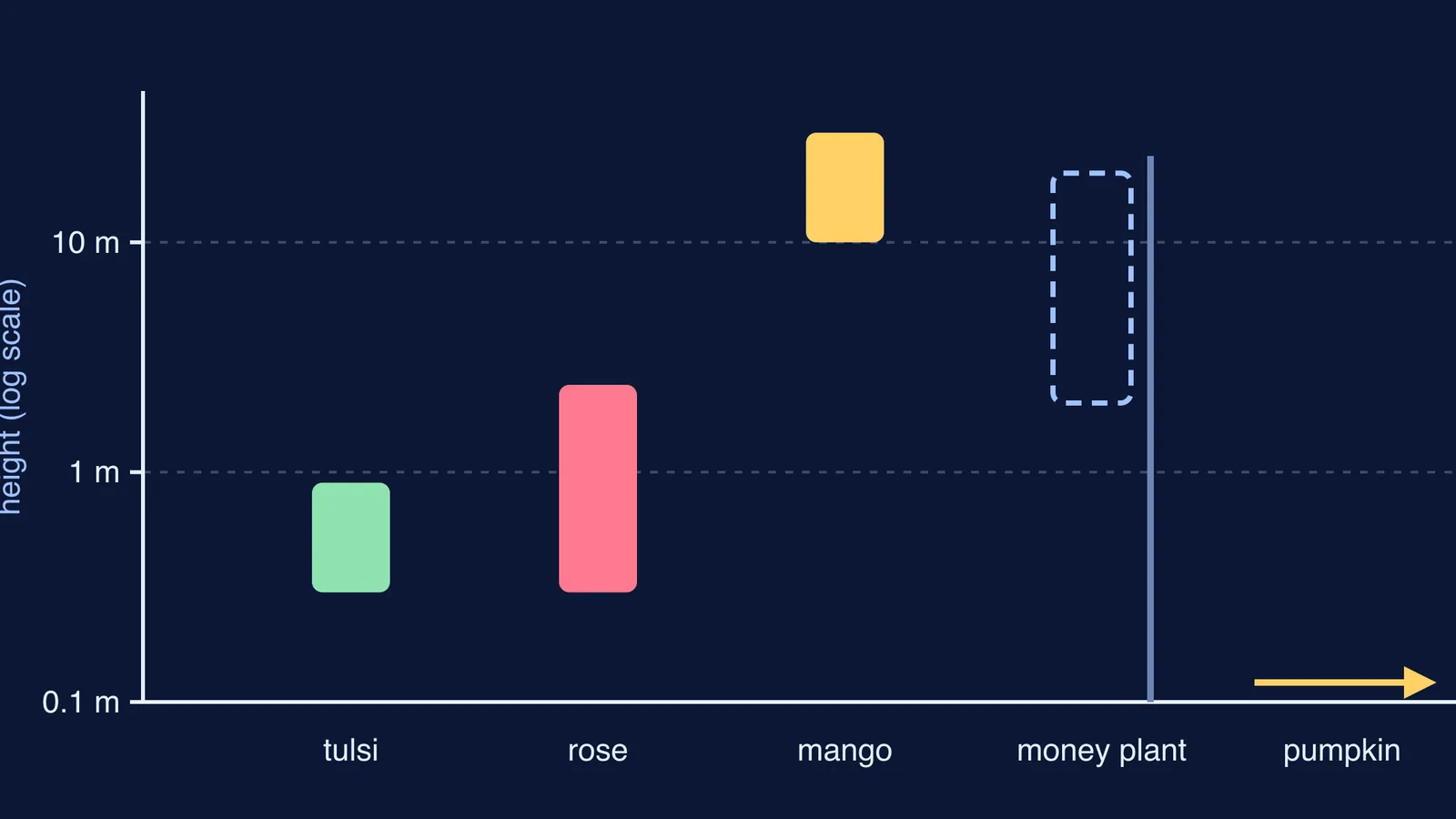
Tulsi: herb, with a twist. The stem stands upright, so skip to step 3: it is green and soft near the tips. Holy basil is an erect, many-branched plant 30 to 60 cm tall with hairy stems, according to its Wikipedia entry. NC State calls it an annual, short-lived perennial or subshrub, and a subshrub is a plant that is largely herbaceous but slightly woody at the base (definition).
Rose: shrub. Upright, with a hard brown stem far thinner than a trunk. NC State describes roses as woody perennial shrubs or vines that grow 1 to 8 feet tall. Note the word vines: climbing roses exist, so a rose trained over a gate is behaving as a climber.
Mango: tree. A single thick, woody trunk. The mango tree grows erect to 30 to 100 feet (about 10 to 30 m), and some specimens are known to be 300 years old and still fruiting, according to Julia Morton's Fruits of Warm Climates, hosted by Purdue University.
Money plant: climber. The stem cannot stand alone, and it grows upward on a pole or wall. It is commonly known as money plant in many parts of the Indian subcontinent, and the vine can grow to 20 m tall, says its Wikipedia entry.
Pumpkin: creeper. The stem cannot stand alone, and on open ground it spreads sideways along the soil.
How should you write the answer in a Class 6 exam?
A strong answer names the group and gives the evidence you observed. Use these as models:
"Rose is a shrub because its stem is hard and brown but thinner than a tree trunk, and it grows to a medium height."
"Money plant is a climber because its stem is weak and it grows upward by holding a support with its roots."
"Pumpkin is a creeper because its weak stem cannot stand upright and spreads along the ground."
Stems that look odd, such as thorns, tendrils and underground rhizomes, are covered in our post on stem modifications with examples. Plant lifespan is a separate way of grouping, explained in annual, biennial and perennial plants.
If words like herbaceous, woody and stem still blur together, the Fermi Concept Library covers every concept in biology, each with its own lesson and its place in the map.
Next time you pass a garden, run the two questions on three plants.


