

On this page
When studying plant biology, categorising plants by their lifespan is a fundamental step. Whether a plant lives for one year, two years, or decades tells us how it allocates its energy to survive and reproduce.
What are annual, biennial and perennial plants?
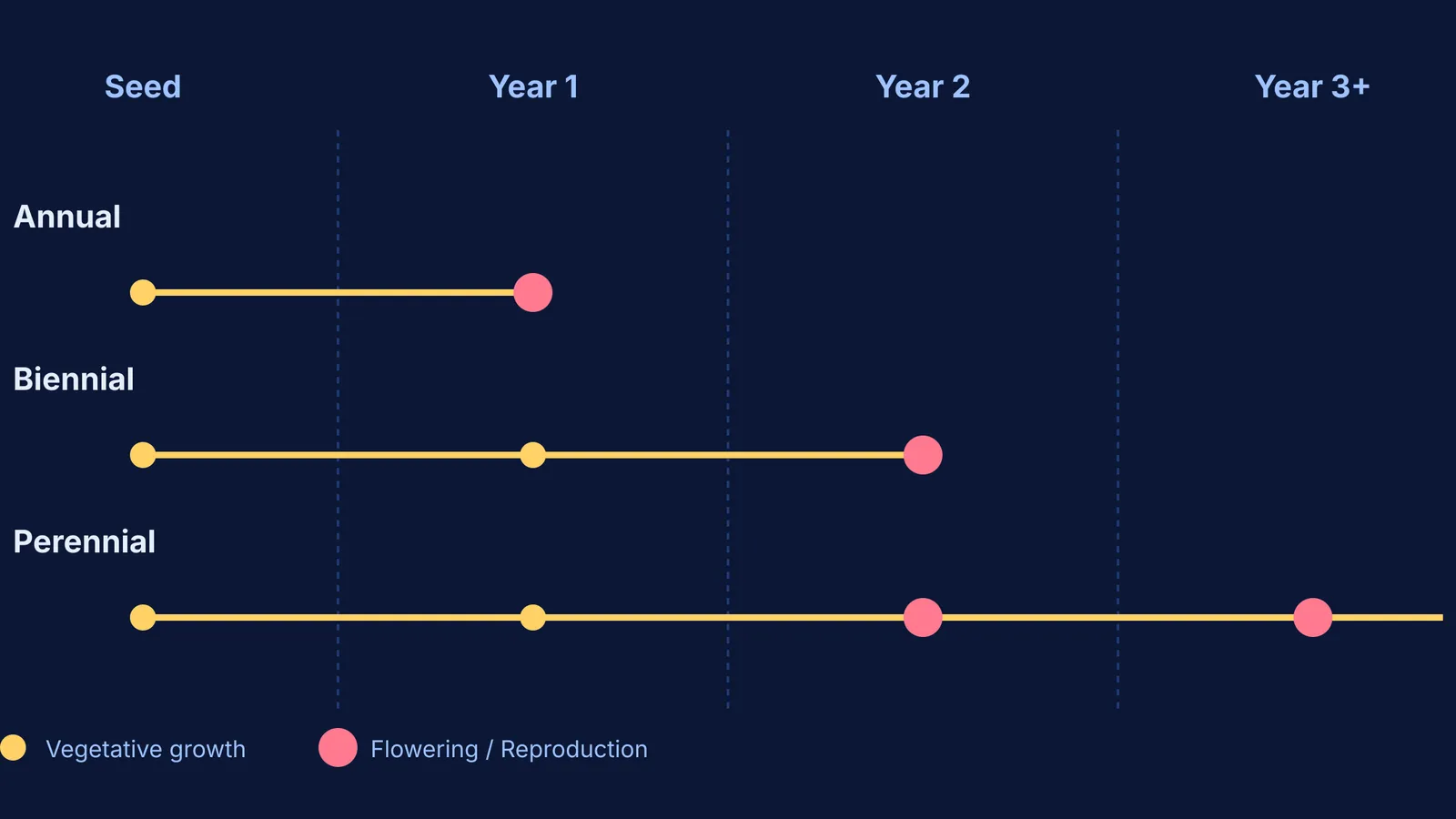
Plants are classified into three main categories based on how long it takes them to complete their biological life cycle, from seed germination to seed production and death.
Annual plants complete their entire life cycle in a single growing season. They germinate, grow, flower, set seeds and die within one year. Wheat is a classic example. Winter wheat is planted in the autumn, stays dormant through the winter, and grows rapidly in the spring to be harvested in the summer (Wikipedia). Because they only have one chance to reproduce, annuals direct most of their energy into producing seeds rather than building permanent root systems or thick stems.
Biennial plants take two years to complete their biological life cycle (Wikipedia). In their first year, they germinate and grow vegetative structures, typically forming a low rosette of leaves and a robust storage root. In their second year, they produce a flower stalk, set seeds, and then die. The carrot is a well-known biennial. During its first year, it grows the fleshy, edible taproot that we harvest for food. If left in the ground, it uses the energy stored in that root to fuel its massive floral display the following year.
Perennial plants live for more than two years. Once they reach maturity, they often flower and produce seeds every year. The mango tree is a perennial that can live and bear fruit for decades (Wikipedia). While they may have "on" and "off" years in terms of fruit yield (a phenomenon known in agriculture as biennial bearing), the tree itself persists year after year. It builds permanent woody structures and deep root systems, allowing it to survive harsh conditions and return to a reproductive state each spring.
If you are revising how different plant structures adapt to these lifespans, such as the role of meristems: apical, intercalary and lateral, and where each lies, tracing the energy flow from root to flower helps connect the concepts.
Why do biennials like carrots flower in their second year?
For a biennial like a carrot to shift from growing leaves to growing flowers, it needs a specific environmental trigger. This trigger is a prolonged period of winter cold, a physiological process known as vernalization (Wikipedia).
Vernalization acts as a biological timer, ensuring the plant only flowers after winter has passed. The cold signals the apical meristem to transition from a vegetative state (producing leaves) to a reproductive state (producing a floral stalk).
If a biennial does not experience this cold period, it will simply continue to grow vegetative leaves indefinitely and will not produce flowers. Conversely, if a young carrot experiences an unusually cold spring during its first year, it might be tricked into bolting (flowering) prematurely. When a carrot bolts, the taproot typically becomes tougher, more fibrous, and woody as the plant redirects its resources toward seed production (Wikipedia). This makes the root completely inedible, which is why commercial growers carefully time their planting to avoid unexpected cold snaps.
Understanding these developmental triggers is a common hurdle in plant physiology. If you find yourself forgetting which hormones and environmental cues control flowering, the Fermi Concept Library gives each concept its own lesson and its place in the map so you can see how the whole system connects. You can also explore how arithmetic vs geometric growth in plants dictates the speed at which these vegetative and reproductive structures develop across different life spans.
How do these lifespans act as survival strategies?
When trying to remember examples of annuals, biennials, and perennials, it helps to think of them as distinct survival strategies rather than just lifespans:
The sprint (Annuals): The strategy is to rush to reproduce. Plants like wheat put all their accumulated energy into making seeds before the growing season ends. They leave nothing behind but the next generation.
The savings account (Biennials): The strategy is to store and wait. Plants like carrots build a storage organ in year one, use winter cold as a foolproof signal that the harsh weather has passed, and then spend their saved energy to flower massively in year two.
The permanent estate (Perennials): The strategy is to build to last. Plants like mango trees invest heavily in durable structures, such as a woody trunk and extensive branches, allowing them to survive seasonal changes and reproduce multiple times over a long life.


