

On this page
Your textbook says gymnosperms bear cones, then shows a female Cycas plant with no cone at all. You are not misreading it. Gymnosperm reproduction comes down to three questions: which modified leaves carry the spores, whether both sexes share one plant, and where the ovule sits. Get those three right and most questions on this part of the chapter answer themselves.
What are male and female cones in gymnosperms?
A cone, or strobilus, is a short axis packed with modified leaves called sporophylls. Gymnosperms make two kinds.
Microsporophylls carry microsporangia (pollen sacs), which make pollen. In conifers, pollen cones are “made up of sporophylls where the pollen sacs (microsporangia) are borne on the lower surface”, according to the University of Wisconsin–Madison botany notes on conifers.
Megasporophylls carry ovules. In conifers the female cone is built from seed scales bearing ovules, and each seed scale with its sterile bract forms a “seed-scale complex” (UW–Madison).
Male and female describe what a cone produces, not two kinds of plant.
Are male and female cones on the same tree or different trees?
It depends on the plant, and this is where students lose marks.
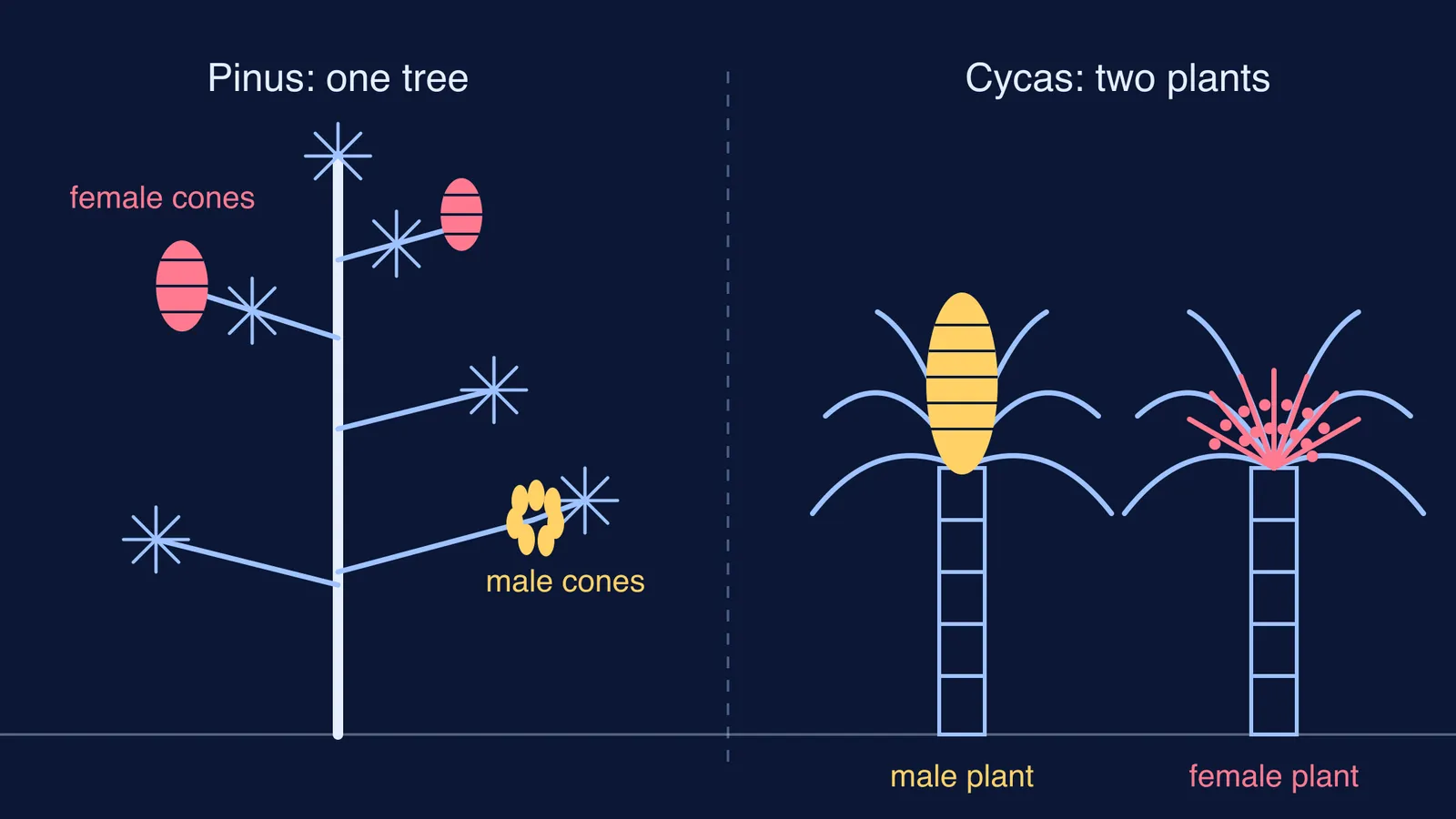
Same tree (monoecious): Pinus. Pines are “monoecious (rarely semi-dioecious)”, with numerous small pollen cones in a dense cluster around the base of the current year's growth, according to the Gymnosperm Database entry for Pinus. That page treats 130 pine species.
Different trees (dioecious): Cycas and Ginkgo. Cycads are dioecious, and male plants produce cones that are clusters of microsporophylls (University of the West Indies botany notes, archived). Female Cycas is the odd one out: its megasporophylls are not grouped into a cone but occur in a ring around the shoot apex (same source), or in the words of UW–Madison's cycad notes, “arranged in a loose cluster around the apex of the plant”. Ginkgo is dioecious too: male trees bear catkin-like pollen strobili, and female trees bear “two ovules at the end of a stalk” (UW–Madison on Ginkgo).
Because classroom examples lean on pine, it is easy to assume most gymnosperms keep both sexes on one tree. They do not. A 2018 review in Basic and Applied Ecology found dioecy in almost 65% of living gymnosperm species, dominant in 8 of the 12 families, out of about 1,000 species in all (Walas and colleagues, 2018).
Why are gymnosperm ovules called naked?
A gymnosperm is a seed plant “in which the ovules are borne naked on the surface of the mega sporophylls, which are often arranged in cones”, in the definition used by the European Environment Agency's GEMET thesaurus. Naked means no ovary wraps the ovule. In flowering plants the ovule sits inside an ovary, which later becomes the fruit; gymnosperms have no ovary, so they form no true fruit.
That is why a pine seed sits on a cone scale. The Gymnosperm Database describes two winged seeds at the base of each cone scale, with seed cones taking 1.5 to 2 years, sometimes 3, to mature. Ginkgo bears its ovules in pairs at the end of a stalk, with no ovary around them, and its pollen tube delivers flagellated sperm to the egg (UW–Madison).
How do you answer exam questions on gymnosperm cones?
Run any statement through these four checks, in order.
Which sporophyll? Pollen and microsporangia mean microsporophyll, so male. Ovules mean megasporophyll or seed scale, so female.
Which genus? Pinus is monoecious; Cycas and Ginkgo are dioecious.
Is there really a cone? Male Cycas has one; female Cycas does not.
Does anything enclose the ovule? If a statement puts a gymnosperm ovule inside an ovary or a fruit, it is wrong.
Worked example. Statement: “In Cycas, male and female cones are borne on the same plant.” Check 2: Cycas is dioecious, so the sexes are on separate plants. Check 3: female Cycas has a loose crown of megasporophylls, not a cone. The statement fails twice. A corrected version: “In Cycas, male cones and loosely arranged megasporophylls are borne on separate plants.”
If the jump from spores to seeds feels shaky, read how heterospory in Selaginella leads to the seed habit. For the whole chapter in one place, see our guide to the plant kingdom from algae to gymnosperms, and compare these cones with unisexual and bisexual flowers in flowering plants.
If a term like megasporophyll keeps slipping, the Fermi Concept Library gives every concept in biology its own lesson and its place in the map. If statement questions keep tripping you up, the Fermi Problem Library has worked problems with a step-by-step solver that explains the reasoning rather than just printing an answer.
Next time you see a pine, look for the small pollen cones clustered at the base of new shoots, then find the woody seed cones on the same tree.


