

On this page
Groundnut (peanut) is a member of the pea family, Fabaceae, and its flowers sit above the ground like any other legume's. The odd part comes after fertilisation. A 2019 review in Frontiers in Plant Science by Kumar and colleagues describes groundnut as a plant with "aerial cleistogamous flowers but subterranean geocarpic fruit" (Kumar et al., 2019). Geocarpy is the name for this habit: the fruit develops in the ground, even though the flower was in the air.
If you have studied the family's floral characters, this is a good fact to add to your notes on Fabaceae compared with Solanaceae and Liliaceae.
What is the peg in a groundnut plant?
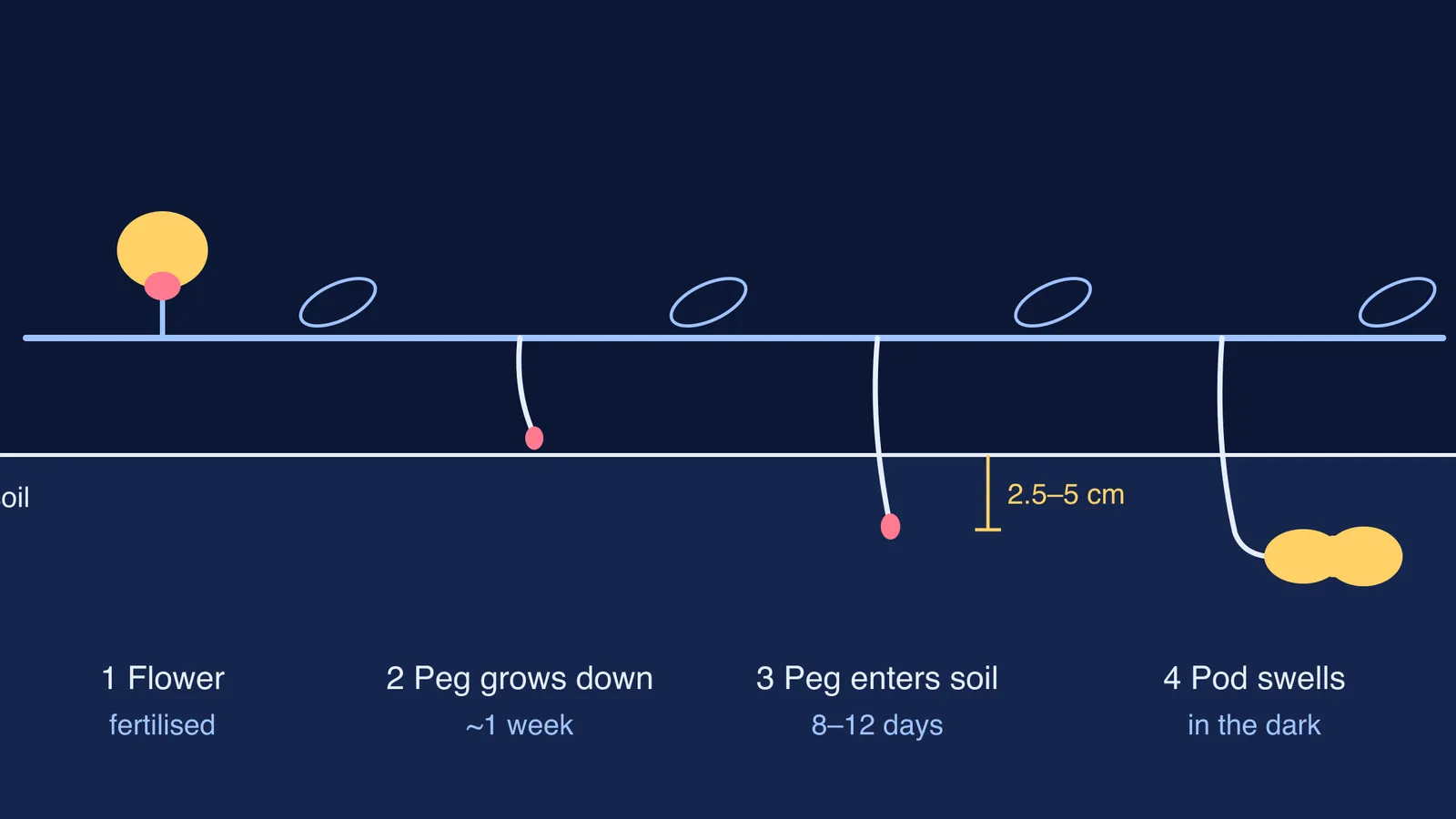
The peg, also called the gynophore, is a stalk that grows from the base of the fertilised ovary and carries it down to the soil. According to the same review, the peg forms after double fertilisation, when intercalary meristem cells at the base of the ovary start to divide and elongate (Kumar et al., 2019). Iowa State University's extension service puts it simply: the stalk below the fertilised ovary "elongates and curves downward" (Iowa State Extension).
The timing is quick. Clemson University's Home and Garden Information Center says the peg is first visible about one week after fertilisation (Clemson HGIC). The same factsheet says that about 8 to 12 days after pollination, the pegs enter the soil to a depth of 1 to 2 inches, which is roughly 2.5 to 5 cm.
How does the peg know which way is down?
The peg shows positive gravitropism: it grows towards gravity (Kumar et al., 2019). The review notes that once the tip has gone vertically into the soil, it turns to grow horizontally. This helps explain why a groundnut pod often lies sideways at the end of its stalk.
If gravitropism is still fuzzy, the classic way to test it is to cancel gravity's one-way pull, as in the klinostat experiment on geotropism.
Why do groundnut pods need to be underground?
Darkness and touch. The review states that sensing darkness and mechanical contact is essential for the peg to turn into a pod. Without these signals the embryo aborts, and the plant may form hard, green pods in the air instead (Kumar et al., 2019).
Calcium from the soil around the pod. University of Georgia Extension notes that once peanuts begin to peg, the peg and developing pod absorb calcium directly from the soil (UGA Extension). The same page advises gypsum at early bloom; lime's calcium is less soluble, so lime has to go on earlier.
Water. Clemson's factsheet says the fruit at the tip of the peg begins to enlarge soon after entering the soil "if water and calcium are present" (Clemson HGIC).
Once underground, the fruit takes time to fill. Iowa State Extension says the fruit matures in 9 to 10 weeks when temperature and moisture are favourable (Iowa State Extension).
Is a groundnut a nut, a seed or a fruit?
The groundnut shell is the pod, which develops from the ovary, and each "nut" inside is a seed; Clemson's factsheet describes "pods and seed" forming underground (Clemson HGIC). So in botany a groundnut is a legume pod, like a pea pod, rather than a true nut. If the line between seed and fruit still trips you up, read seed vs fruit with mango, pea and wheat.
How to write geocarpy in an exam answer
Use this four-step sequence, which matches the diagram at the top of this post:
The flower above the ground is fertilised.
Intercalary meristem at the base of the ovary grows into a stalk, the peg or gynophore.
The peg grows down (positive gravitropism) and pushes the ovary into the soil.
In darkness, the tip turns sideways and the ovary develops into a pod with seeds.
A model two-mark answer: "In groundnut, after fertilisation the stalk at the base of the ovary elongates into a peg (gynophore) that grows downwards and pushes the ovary into the soil, where it develops into a pod. This development of fruit below the ground is called geocarpy."
Watch for three traps:
Calling the pod a root or tuber. It comes from the ovary, so it is a fruit. A potato is a stem tuber; a groundnut is not.
Saying the flower is underground. The flower is in the air; only the fruit develops below.
Skipping "after fertilisation". The peg only forms after fertilisation, so leave that phrase in.
To check where gravitropism, legume fruits and plant families sit together, you can open each idea in the Fermi Concept Library, which covers every concept in biology with its own lesson and its place in the map. If you are practising past questions on plant morphology, the Fermi Problem Library has worked problems with a step-by-step solver that explains the reasoning rather than printing an answer.
Next time you shell a groundnut, look at the stalk end of the pod. That is where the peg was attached.


