

On this page
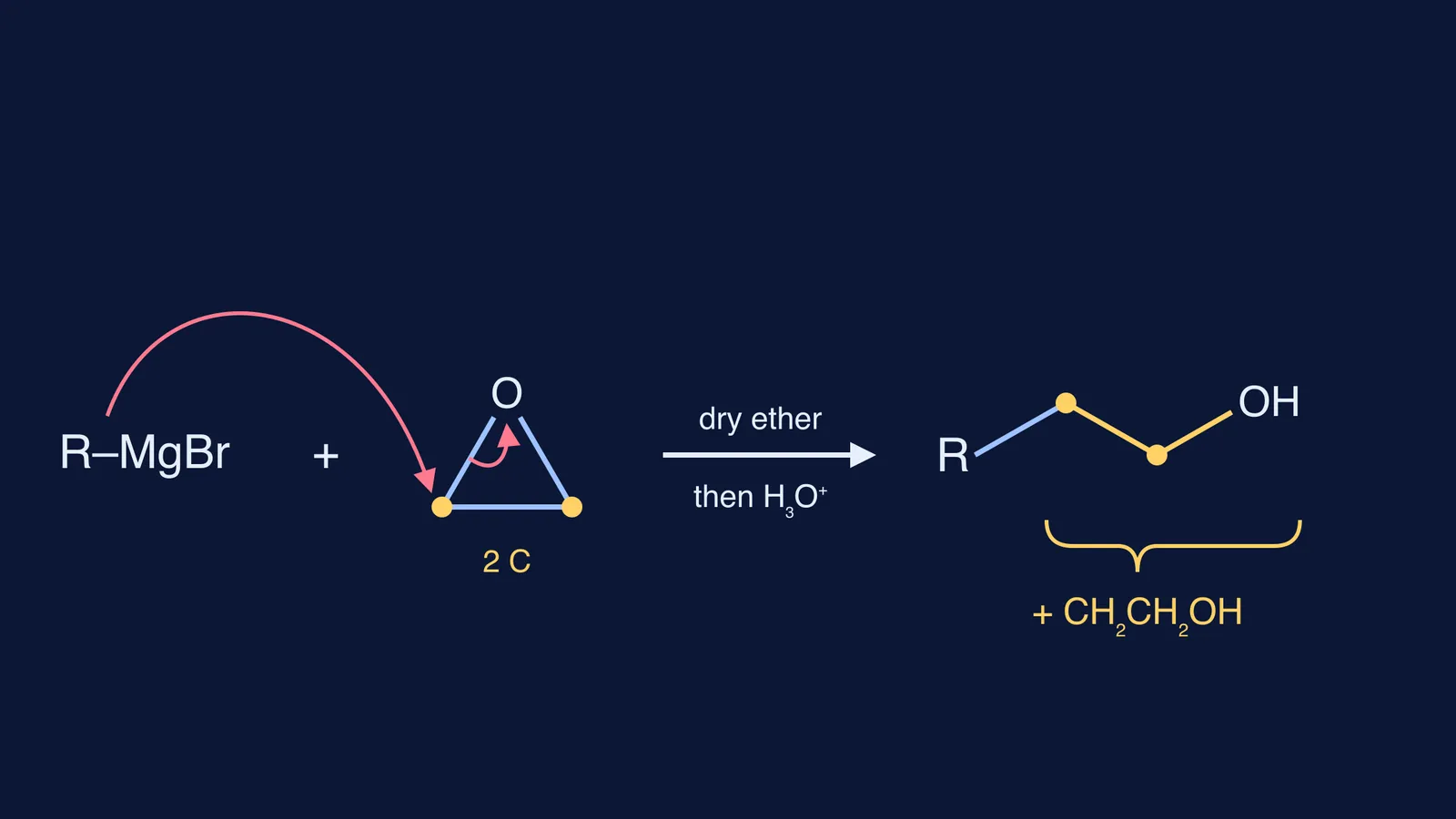
If a board or JEE Main question gives you R–MgX and ethylene oxide, the answer has the same shape every time: R–CH2CH2OH. The Grignard carbon bonds to one carbon of the three-membered ring, the ring opens, and acid work-up turns O–MgX into O–H. Here is why it happens, how to count the carbons without slipping, and the one variation that catches students out.
What does a Grignard reagent give with ethylene oxide?
It gives a primary alcohol with two more carbons than the Grignard reagent. The OpenStax organic chemistry text on LibreTexts says ethylene oxide is frequently used for this: it converts a Grignard reagent into a primary alcohol with two more carbons than the starting alkyl halide. Its own example converts 1-bromobutane, through its Grignard reagent, into hexan-1-ol (1-hexanol).
Write the general reaction as two steps:
R–MgBr + ethylene oxide, in dry ether, gives R–CH2CH2–O–MgBr.
Dilute acid (H3O+) then gives R–CH2CH2–OH.
Ethylene oxide (oxirane) is two CH2 groups and an oxygen joined in a triangle. Both carbons end up in your product, and the oxygen ends up as the OH at the far end. That is why the alcohol is always primary: the OH sits on a CH2 with only one carbon neighbour.
Why does the ring open at all?
Ethers are usually unreactive; the difference here is strain. The OpenStax text explains that, although an ether oxygen is normally a poor leaving group, the strain of the three-membered ring means epoxides can be opened by bases and nucleophiles, not just by acid.
The Grignard carbon behaves like a carbanion: electron-rich and strongly nucleophilic. The Wade organic chemistry text on LibreTexts treats the reaction as the same SN2 ring opening that epoxides undergo in basic conditions, because Grignard reagents are both strong nucleophiles and strong bases. So picture SN2: R attacks a ring carbon from the back, that carbon's C–O bond breaks, and the oxygen keeps the electron pair as an alkoxide until acid protonates it.
How do you count the carbons in the product?
Run this three-step check on every question:
Count the carbons in R, the group on magnesium. The halogen and Mg do not count.
Add 2.
Put the OH on the last carbon, then name the longest chain that contains it.
Worked examples:
CH3MgBr: 1 + 2 = 3 carbons, so CH3CH2CH2OH, propan-1-ol.
CH3CH2MgBr: 2 + 2 = 4 carbons, so butan-1-ol.
CH3CH2CH2CH2MgBr: 4 + 2 = 6 carbons, so hexan-1-ol, matching the textbook example above.
C6H5MgBr: phenyl plus two carbons gives C6H5CH2CH2OH, 2-phenylethanol. The benzene ring is a substituent, so the parent chain is the two-carbon ethanol.
It helps to set this beside the other Grignard routes to alcohols, which our guide to the main Grignard reagent reactions covers in more detail. The Morsch organic chemistry text on LibreTexts/17%3A_Alcohols_and_Phenols/17.05%3A_Alcohols_from_Carbonyl_Compounds_-_Grignard_Reagents) gives the pattern:
Formaldehyde gives a primary alcohol, adding one carbon.
Other aldehydes give secondary alcohols.
Ketones give tertiary alcohols.
Ethylene oxide gives a primary alcohol, adding two carbons.
What changes with a substituted epoxide?
Ethylene oxide is symmetric, so it does not matter which carbon R attacks. Propylene oxide (methyloxirane) is not. In base-catalysed SN2 opening, the nucleophile attacks the less hindered epoxide carbon, and the OpenStax text notes that a similar ring opening happens with Grignard reagents.
So CH3MgBr hits the CH2 end of propylene oxide, and the oxygen stays on the carbon that carries the methyl group. The product is CH3CH2CH(OH)CH3, butan-2-ol, a secondary alcohol. The two-carbon, primary-alcohol rule belongs to ethylene oxide only.
Where do students lose marks?
Adding the acid too early. Grignard reagents act as strong bases towards acidic protons such as O–H, and ether or THF is needed to form them (Morsch text on LibreTexts/17%3A_Alcohols_and_Phenols/17.05%3A_Alcohols_from_Carbonyl_Compounds_-_Grignard_Reagents)). If water or acid meets R–MgBr before the epoxide does, you get R–H, not an alcohol. Acid comes in step 2.
Writing a secondary alcohol for ethylene oxide. The OH can only land on the end CH2.
Losing count. Forgetting the two ring carbons, or counting Mg or Br as part of the chain.
Mixing up the one-carbon and two-carbon step-ups. If a question asks you to lengthen a chain by a single carbon, use a different route, such as those in our post on ascending a homologous series by one carbon.
To work backwards, cut the –CH2CH2OH off a target alcohol; what remains is R, made from R–Br. Our post on choosing the carbonyl partner in Grignard retrosynthesis uses the same idea for aldehydes and ketones.
If you get the carbon count right but keep slipping on the name or the mechanism, try a few conversions in the Fermi Problem Library, where a step-by-step solver explains the reasoning rather than printing an answer. To revise nucleophilic substitution or epoxides from the ground up, each idea has its own lesson in the Fermi Concept Library.


