

On this page
Anne Frank was given her diary for her thirteenth birthday, and the extract in NCERT First Flight, Chapter 4 covers two things: why she starts writing, and one funny story from school.
What happens in From the Diary of Anne Frank?
The NCERT chapter has three parts.
Why a diary. Anne says writing feels strange, because no one will be interested in "the musings of a thirteen-year-old schoolgirl". Then she remembers the saying "Paper has more patience than people." She has loving parents, a sixteen-year-old sister and about thirty people she calls friends, but with them she only talks about ordinary things. So she makes the diary her friend, Kitty.
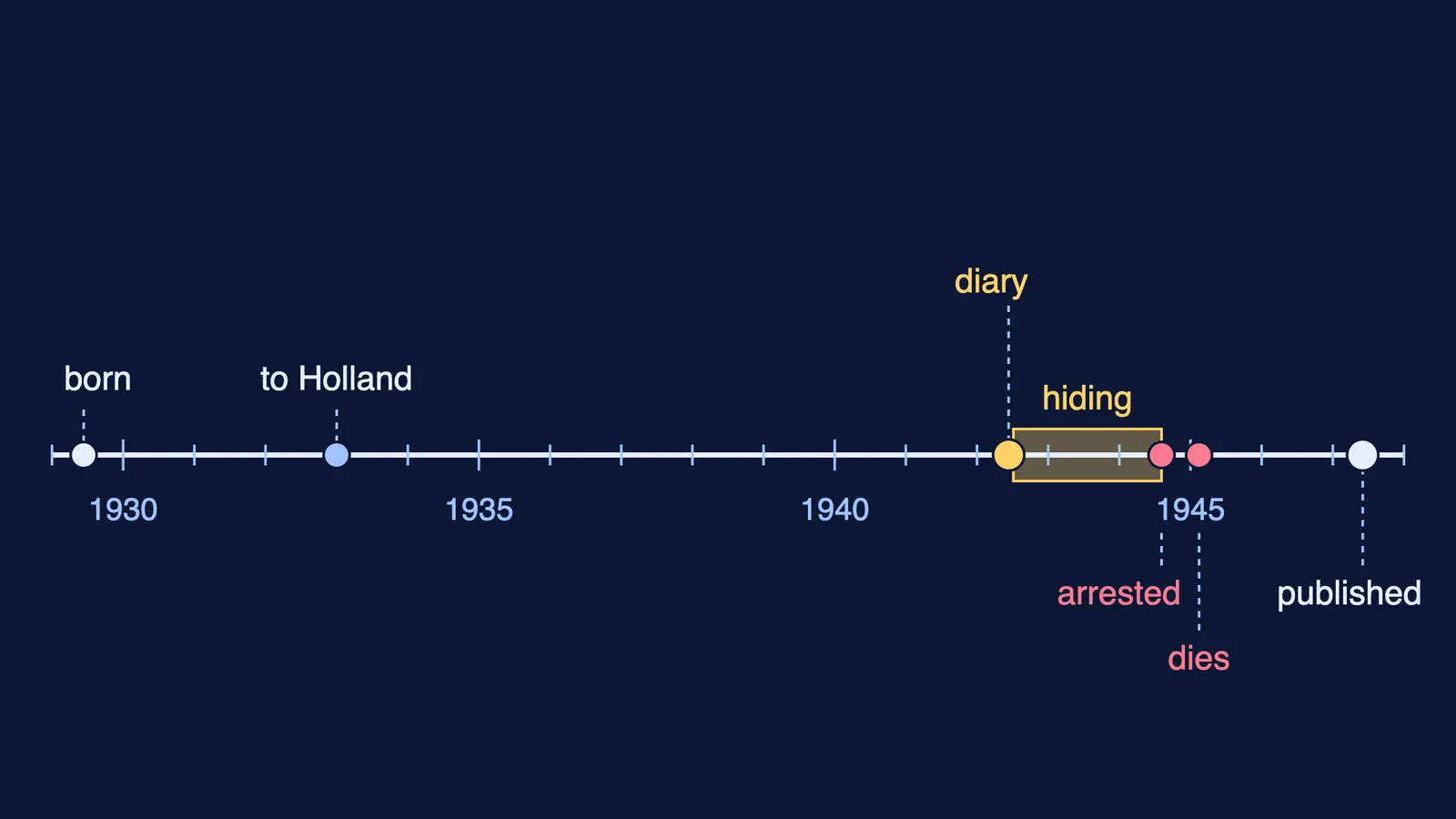
A sketch of her life. So Kitty can follow her stories, Anne sketches her background: born on 12 June 1929, she lived in Frankfurt until she was four, her father emigrated to Holland in 1933, she went to a Montessori nursery school, and her grandmother died in January 1942.
The chatterbox essays (Saturday, 20 June 1942). Annoyed by her talking, her maths teacher Mr Keesing sets an essay, "A Chatterbox". Anne writes three pages arguing that talking is a student's trait and that she inherited it from her mother. He laughs, then sets "An Incorrigible Chatterbox", and finally "Quack, Quack, Quack, Said Mistress Chatterbox". With help from her friend Sanne, Anne writes the third one as a poem about a mother duck, a father swan and three ducklings. Mr Keesing reads it to the class and to several other classes, and from then on he lets her talk.
The Anne Frank House records that the family went into hiding in July 1942 in the annex at Prinsengracht 263, Amsterdam, were arrested on 4 August 1944, and that Anne died in Bergen-Belsen in February 1945.
Why does Anne call her diary Kitty?
The NCERT text gives three reasons: she has no true friend she can confide in, paper is patient, and she wants "the diary to be my friend" rather than a place to jot down facts. The name itself came from Kitty Francken, a character in the Joop ter Heul books by Cissy van Marxveldt, according to the Anne Frank House.
A model answer in about 40 words: Anne had a family and many friends but no one she could share her real feelings with. Believing paper has more patience than people, she wanted the diary to be a friend, not a record of facts, so she gave it a name, Kitty.
What are the themes of the chapter?
Loneliness in a crowd. Anne seems to have everything "except my one true friend".
Honesty. She is honest even about herself: "Maybe it's my fault that we don't confide in each other."
Wit over punishment. She turns three punishments into arguments and a poem, and makes sure "the joke was on him".
Teachers are people too. Mr Keesing moves from irritation to laughter, which fits Anne's line that teachers are "the most unpredictable creatures on earth".
Character sketches: Anne and Mr Keesing
Anne is candid, witty and self-aware. She admits she might be to blame for her shallow friendships, mocks the "dummies" in her class, and remembers her grandmother lovingly.
Mr Keesing is strict but fair. He warns Anne several times before setting extra work, laughs at her first argument, and takes her poem the right way.
Which exam questions come from this chapter?
The "Thinking about the Text" questions in the NCERT chapter are your practice set. Answer each with Point, Proof, Person: make the point, quote one line, then say what it shows about Anne.
Was Anne right that the world would not be interested in a thirteen-year-old's musings? Point: no. Proof: the Anne Frank House says the diary has been translated into more than 75 languages. Person: she underrated her own voice.
Why does Anne give a brief sketch of her family? Point: Kitty is a new friend. Proof: no one would understand her stories if she plunged right in. Person: she wants Kitty to know her properly.
How did Anne justify being a chatterbox? Point: talking is a student's trait. Proof: her mother talks as much as she does, and inherited traits can't be helped. Person: clever and cheeky.
Is Mr Keesing unpredictable? Point: yes. Proof: he punishes her three times, then lets her talk and is always making jokes. Person: Anne's wit changed his mind.
See also how to check an AI summary of an English chapter against the pages, our diary entry format guide with a sample and the guide to case-based questions in CBSE board exams.
If English revision is squeezing your science and maths time, Fermi's AI tutor can work out what you already know and build a plan for the session, so you sit down to a clear next step.
Tonight, read the chapter once, then write the four answers above in your own words.


