

On this page
In classical physics, an accelerating charge must radiate electromagnetic energy continuously. If an electron revolves in a circle, it should emit light at the exact same frequency as its orbit. But if atoms behaved this way, electrons would spiral into the nucleus within a fraction of a second, and matter as we know it could not exist.
Niels Bohr solved this stability problem in 1913 by proposing that electrons exist in special "stationary" orbits where they do not radiate. Instead, they only emit or absorb light when they jump from one energy level to another. This brilliant insight saved the atom, but it created a jarring contradiction: the frequency of the emitted photon has nothing to do with how fast the electron was spinning.
Why does the Bohr electron frequency differ from emitted light?
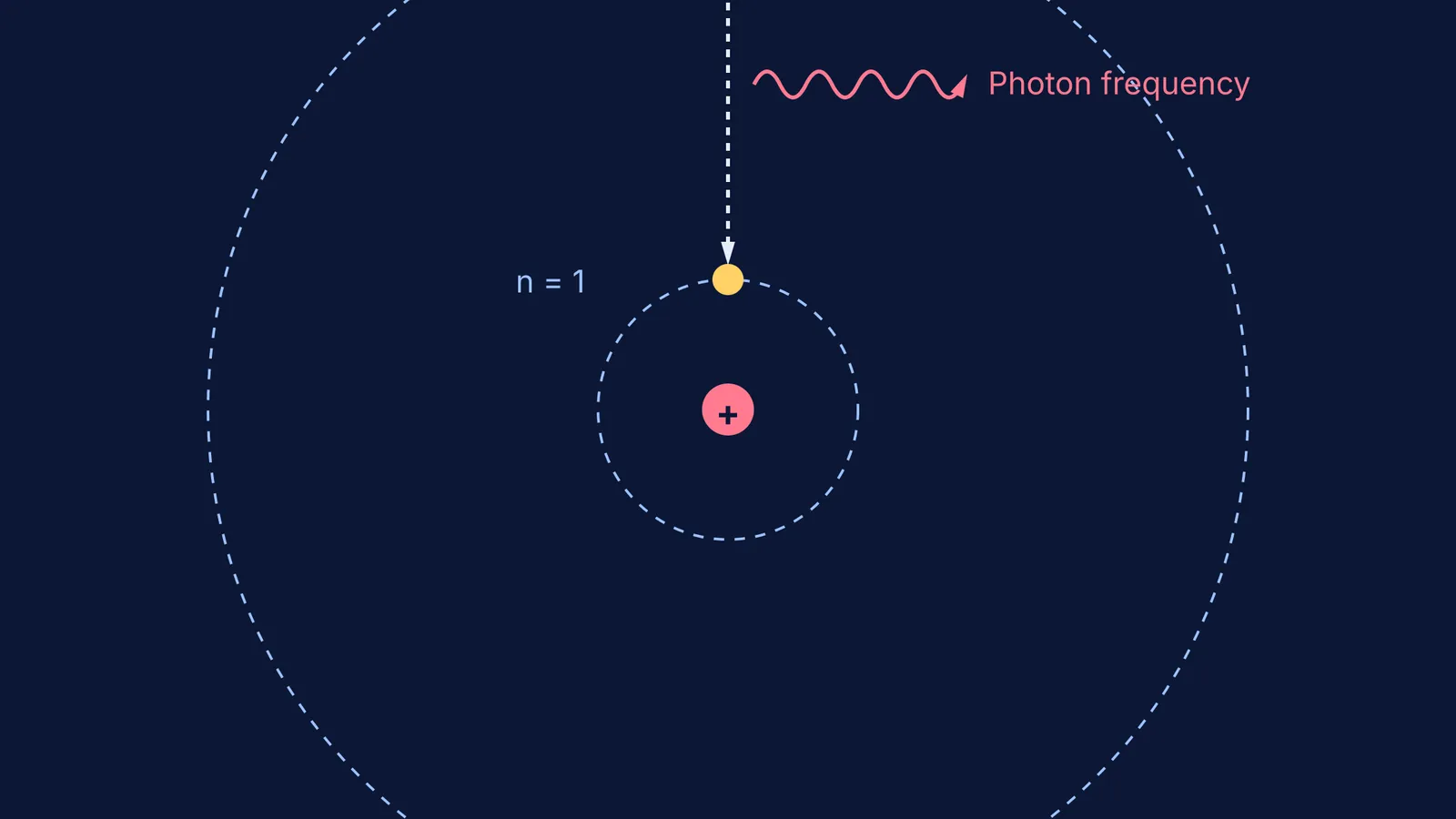
For small quantum numbers (such as n = 1 or n = 2), the orbital frequency of the electron and the frequency of the emitted photon are completely disconnected. The atomic world at this scale is strictly quantized, meaning it operates in steps rather than smooth gradients.
Orbital frequency: An electron's speed decreases and its orbital radius increases dramatically as it moves to higher, outer energy levels. Because it has further to travel and moves more slowly, the orbital frequency (f_orb) drops rapidly. Mathematically, it is proportional to 1/n³.
Emission frequency: The photon's frequency is not driven by the electron's physical spin. It depends entirely on the energy difference between the starting and ending orbits, calculated using Max Planck's famous equation E = hf.
When an electron jumps from n = 2 to n = 1 in a hydrogen atom, the energy levels are widely spaced. The emitted light (which you can test in a Bohr model simulation) has a single frequency that is neither the electron's orbital frequency at n = 2 nor its frequency at n = 1. It is a discrete "quantum jump", not a continuous wave generated by the electron's circular motion. Classical mechanics simply breaks down when dealing with these deep, tightly bound orbits.
If you struggle to picture how these energy gaps shrink at higher levels, the Fermi Concept Library has every concept in physics, chemistry, biology, mathematics and computing, each with its own lesson and its place in the map.
What is the correspondence principle?
While Bohr recognized that classical physics failed deep inside the atom, he also knew it worked perfectly in the macroscopic world. Therefore, he realized that his new quantum rules could not contradict classical physics everywhere. For very large systems, quantum mechanics must reproduce the results of classical physics. This fundamental requirement is known as the correspondence principle.
As the principal quantum number n becomes very large (for example, n = 10,000), the atom swells to a microscopic size. In these outer reaches, the allowed energy levels get closer and closer together, and the energy spectrum becomes nearly continuous rather than stepped.
A jump from an orbit n to the adjacent orbit n-1 represents a tiny, almost imperceptible fractional change in the electron's total energy. In this "classical limit", the discrete quantum jump mimics continuous classical radiation. An observer looking at this highly excited atom would see the electron radiating at a frequency that matches its orbital motion, just as James Clerk Maxwell's classical electrodynamics predicted.
How to prove they converge for large orbits?
We can prove this convergence mathematically by comparing the energy formulas for the hydrogen atom at very large quantum numbers.
First, let us look at the emitted photon. The energy of an electron in orbit n is proportional to -1/n². When it jumps to the next lower orbit (n-1), the energy of the emitted photon is proportional to the difference between these two states:
Difference = 1/(n-1)² - 1/n²
If we cross-multiply and expand this expression, we get (2n - 1) / (n²(n-1)²). For a very large n, we can safely approximate (n-1) as just n, and 2n - 1 as 2n. The complex formula simplifies beautifully to:
Difference ≈ 2n / n⁴ = 2/n³
Now, let us examine the orbital frequency of the electron. Orbital frequency depends on the electron's velocity and the radius of its orbit. According to Bohr's postulates, velocity is proportional to 1/n, and the orbital radius is proportional to n². Since frequency is velocity divided by circumference (v / 2πr), the orbital frequency is proportional to:
(1/n) / n² = 1/n³
The result is perfectly consistent. Both the emission frequency and the orbital frequency scale exactly as 1/n³ for large orbits. As n approaches infinity, the gap between the two completely disappears. The frequency of the emitted photon converges to the orbital frequency of the electron, proving that the correspondence principle holds true.
Whether you are deriving atomic formulas or trying to understand why 2s and 2p have the same energy in hydrogen, Fermi's AI tutor can work out what you already know and build a plan for the session, so you sit down to a clear next step.


