On this page
Many Class 8 questions on force ask you to look at an everyday scene, name the push or pull, and say what it changed. Here is one example for each effect, a three-step answer method and a short practice set.
What are the effects of force on objects in Class 8?
NCERT's Class 8 science textbook, *Curiosity*, covers this in Chapter 5, Exploring Forces. It defines a force as a push or pull on an object that comes from the object's interaction with another object. The SI unit of force is the newton, written N.
The same chapter lists what a force can do. A force applied on an object may:
make an object move from rest
change the speed of an object if it is moving
change the direction of motion of an object
bring about a change in the shape of an object
cause some or all of these effects
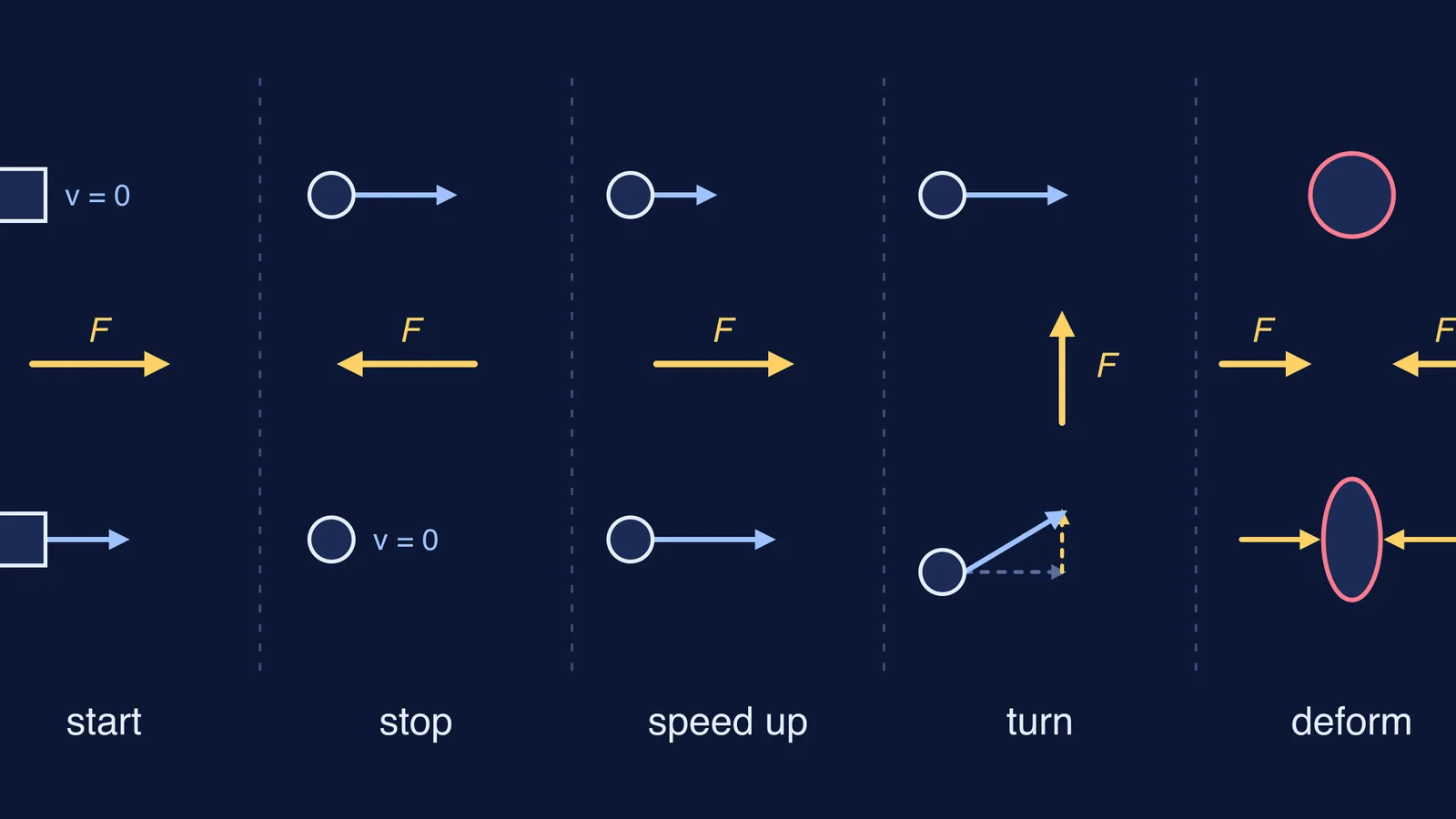
Stopping is a change in speed down to zero. NCERT's own table gives "stopping or decreasing the speed of the bicycle" as one effect. So you can remember five effects: start, stop, speed up, turn and deform.
What is one example of each effect of force?
Each example below names the object, the push or pull, and what changed. Most come from the everyday situations listed in the NCERT chapter.
Start (move from rest): you pull a closed drawer and it slides open. The drawer was at rest, and your pull set it moving.
Stop (speed falls to zero): a friend holds your moving bicycle from behind until it stops. The pull acts against the motion.
Speed up (speed rises): you kick a football that is already rolling, along the direction it is moving. The push makes it go faster.
Turn (direction changes): a batter hits a moving ball. The push from the bat sends the ball off in a new direction.
Deform (shape changes): you press an inflated balloon, stretch a rubber band or roll a chapati. The push or pull changes the shape.
Notice the difference within the last example. The rubber band goes back to its shape when you let go, but the rolled chapati stays flat. Both count as a change in shape.
Can one force do more than one thing at once?
Yes. The NCERT list ends with "some or all of these effects", so a question may ask for more than one. When a fielder stops a ball, its speed falls to zero. A bat hitting a moving ball changes its direction and usually its speed too.
If a question asks for all the effects, check speed, direction and shape, and give one line for each that changed.
How do you write an effects-of-force answer that scores?
Use the same three steps for every scene, whether it is a one-mark question or a short answer.
Name the object and the force. "The bat pushes the ball."
Say what it was doing before. "The ball was moving towards the batter."
Say what changed. "The push changed its direction of motion, and its speed."
Try it on a harder scene: an autorickshaw driver turns the steering handle. Force: a push and pull from the driver's hands. Before: moving straight. Change: direction of motion.
Practise with these five. Cover the answers, then check.
A goalkeeper catches a fast ball: stop (and some change of shape in the ball).
You squeeze a lump of dough: change of shape.
A cyclist pedals harder on a flat road: speed up.
You push a cardboard box that was resting on the floor: start.
A footballer heads a ball towards the goal: change of direction.
How does F = ma explain the effects of force?
In higher classes, one rule ties these effects together. Newton's second law, as OpenStax College Physics states it, is net force = mass × acceleration (F = ma). Acceleration means any change in velocity, so start, stop, speed up and turn are all forms of acceleration. OpenStax defines one newton as the force needed to accelerate a 1 kg mass at 1 m/s².
A quick worked example using that formula: a net push of 4 N on a 2 kg trolley gives an acceleration of 4 ÷ 2 = 2 m/s², in the direction of the push. Double the push and the acceleration doubles.
To go further, read our guide to inertia of rest, motion and direction, which explains why objects resist these changes. Our post on contact and non-contact forces in Class 8 covers the types of force, and our overview of the new NCERT Class 8 books shows where this chapter fits in the year.
When a definition still feels shaky, the Fermi Concept Library gives every physics concept its own lesson and shows where it sits on the map. If turning or squashing is hard to picture, the Fermi Simulation Lab has interactive simulations for ideas that are easier to see than to read.