

On this page
Fischer projections are a standard way to draw 3D molecules on a 2D page, especially for carbohydrates and amino acids. But knowing which bonds point towards you and which point away can be confusing.
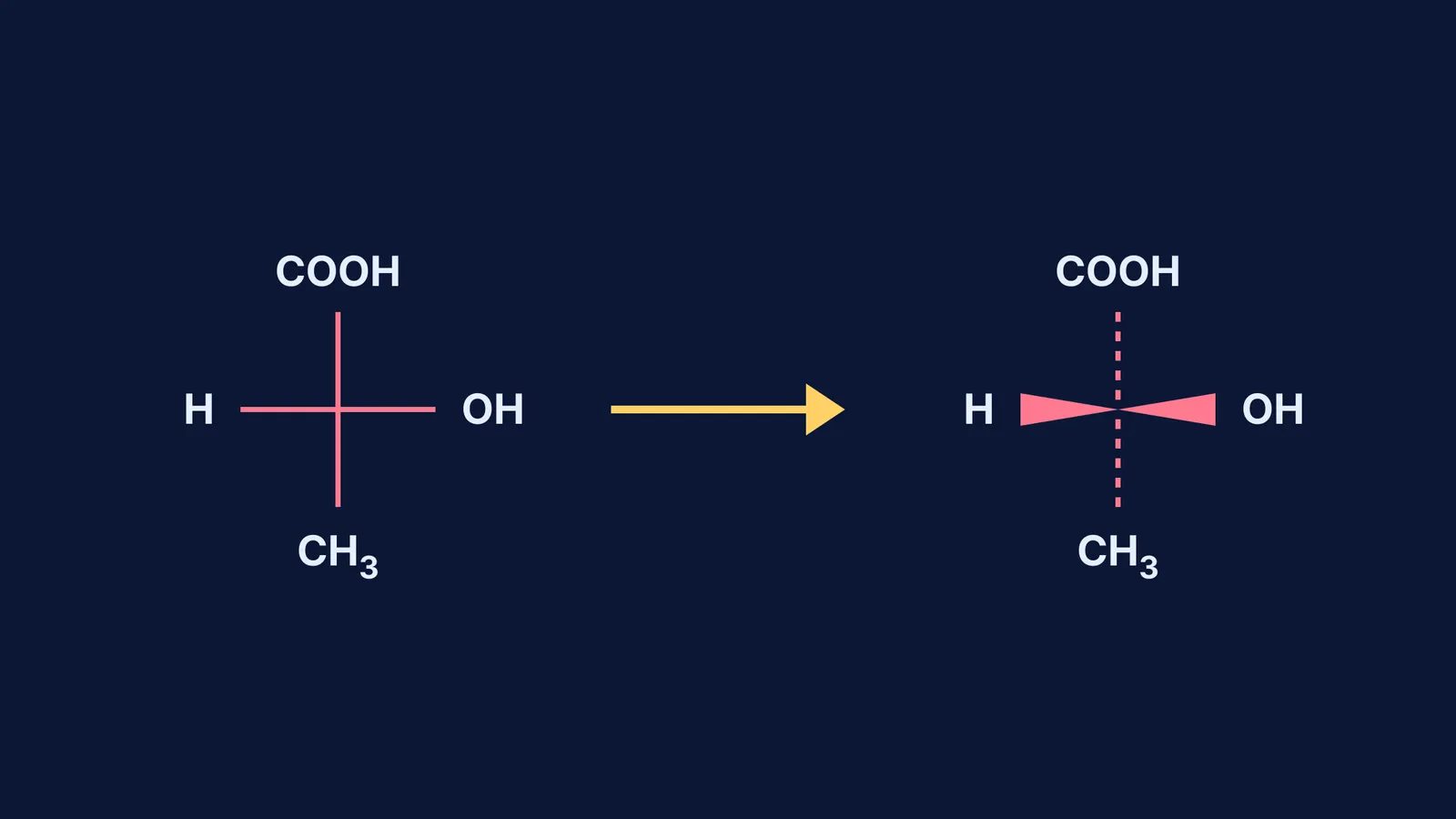
According to the IUPAC Gold Book, a Fischer projection means the horizontal bonds point toward you (like wedges) and the vertical bonds point away from you (like dashes). A 2010 study published in *Spatial Cognition & Computation* found that chemistry experts rely on simple rules like these rather than mentally rotating the molecules, making their conversions faster and more accurate.
Here is exactly how to translate a Fischer projection into a wedge-dash diagram, and the foolproof way to check that you kept the configuration.
What is the rule for Fischer projections?
When you look at a Fischer projection cross, the carbon atom sits at the centre. The rule for the bonds is:
Horizontal bonds come out of the page towards you.
Vertical bonds go into the page away from you.
A common mnemonic is the "hug": the horizontal bonds are arms reaching out to hug you, while the vertical bonds are the body leaning away.
How do you convert a Fischer projection to a wedge-dash diagram?
Converting the molecule is a direct substitution using the rule above.
Draw the chiral centre. Start by drawing a central carbon atom (or just the intersection point).
Assign the horizontal groups to wedges. Look at the groups on the left and right of the Fischer projection. Draw them on solid wedges to show they are coming towards you.
Assign the vertical groups to dashes. Look at the groups on the top and bottom. Draw them on dashed lines to show they are pointing away.
If you need to draw the molecule as a standard zig-zag chain, you can take this 3D cross and gently "flatten" it into the plane of the page. This often means rotating the molecule so that two bonds are in the plane (straight lines), one is wedged, and one is dashed.
How do I check if I kept the configuration?
The best way to ensure you have not accidentally drawn the mirror image (enantiomer) during the conversion is to check the R/S configuration of both diagrams. If the Fischer projection is *R*, your wedge-dash drawing must also be *R*. Checking the configuration is especially useful when tracking whether a reaction caused inversion or racemisation, which you can read about in our guide to SN1 and SN2 stereochemistry.
To find the configuration on a Fischer projection:
Assign priority (1 to 4) to the four groups based on atomic number.
Check where the lowest priority group (4) is.
If group 4 is vertical: Trace the path from 1 to 2 to 3. Clockwise is *R* and counter-clockwise is *S*.
If group 4 is horizontal: Trace the path from 1 to 2 to 3, but reverse your result. Clockwise becomes *S* and counter-clockwise becomes *R*.
Once you have your wedge-dash drawing, check its configuration. If the lowest priority group is on a dash, the 1-2-3 path gives the configuration directly. If it is on a wedge, reverse it. If the letters match, your conversion is correct.
If you are unsure where to start with priority rules, the Fermi Concept Library explains the Cahn-Ingold-Prelog priority system step by step. When you get stuck on a specific conversion, or need help with asking AI the 'why' behind named organic reactions, you can put the structure into the Fermi Problem Library. The AI tutor will walk you through assigning priorities and applying the rules. It checks understanding as it goes and explains the reasoning rather than printing an answer.


