

On this page
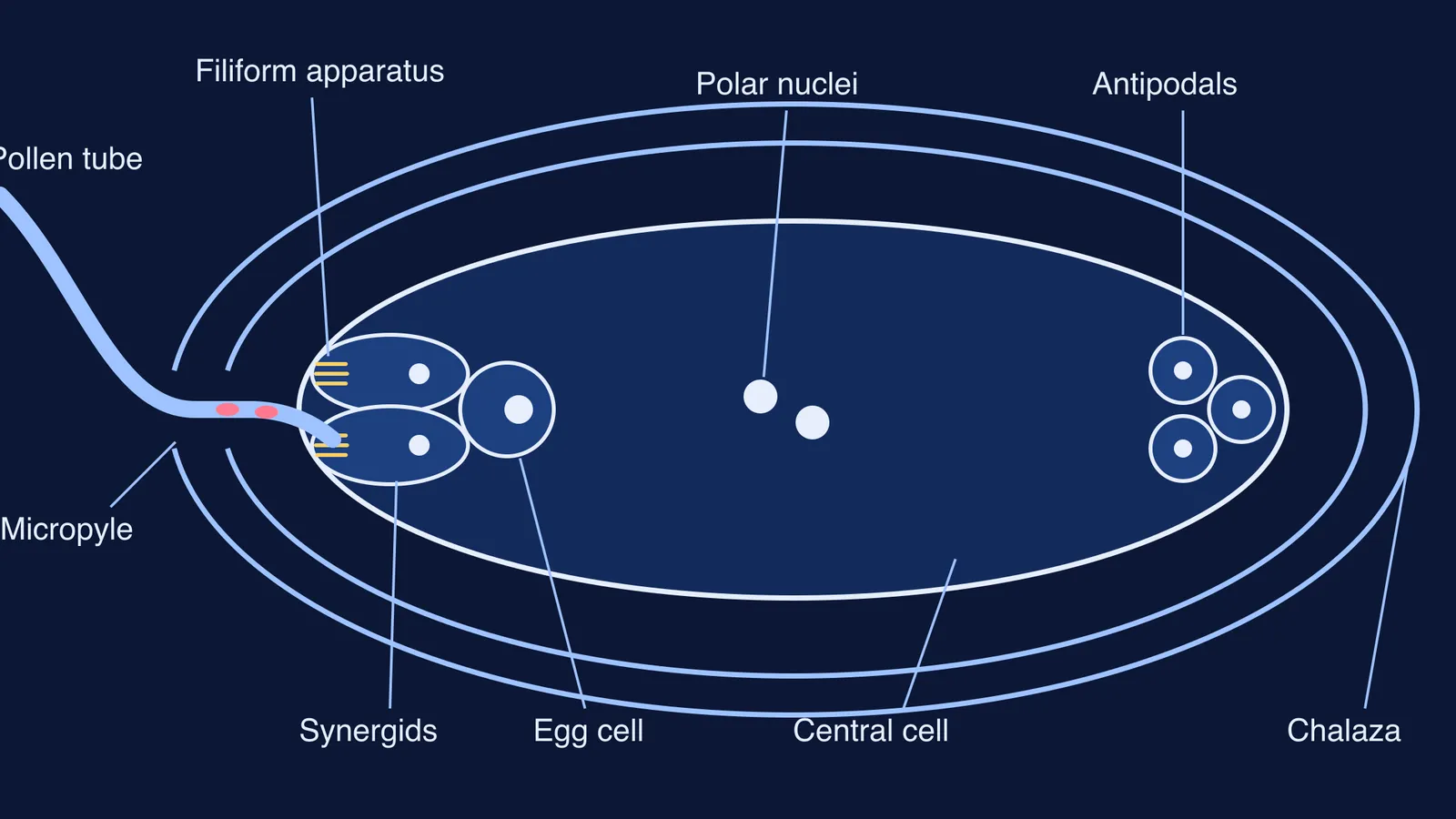
You have probably drawn the embryo sac many times. The two cells at its micropylar end, the synergids, often get one line in revision notes. Yet in the last stretch of the pollen tube's journey, they and their filiform apparatus do most of the work. Here is the route, step by step, and what happens to each synergid.
What are the filiform apparatus and synergids?
NCERT's Class 12 Biology textbook describes the egg apparatus as three cells at the micropylar end of the embryo sac: two synergids and one egg cell (NCERT Biology, Chapter 1).
The filiform apparatus is a set of special cellular thickenings at the micropylar tip of the synergids that guides pollen tubes into the synergid (NCERT).
A typical angiosperm embryo sac at maturity is 8-nucleate but 7-celled: the egg apparatus, three antipodals at the chalazal end, and a large central cell holding two polar nuclei (NCERT). For how those nuclei arise, see our explainer on how the 7-celled, 8-nucleate embryo sac forms.
How does the pollen tube travel from micropyle to egg?
NCERT gives the route in this order (NCERT, sections 1.2 and 1.3):
The pollen tube grows through the stigma and style and reaches the ovary.
It enters the ovule through the micropyle.
It enters one synergid through the filiform apparatus.
It releases its two male gametes into that synergid's cytoplasm.
One male gamete fuses with the egg nucleus (syngamy), forming a diploid zygote.
The other fuses with the two polar nuclei (triple fusion), forming the triploid primary endosperm nucleus.
Together, syngamy and triple fusion are double fertilisation.
What is the role of synergids in fertilisation?
Research fills in what NCERT says in one line. Synergids attract the tube, receive it, and give way so the gametes can get out.
Attract. Using laser cell ablation, Tetsuya Higashiyama and colleagues showed that the two synergids beside the egg attract the pollen tube; one synergid was enough to send the signal, and two made it stronger (Science, 2001).
Signal. The same group later identified LUREs, defensin-like polypeptides secreted by the synergids of Torenia fournieri; knocking them down with antisense molecules impaired pollen tube attraction (Nature, 2009).
Receive. In Arabidopsis, a receptor-like kinase called FERONIA builds up in the synergid membrane at the filiform apparatus; in feronia mutants the tube fails to stop and keeps growing inside the embryo sac (Science, 2007).
Release. The synergid that takes in the tube, the receptive synergid, degenerates. An Arabidopsis study found that pollen tubes that burst always discharged into a degenerated synergid, and its data support the idea that contact with the tube, or signals it secretes, starts the degeneration (Plant Physiology, 2015).
What happens to the other synergid after fertilisation?
The second, persistent synergid could in principle keep calling more tubes. Higashiyama's 2001 study found that after fertilisation the embryo sac stops attracting pollen tubes even though one synergid persists, and suggested this may help block polyspermy (Science, 2001).
A 2015 Arabidopsis study showed how: the persistent synergid fuses with the endosperm, which rapidly dilutes the pollen tube attractant already made in it and prevents extra tubes from being attracted (Cell, 2015). Fertilisation of the central cell triggers this fusion, while fertilisation of the egg mainly switches on ethylene signalling, which helps disorganise the synergid's nucleus.
That is why NCERT's figure of a fertilised embryo sac labels the synergids as degenerating (NCERT, Figure 1.13). The discovery of the two sperm cells has its own story: Sergei Nawaschin and the two sperm cells of the lily.
How do you write this answer in a board exam or NEET?
Questions usually ask for the role of the filiform apparatus, the fate of the synergids, or a labelled embryo sac. This three-sentence frame covers the keywords:
Define: the filiform apparatus is the set of cellular thickenings at the micropylar tip of the synergids.
Route: the pollen tube enters the ovule through the micropyle, enters one synergid through the filiform apparatus and releases two male gametes there.
Fate: the receptive synergid degenerates when the tube discharges into it; the persistent synergid degenerates after fertilisation.
Before you hand in a diagram, check it against the one at the top of this page:
Synergids at the micropylar end, with the filiform apparatus at their micropylar tip.
The egg cell beside the synergids, slightly towards the centre.
Two polar nuclei inside one central cell, not two separate cells.
Three antipodals at the chalazal end, and the pollen tube ending in a synergid, not the egg.
If these structures blur together, the Fermi Concept Library has a lesson for every concept in biology, each with its place in the map, so you can see how the embryo sac links to pollination and double fertilisation. For practice, the Fermi Problem Library works through problems step by step and explains the reasoning rather than printing an answer.
Next time you draw the embryo sac, trace the tube's path with your pencil before you label anything.


