

On this page
When treating industrial waste, some chemicals simply refuse to break down. Standard biological treatment relies on bacteria, but toxic compounds like pesticides or industrial solvents will kill the bacteria instead of feeding them. This is where advanced oxidation processes step in.
Fenton's reagent is one of the oldest and most effective tools for this job. Developed in the 1890s by Henry John Horstman Fenton as an analytical tool, it is a simple mixture of hydrogen peroxide (H₂O₂) and an iron(II) catalyst, usually iron(II) sulfate 1. Despite its age, it remains a cornerstone of modern environmental engineering.
What makes Fenton's reagent so reactive?
The reagent's reactivity comes from the hydroxyl radical (OH•). While hydrogen peroxide is an oxidiser on its own, adding iron triggers a catalytic cycle that creates free radicals—molecules with unpaired electrons that aggressively steal electrons from anything nearby.
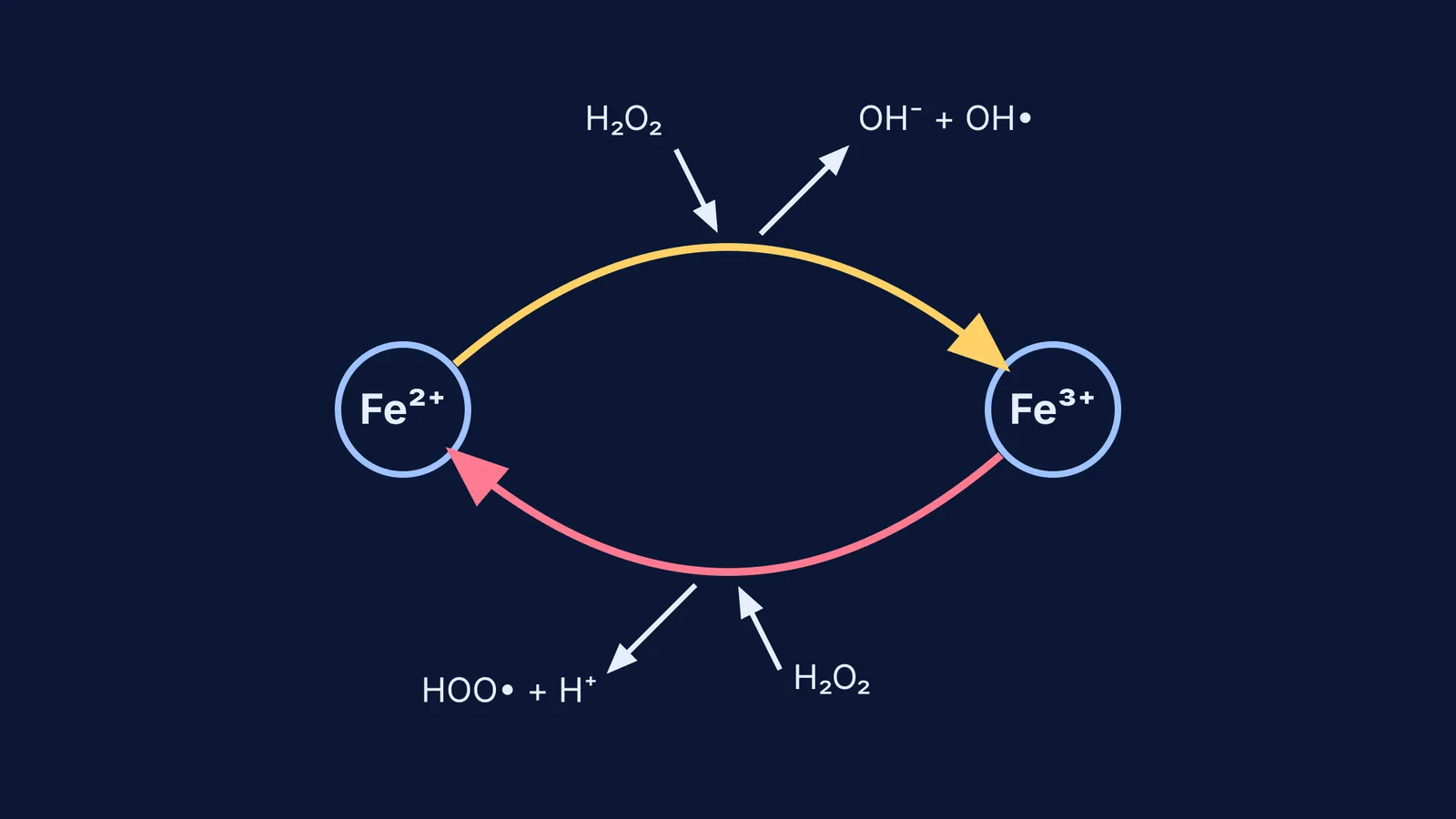
The core mechanism, first proposed by Haber and Weiss in the 1930s, happens in two main steps:
Initiation: Iron(II) reacts with hydrogen peroxide. The iron gives up an electron to become iron(III), splitting the peroxide molecule into a hydroxide ion (OH⁻) and a hydroxyl radical (OH•).
Regeneration: To keep the cycle going, the iron(III) must be reduced back to iron(II). It does this by reacting with another molecule of hydrogen peroxide, this time creating a hydroperoxyl radical (HOO•) and a hydrogen ion (H⁺).
The net result is a continuous disproportionation of hydrogen peroxide into highly reactive oxygen radicals. The hydroxyl radical is non-selective, meaning it will attack almost any organic bond it encounters, driving the oxidation of contaminants all the way to carbon dioxide and water.
How does pH affect the hydroxyl radical?
Fenton's reagent is notoriously sensitive to pH. The reaction must be run in a highly controlled, acidic environment because the chemistry collapses if the solution becomes too basic or too acidic.
If the pH climbs too high, the iron(III) formed in the first step precipitates out of the solution as solid iron(III) hydroxide. At near-neutral pH, Fe³⁺ is about 100 times less soluble than Fe²⁺, meaning the catalyst simply drops out of the liquid and the cycle stops 1. Conversely, if the pH drops too low, the excess hydrogen ions act as scavengers, reacting with the hydroxyl radicals before they have a chance to attack the pollutants.
How is Fenton's reagent used in wastewater treatment?
In wastewater management, Fenton's reagent is classed as an advanced oxidation process. It is deployed against refractory organics—compounds like trichloroethylene and tetrachloroethylene that resist standard bacterial digestion.
The process often serves as a pre-treatment. By unleashing hydroxyl radicals, the reagent breaks large, toxic molecules into smaller, less harmful fragments. These smaller fragments are then sent to a conventional biological treatment plant where bacteria can safely consume them. As a secondary benefit, when the treatment is finished and the pH is neutralised, the iron precipitates out as a dense sludge. This sludge acts as a coagulant, sweeping up suspended solids and heavy metals as it settles to the bottom of the tank.
Can it be used in organic synthesis?
Beyond destroying waste, chemists use the controlled generation of radicals for synthesis. Fenton's reagent is used to hydroxylate arenes, driving radical substitution reactions. For example, it is a classic method for converting benzene into phenol, and it can oxidise barbituric acid into alloxan.
If you are studying chemical kinetics or environmental chemistry, tracking these mechanisms and radical pathways can be tricky. You can explore redox cycles in the Fermi Concept Library, where Fermi's AI tutor works out what you already know and builds a plan for the session, guiding you through the reaction steps.
For more on how oxidation shapes our world, see how it applies to Corrosion and rancidity: everyday oxidation in Class 10 science. If you are looking at the biological side of water purification, read up on Sewage treatment and BOD: the stages and the numbers behind them. You can also brush up on assigning states in Oxidation numbers from structure: Fe3O4, S4O6²⁻ and CrO5.


