

On this page
You learn the ground state first: fill orbitals from the lowest energy upwards. Exam questions then flip it around and ask whether a configuration is ground, excited or impossible.
What is an excited state electron configuration?
The ground state is "the lowest energy, or ground-state, electron configuration" of an atom, in the words of OpenStax Chemistry 2e.
An excited state is any state of the atom with more energy than the ground state, as the Wikipedia entry on excited states defines it. The same entry notes that excited states are usually short-lived: the atom soon gives the energy back, often as a photon, and drops to a lower state.
For configurations, that means at least one electron sits in a higher orbital while a lower one still has room. The electron count stays the same; only an electron's address changes.
How do you write one, step by step?
Write the ground state from the atomic number. Nitrogen (Z = 7): 1s² 2s² 2p³.
Pick an electron in an occupied orbital and move it to a higher one. Move one 2s electron to 2p: 1s² 2s¹ 2p⁴.
Count again. 2 + 1 + 4 = 7. Same atom, same electron count.
Check the new address is legal (next section).
How do you spot excited versus impossible configurations in MCQs?
Run three checks, in this order. Each rule below is from OpenStax Chemistry 2e, section 6.3 and section 6.4.
Does the subshell exist? For a shell n, the azimuthal quantum number l can only be 0, 1, 2 ... up to n − 1. So 1p, 2d and 3f do not exist, and any option that uses them is impossible.
Is any subshell overfilled? An s subshell holds at most 2 electrons, p holds 6, d holds 10 and f holds 14. Write 2p⁷ and the option is impossible.
Does any orbital hold more than two electrons? Following the Pauli exclusion principle, no more than two electrons can share an orbital, and two that do must have opposite spins. Three arrows in one box is impossible.
If an option passes all three and still differs from the ground state, it is excited. Count the electrons too: if the total does not match the atomic number, you are looking at an ion or a different element.
OpenStax states Hund's rule this way: "the lowest-energy configuration" for electrons in a set of degenerate orbitals is the one with the most unpaired electrons. To practise, our guide on counting unpaired electrons with Hund's rule walks through it.
Worked example: ground, excited or impossible?
1s² 2s² 2p⁶ 3s¹: 11 electrons, filled in order. Ground state sodium.
1s² 2s¹ 2p¹: 4 electrons, so beryllium, with one 2s electron moved up to 2p. Excited.
1s² 2s² 2p⁷: p cannot hold 7. Impossible.
1s² 2d¹: n = 2 allows only l = 0 and 1, so there is no 2d. Impossible.
1s² 2s² 3s¹: 5 electrons (boron) with the fifth electron in 3s, while 2p is empty. Excited.
The subshell check is the same logic examiners use in "which set of quantum numbers is not possible" questions; our post on spotting impossible sets of quantum numbers covers that version. If you keep tripping on the same option type, the Fermi Problem Library has worked problems with a step-by-step solver that explains the reasoning rather than printing an answer.
Why does an excited state explain hybridisation?
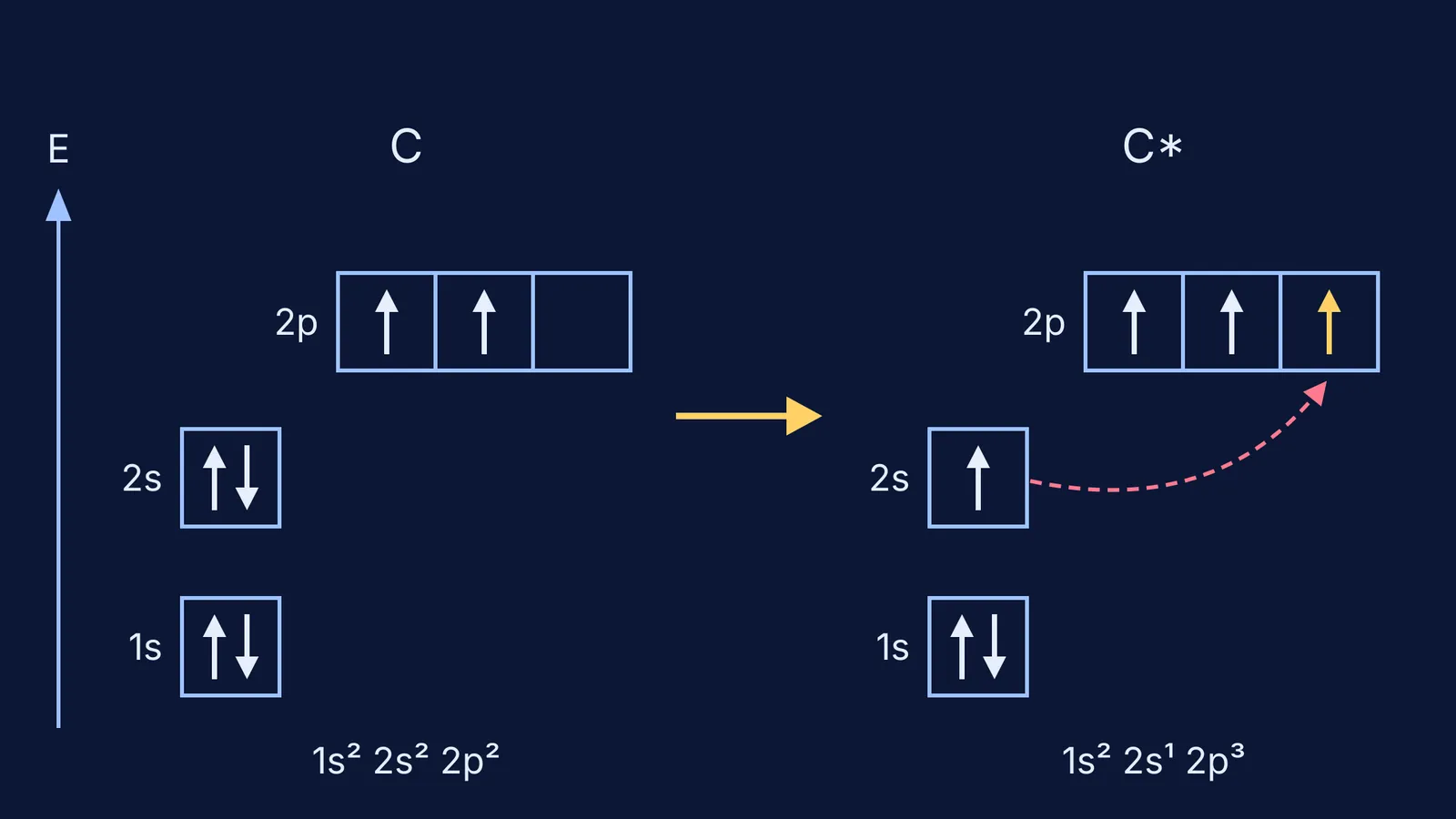
Carbon's ground state, 1s² 2s² 2p², leaves only two unpaired electrons, yet carbon forms four bonds in methane. The Chemguide page on bonding in methane explains that carbon spends a small amount of energy to promote an electron from 2s to the empty 2p, giving four unpaired electrons.
That excited state, 1s² 2s¹ 2p³, is the one in the diagram above. The Wikipedia article on orbital hybridisation notes that the energy released by forming two extra C–H bonds more than pays for the promotion.
The four half-filled orbitals then mix into four sp³ hybrids. According to OpenStax section 8.2, the number of hybrid orbitals always equals the number of atomic orbitals combined, and sp³ hybrids point 109.5° apart.
The same pattern gives you a quick link for other central atoms:
Beryllium: excited 2s¹ 2p¹, two orbitals mix, sp, 180° (BeCl₂).
Boron: excited 2s¹ 2p², three orbitals mix, sp², 120° (BH₃).
Carbon: excited 2s¹ 2p³, four orbitals mix, sp³, 109.5° (CH₄).
Angles and examples are from OpenStax section 8.2. Our longer guide to sp, sp² and sp³ hybridisation shows how to read the type straight from a structure.
If the idea of an orbital itself still feels shaky, start with the orbital and quantum number lessons in the Fermi Concept Library.


