

On this page
Ask a seven-year-old who keeps the street clean, and you may get a blank look, then a sudden memory of the man with the big broom who comes at dawn. That moment is the lesson: community helpers are people your child already sees, not a list to learn by heart.
This guide gives parents and teachers of Classes 1 to 3 a list of helpers, a draw-and-match game for one evening, a script for a neighbourhood walk, and one safety habit worth teaching early.
Who are community helpers for Class 2?
A community helper is a person whose job serves the people living around them. A Class 2 child can remember each one as three things: who they are, where they work, and what they use.
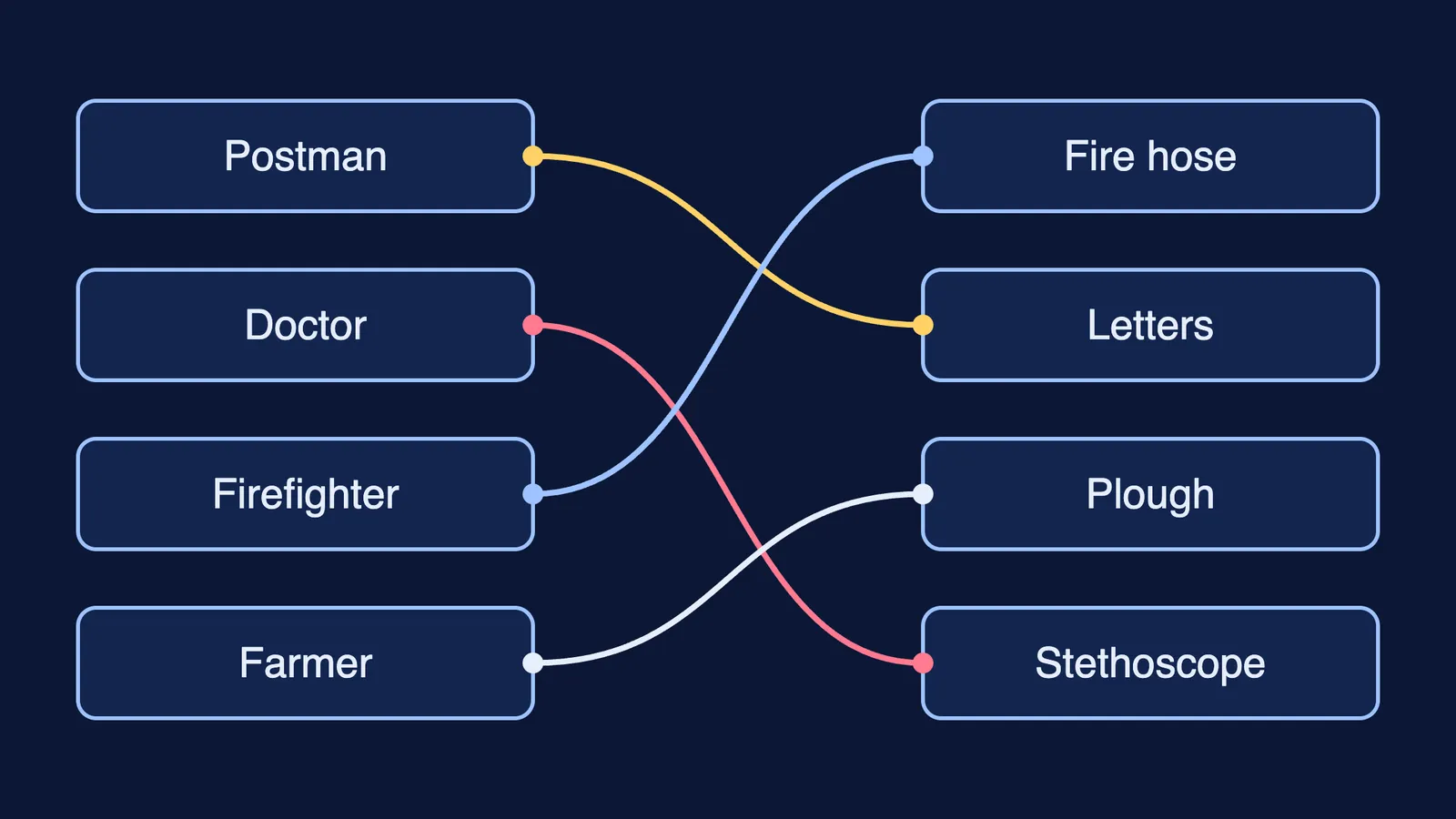
Postman: works from the post office, carries letters and parcels in a bag.
Doctor and nurse: work at a clinic or hospital, use a stethoscope and thermometer.
Police officer: works at the police station, keeps people safe and helps when someone is lost.
Firefighter: works at the fire station, uses a fire engine and hose.
Sanitation worker: works on our streets, uses a broom and a garbage van.
Farmer: works in the fields, uses a plough and seeds to grow our food.
Vegetable seller: works at the market or a cart, uses a weighing scale.
Teacher: works at school, uses books and a blackboard.
Add the helpers your child actually meets: the cobbler near the bus stop, the electrician who fixed the fan, the auto driver who takes them to school.
Why do Classes 1 to 3 learn about helpers this way?
The National Curriculum Framework for the Foundational Stage (NCERT, 2022) treats ages 3 to 8 as one stage and places ages 6 to 8 in Grades 1 and 2. The same framework says supervised play-based education builds, among other things, awareness of the immediate environment, empathy and the ability to interact respectfully with others. It lists drawing and painting, and indoor and outdoor play, as part of early learning, and it names neighbours and others in the close community as having a significant impact on a child at this age.
So the method matters: seeing a helper at work, drawing them and talking about them fits this stage better than copying a chart.
How do you play the draw-and-match game?
You need a stack of small cards (cut up an old notebook cover), crayons and a floor.
Pick six helpers your child has seen. Say the names together.
On six cards, your child draws one helper each. Stick figures are fine.
On six more cards, they draw what each helper uses or where they work: a letter, a stethoscope, a fire engine, a plough, a broom, a weighing scale.
Shuffle the second set and lay both rows face up.
Your child matches each helper to their card and says one full sentence: The postman works at the post office and carries letters.
Turn the cards face down and play it as a memory game. Then make a wrong match on purpose and let your child correct you.
To stretch it across classes:
Class 1: four pairs, pictures only, one spoken sentence per match.
Class 2: six to eight pairs, with the who-where-what sentence written under each pair.
Class 3: add what-if cards (what if the sanitation worker did not come for a week?) and mark each helper on a map of your lane.
What can your child ask a helper on a walk?
A short walk turns the cards into people. Before you go, practise these lines at home:
Namaste. Can I ask you about your work?
What time does your work start?
What is the hardest part of your job?
Thank you for helping us.
Ask only when the person is free, and let your child do the talking. Follow-up questions are a good sign; see our guide to a young child's endless why questions, or try the same close watching when observing ants with children.
Which helpers should a child know in an emergency?
By Class 2, a child can learn that 112 is India's single emergency number for police, fire and ambulance help, which brings together older numbers such as 100 (police) and 101 (fire) (112 entry, Wikipedia)). Teach it with a pretend phone, together with a parent's mobile number and your home address.
For a child in distress, here is what happens when you call Childline 1098.
Older siblings may get curious about the science behind a helper's tools, like how a stethoscope carries sound. The Fermi Concept Library has a lesson for each concept in physics, chemistry and biology, so that curiosity has somewhere to go.
Start with tomorrow morning: watch for one helper on the way to school, and draw them together that evening.


