On this page
An estuary is a unique transition zone where the land meets the sea. It is a partially enclosed coastal body of water where fresh water from rivers and streams mixes with the salt water of the ocean. This mixing creates a unique environment of brackish water that is neither fully fresh nor fully salty.
Estuaries go by many names—bays, lagoons, sounds, and sloughs. While they may look calm on the surface, they are among the most biologically active places on the planet.
What is an estuary ecosystem?
At its core, an estuary ecosystem is an ecotone—a region where two distinct biological communities meet and integrate. Instead of a sharp line dividing the river from the sea, the estuary forms a gradual gradient.
The physical structure of an estuary is usually formed by drowned river valleys, sandbars, or tectonic activity that creates a protected basin. Because they are sheltered, these waters do not experience the violent pounding of ocean waves. This stillness allows fine sediments to settle, building mudflats, salt marshes, and mangrove forests that define the physical landscape of the ecosystem.
Why are estuaries so productive?
Estuaries are often compared to tropical rainforests and coral reefs in terms of their high ecosystem productivity. This biological wealth comes from the constant mixing of two different environments.
As river water flows toward the sea, it carries nutrients eroded from the land. When this flowing water meets the slower-moving water of the estuary, it drops sediment and organic matter, creating nutrient-rich mudflats and marshes. At the same time, the tides push ocean water into the estuary, bringing in marine nutrients.
This trapped concentration of nutrients supports a massive growth of primary producers, such as marsh grasses, mangroves, seagrasses, and phytoplankton. This forms the base of a complex and highly efficient food web. To understand why such regions are critical for species survival, you might look at how biodiversity changes across different zones. The abundance of plant life provides food for insects, shellfish, and small fish, which in turn attract larger predators and migratory birds.
How does brackish water form?
The defining feature of an estuary is its brackish water. This forms through a constant tug-of-war between river flow and ocean tides.
Freshwater input: Rivers constantly push fresh water, which has a salinity of near zero parts per thousand (ppt), towards the coast.
Saltwater intrusion: The tides push ocean water, which has a salinity of about 35 ppt, inland. Have you ever wondered why the sea is salty but river water is not? It is this oceanic salt that creates the gradient.
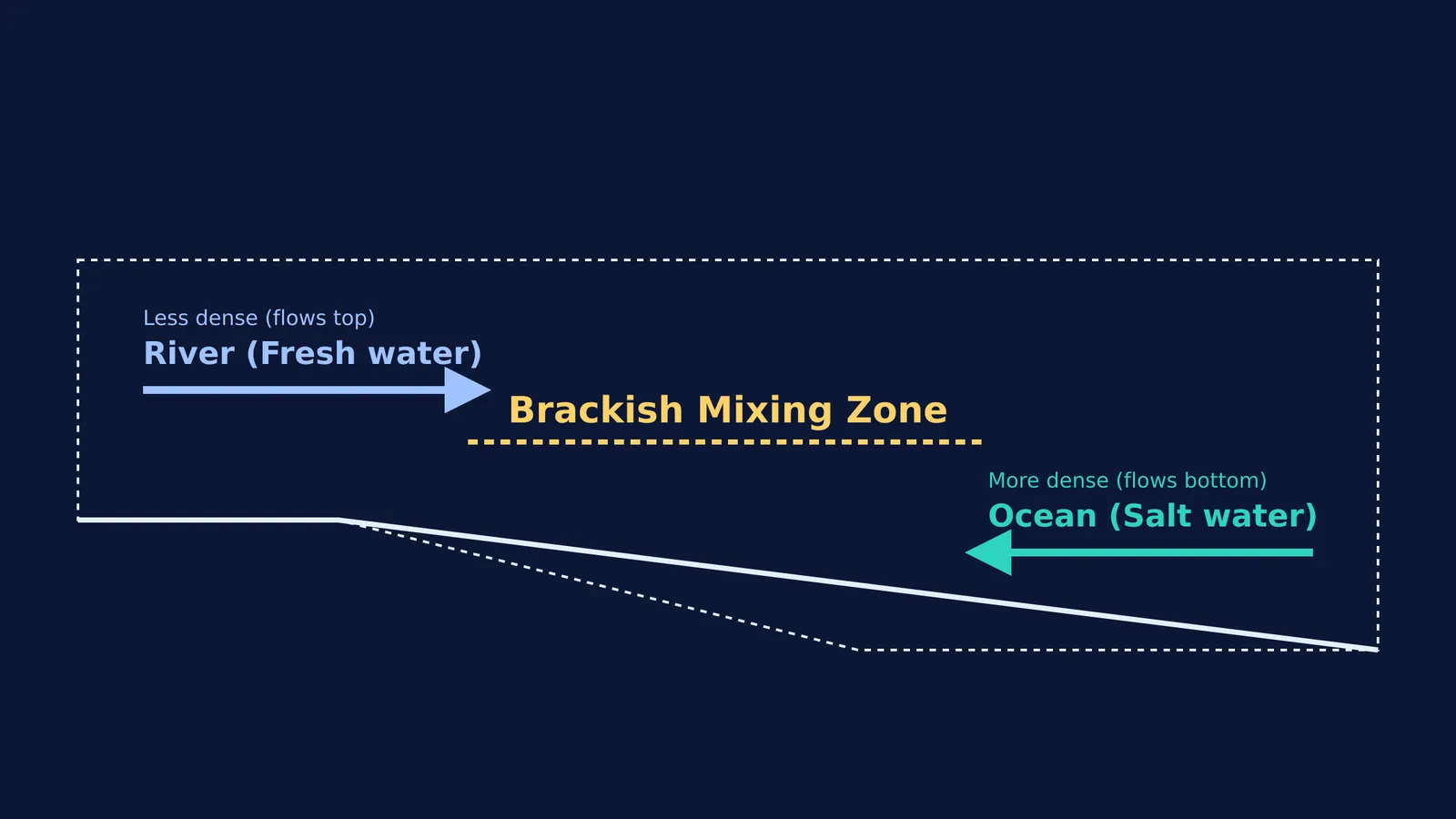
The mixing zone: Because fresh water is less dense than salt water, it often flows out over the top of the heavier incoming seawater. The winds, tides, and shape of the estuary basin mix these layers to create brackish water. The exact salinity at any given point changes daily with the tides and seasonally with rainfall.
Why are estuaries called the nurseries of the sea?
Estuaries are frequently referred to as the "nurseries of the sea" because they provide a critical habitat for many marine species during their vulnerable early life stages.
According to the National Oceanic and Atmospheric Administration (NOAA), estuaries are the nursing grounds for 75% of the fish we catch (source). They provide a critical habitat for marine species during their vulnerable early life stages, including salmon, herring, crabs and oysters (source).
The calm, shallow waters are protected by barrier islands, reefs, or peninsulas, offering a safe haven from large ocean predators and strong ocean waves. The high productivity of the marsh grasses and seagrasses ensures a constant supply of food for growing juveniles. Without estuaries, many marine fish and shellfish populations would collapse, affecting both the ecosystem and human coastal economies.
A checklist for identifying an estuary
If you are studying coastal geography or biology, you can use this framework to identify whether a body of water is an estuary:
Semi-enclosed structure: Is the water partially surrounded by land, protecting it from the full force of the ocean?
Freshwater source: Is there a river or stream actively flowing into it?
Marine connection: Is there an open connection to the sea, allowing tidal exchange?
Salinity gradient: Does the water transition from fresh to brackish to salty as you move toward the ocean?
If you are struggling to picture how these different ecosystems connect and function, the Fermi Concept Library maps out every concept in physics, chemistry, biology, mathematics and computing, each with its own lesson to help you trace the energy and nutrient flows.
Understanding the mechanics of an estuary ecosystem helps us appreciate why these delicate transition zones need protection to sustain both marine life and coastal communities.