

On this page
If you have ever swallowed a mouthful of seawater at the beach, you know the ocean is remarkably salty. Yet the rivers that empty into the ocean—and the rain that feeds those rivers—taste completely fresh.
This raises an obvious question for anyone studying the water cycle: if rivers fill the oceans, where does all the sea salt come from?
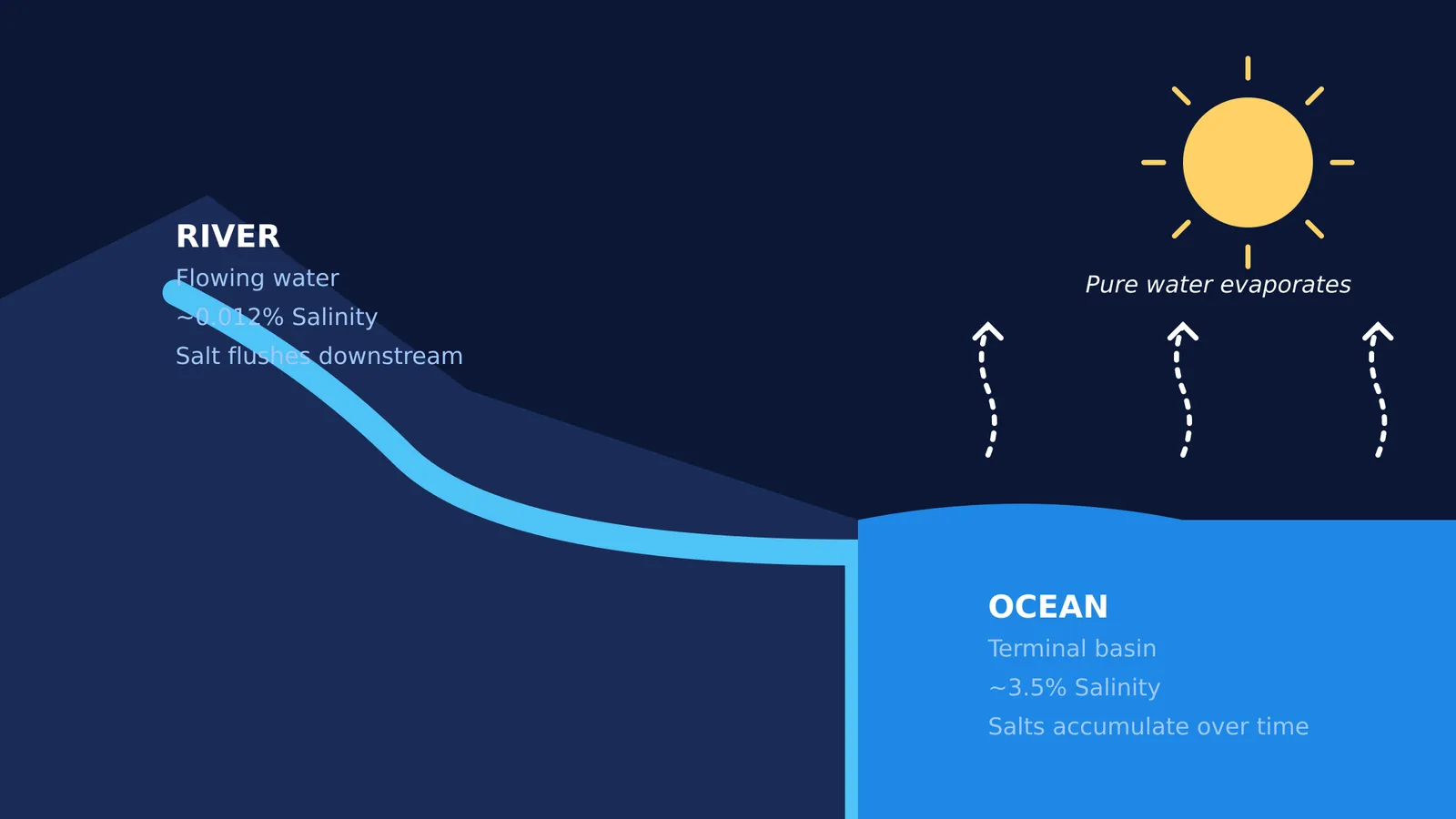
The answer lies in a continuous planetary process driven by the sun, where rivers act as conveyor belts and the ocean acts as a giant evaporating dish.
Where does the salt in the ocean come from?
The salt in the sea actually begins on land. When rainwater falls, it is not perfectly pure. It picks up carbon dioxide from the atmosphere, forming a weak carbonic acid. As this slightly acidic rain falls on rocks and soil, it chemically weathers them, dissolving minerals and breaking their ionic bonds to release individual ions like sodium, chloride, calcium, and magnesium.
Runoff carries these dissolved ions into streams and rivers. While river water tastes fresh to us, it is not entirely free of minerals. According to Britannica, the global average salinity of river water is approximately 0.012% (120 parts per million). This concentration is so incredibly low that our taste buds simply register it as fresh water, far below the threshold required to taste any saltiness.
However, because of the massive volume of water flowing across the globe, the total mineral payload is immense. The U.S. Geological Survey (USGS) notes that a single cubic mile of seawater contains about 120 million tons of dissolved salt.
Why is sea water salty but river water is not?
The main difference is that a river is in constant motion, while the ocean is a terminal basin.
Rivers continuously flush their water downstream, so the salt never accumulates. But once water reaches the ocean, it has nowhere else to flow. The only way water leaves the sea is through evaporation driven by the sun's heat.
During evaporation, only pure water vapour rises into the atmosphere. The dissolved minerals are too heavy to evaporate, so they stay behind. Over millions of years, this continuous cycle of freshwater delivery and pure water evaporation has steadily concentrated the ocean's minerals. Today, the ocean's average salinity sits at about 35 parts per thousand (3.5% by weight). To picture the scale of this accumulation, the USGS points out that if you extracted all the salt in the ocean and spread it evenly over the Earth's land surface, it would form a solid layer more than 500 feet thick—roughly the height of a 40-story building.
If you are reviewing the behaviour of mixtures and solutions, the Fermi Concept Library contains every concept in physics, chemistry, biology, mathematics and computing, each with its own lesson and its place in the map.
Why isn't the ocean getting saltier?
Given the massive amount of salt dumped into the sea annually, you might reasonably assume the ocean is becoming more saline every year. In reality, the ocean's overall salinity has remained relatively stable for hundreds of millions of years.
This stability is a classic example of chemical equilibrium on a planetary scale. The rate at which new salts are added by rivers and hydrothermal vents is perfectly balanced by the rate at which they are removed. Marine organisms absorb many dissolved ions to build shells, which fall to the ocean floor when they die. Other minerals react chemically with volcanic rocks on the seafloor or precipitate out of the water, settling as solid sediment.
*(If you want to read more about how precipitation works in chemical systems, we have a guide on why solids drop out of equilibrium constants in heterogeneous mixtures.)*
A practical experiment: making your own 'sea water' at home
You can model this planetary process on your kitchen counter to clearly see how evaporation concentrates a solution. This is a great active-learning exercise for students visualising the water cycle.
Create your "river water": Dissolve half a teaspoon of standard table salt in a large glass of warm water. The water will barely taste salty, mimicking the very low initial mineral concentration of a flowing river. *(We have covered how temperature affects aqueous solutions like water's neutral pH in previous posts).*
Set up the "ocean basin": Pour a small amount of this diluted saltwater into a shallow, dark-coloured dish and place it on a warm, sunny windowsill.
Observe the evaporation: Leave the dish completely undisturbed for a few days. As the liquid water slowly evaporates into the air, the salt solution left behind will become increasingly concentrated.
The result: Once all the liquid water has evaporated, you will see distinct, white cubic salt crystals left behind on the surface of the dish.
To watch how evaporation concentrates a solution without waiting days for the water to dry, the Fermi Simulation Lab features interactive simulations for the ideas that are easier to see than to read.


