

On this page
What is the difference between endothermic and endergonic reactions?
In Class 11 physical chemistry, students often confuse heat transfer with reaction spontaneity. They belong to two distinct thermodynamic bookkeeping systems.
According to OpenStax Chemistry Section 5.3, an endothermic reaction is defined solely by a positive change in enthalpy (ΔH > 0), meaning the system absorbs heat from its surroundings at constant pressure. In contrast, an exothermic reaction has a negative enthalpy change (ΔH < 0) and releases heat.
Endergonic reactions relate to useful work rather than heat flow. As defined in OpenStax Chemistry Section 16.4, an endergonic process has a positive change in Gibbs free energy (ΔG > 0). It is non-spontaneous and requires an input of free energy to proceed. Conversely, an exergonic reaction has a negative free energy change (ΔG < 0) and proceeds spontaneously without continuous external intervention.
The distinction is straightforward:
Enthalpy (ΔH) measures thermal exchange with the surroundings.
Gibbs free energy (ΔG) governs thermodynamic spontaneity and available work.
Reviewing thermodynamic sign conventions helps keep these quantities distinct before setting up numerical problems.
Can an endothermic reaction be spontaneous?
Yes. An endothermic reaction proceeds spontaneously whenever an increase in entropy provides sufficient driving force.
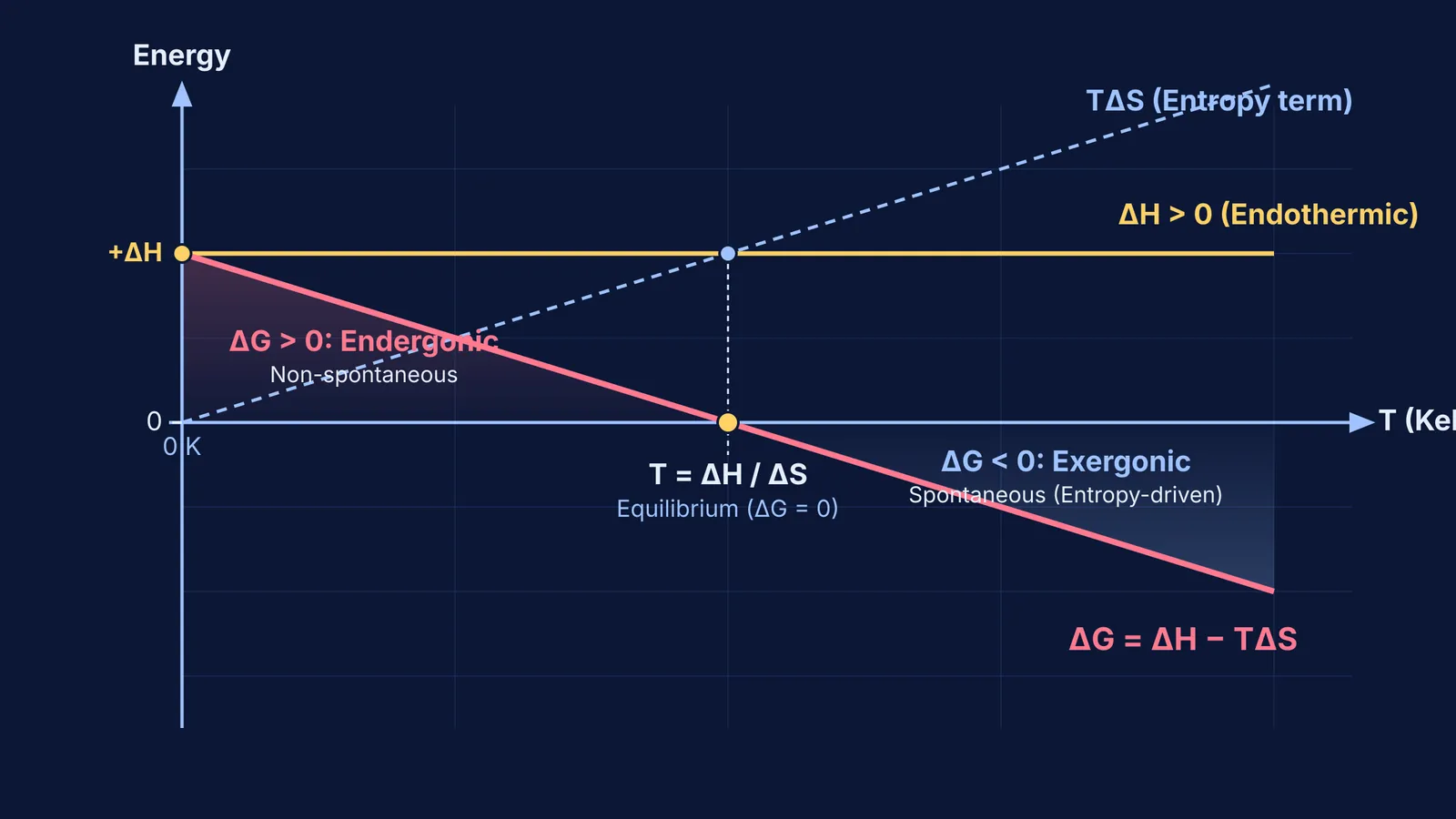
The Gibbs equation at constant temperature and pressure connects both properties: ΔG = ΔH − TΔS
Here, T represents absolute temperature in Kelvin, and ΔS denotes the change in entropy, which measures energy dispersal as detailed in OpenStax Chemistry Section 16.2. Because temperature in Kelvin is always positive, an increase in molecular disorder (ΔS > 0) makes the term −TΔS negative. When this negative term exceeds the positive enthalpy change (+ΔH) in magnitude, the overall Gibbs free energy becomes negative (ΔG < 0).
Ice melting at room temperature (298.15 K) demonstrates this principle, as discussed in OpenStax Chemistry Section 10.3. Breaking the hydrogen-bonded solid requires latent heat of fusion (+6.01 kJ/mol), so melting is endothermic. Liquid water has greater positional entropy than ice (+22.0 J/(mol·K)). At 298.15 K, the entropic factor TΔS equals +6.56 kJ/mol, outweighing the +6.01 kJ/mol enthalpy barrier and yielding a spontaneous free energy change of ΔG = −0.55 kJ/mol.
How do temperature and entropy change the reaction direction?
Because spontaneity depends on two competing variables, every chemical process falls into one of four conditions:
Negative ΔH and positive ΔS: ΔG is negative at all temperatures. The reaction is always exothermic and spontaneous.
Positive ΔH and negative ΔS: ΔG is positive at all temperatures. The reaction is always endothermic and non-spontaneous (endergonic).
Negative ΔH and negative ΔS: ΔG is negative only at low temperatures, where enthalpy dominates over the entropy penalty.
Positive ΔH and positive ΔS: ΔG is negative only at high temperatures, where the −TΔS term outweighs the positive ΔH.
Understanding this balance is central to Gibbs energy and spontaneity. For students connecting these principles across physical chemistry, the Fermi Concept Library covers every concept in physics, chemistry, biology, mathematics and computing, each with its own lesson and its place in the map.
Worked example: why does ammonium nitrate dissolve spontaneously?
The dissolution of solid ammonium nitrate in water shows how entropy drives an endothermic process. As detailed in OpenStax Chemistry Section 11.1, this reaction powers instant cold packs: NH₄NO₃(s) → NH₄⁺(aq) + NO₃⁻(aq)
At 298.15 K (25 °C), standard thermochemical data gives:
Standard enthalpy of solution: ΔH° = +25.7 kJ/mol
Standard entropy of solution: ΔS° = +108.7 J/(mol·K) = +0.1087 kJ/(mol·K)
Evaluating the net free energy step by step:
Enthalpy penalty: ΔH° = +25.7 kJ/mol. The salt absorbs thermal energy from the water, cooling the solution near 0 °C.
Entropy term: TΔS° = 298.15 K × 0.1087 kJ/(mol·K) = +32.41 kJ/mol. Dissociating into aqueous ions creates large structural disorder.
Free energy balance: ΔG° = ΔH° − TΔS° = 25.7 kJ/mol − 32.41 kJ/mol = −6.71 kJ/mol.
Because ΔG° is negative (−6.71 kJ/mol), dissolution is exergonic and spontaneous at 25 °C, despite absorbing 25.7 kJ/mol of heat.
The Fermi Problem Library provides worked problems with a step-by-step solver that explains the reasoning rather than printing an answer, helping students verify each unit conversion.
A four-step diagnostic checklist for exam problems
When tackling exam problems, use this four-step diagnostic sequence:
Identify the target concept: Determine whether the question asks about heat exchange (endothermic versus exothermic) or spontaneity and useful work (endergonic versus exergonic).
Check the sign of ΔH: Positive indicates heat absorbed; negative indicates heat released. Never infer spontaneity from ΔH alone.
Determine the sign of ΔS: Look for phase changes or gas-mole changes by predicting the sign of entropy changes.
Compute the transition temperature: Evaluate T = ΔH / ΔS to find where ΔG equals zero. Compare the given temperature to this value to determine whether the reaction is endergonic or exergonic.
Visualising this boundary clarifies why reactions change direction. The Fermi Simulation Lab offers interactive simulations for ideas that are easier to see than to read, allowing students to observe how changing temperature shifts spontaneity in real time.


