On this page
Every Class 12 student learns that the electric field inside a conductor is zero. A few chapters later, the same textbooks write E = ρJ for a copper wire, with E clearly not zero. Both are true. They describe two different situations, and mixing them up costs marks in assertion-reason questions and numericals.
Why is the electric field zero inside a conductor in electrostatics?
The zero-field rule only holds when the charges have stopped moving. OpenStax University Physics explains that the electric field inside a conductor in electrostatic equilibrium vanishes. The argument is short: if there were a field inside, it would push on the free electrons and they would move, but moving charges are not static, so the charges rearrange until the field inside cancels.
Why is there an electric field inside a wire carrying current?
Connect the wire to a cell and it never settles. The cell keeps one end at a higher potential than the other, so charge keeps flowing and the wire is never in electrostatic equilibrium. A steady current needs a steady push on the free electrons, and that push is an electric field along the wire.
Where does that field come from? In a 1996 paper in the American Journal of Physics, physicist J. D. Jackson showed that surface charges on circuit wires maintain the potential around the circuit and keep the current confined inside the wire. These charges shape the field so that it runs along the wire, even around bends.
How do you calculate the electric field inside a current-carrying wire?
You need two relations, both from OpenStax University Physics, section 9.3.
E = ρJ. Resistivity is defined as ρ = E/J, where J = I/A is the current density. This is Ohm's law written for a point inside the material.
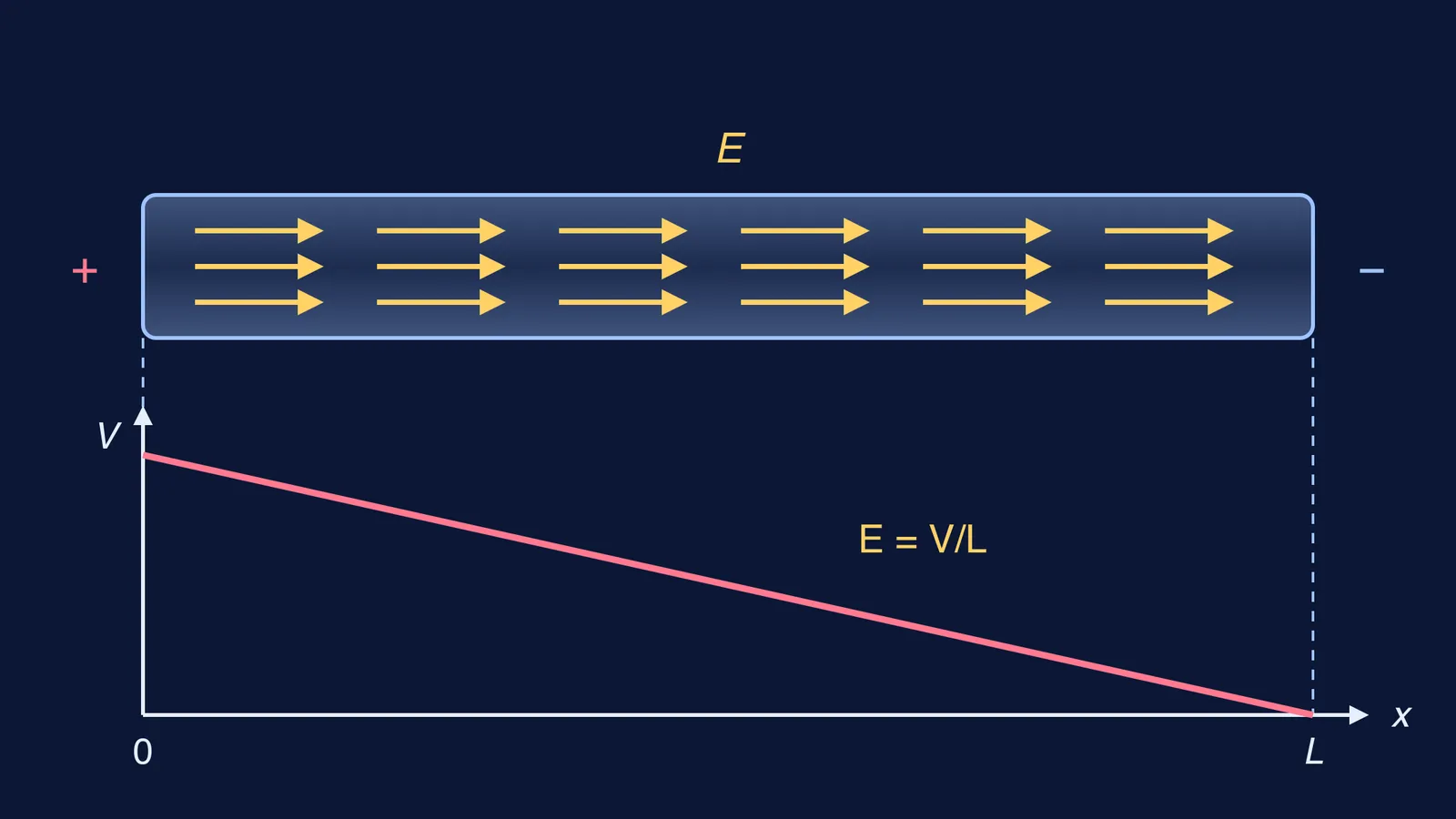
E = V/L. For a uniform wire, the field across a segment equals the voltage across it divided by its length.
The two give the same answer, because V = IR and R = ρL/A. Substitute and you get V/L = ρI/A = ρJ. Use E = ρJ when you know the current and the material. Use E = V/L when you know the voltage across the wire.
The resistivity of copper at 20 °C is 1.68 × 10⁻⁸ Ω m, listed in OpenStax's Table 9.1 and in HyperPhysics's resistivity table.
Worked example: field in a copper wire
A copper wire is 10 m long and 1.0 mm in diameter. It carries a steady current of 2.0 A at 20 °C. Find the field inside it two ways, using ρ = 1.68 × 10⁻⁸ Ω m from the OpenStax resistivity table.
Method 1: E = ρJ
Radius r = 0.50 mm = 5.0 × 10⁻⁴ m.
Area A = πr² = π × (5.0 × 10⁻⁴)² = 7.85 × 10⁻⁷ m².
Current density J = I/A = 2.0 / 7.85 × 10⁻⁷ = 2.55 × 10⁶ A/m².
Field E = ρJ = 1.68 × 10⁻⁸ × 2.55 × 10⁶ = 0.043 V/m.
Method 2: E = V/L
Resistance R = ρL/A = 1.68 × 10⁻⁸ × 10 / 7.85 × 10⁻⁷ = 0.214 Ω.
Voltage across the wire V = IR = 2.0 × 0.214 = 0.428 V.
Field E = V/L = 0.428 / 10 = 0.043 V/m.
Both methods give about 0.043 V/m, pointing along the wire in the direction of conventional current. Copper conducts so well that a tiny push keeps a few amperes moving.
One step further: OpenStax uses about 8.34 × 10²⁸ free electrons per cubic metre for copper. The drift speed is v = J/(ne) = 2.55 × 10⁶ / (8.34 × 10²⁸ × 1.6 × 10⁻¹⁹), or roughly 0.19 mm/s. A small field and a slow drift go together.
Where do students go wrong?
Writing E = 0 inside a wire in a circuit because "the field inside a conductor is zero". That rule needs charges at rest.
Using the full cell voltage in E = V/L when only part of it drops across the wire. Use the voltage across the segment you are asked about.
Forgetting that in a wire of varying thickness, J and therefore E are larger where the wire is thinner, even though the current is the same everywhere.
If the gap is the idea itself, the Fermi Concept Library has a lesson for every concept in physics, each with its place in the map of related ideas. If you understand it but keep slipping in the arithmetic, the Fermi Problem Library has worked problems with a step-by-step solver that explains the reasoning rather than printing an answer.
Next, read our walk-through of drift velocity, current density and resistivity, revisit why conductors in electrostatics have zero field and surface charge, and see why a bulb glows instantly even though drift is slow.