

On this page
When you bite into a juicy mango or drink the sweet water from a coconut, you are eating a type of fruit known as a drupe (Testbook). A drupe is a fleshy, one-seeded fruit that develops from a monocarpellary superior ovary. Because they develop directly from the fertilised ovary, they are true fruits—not to be confused with false fruits and parthenocarpy, where other floral parts contribute to the flesh.
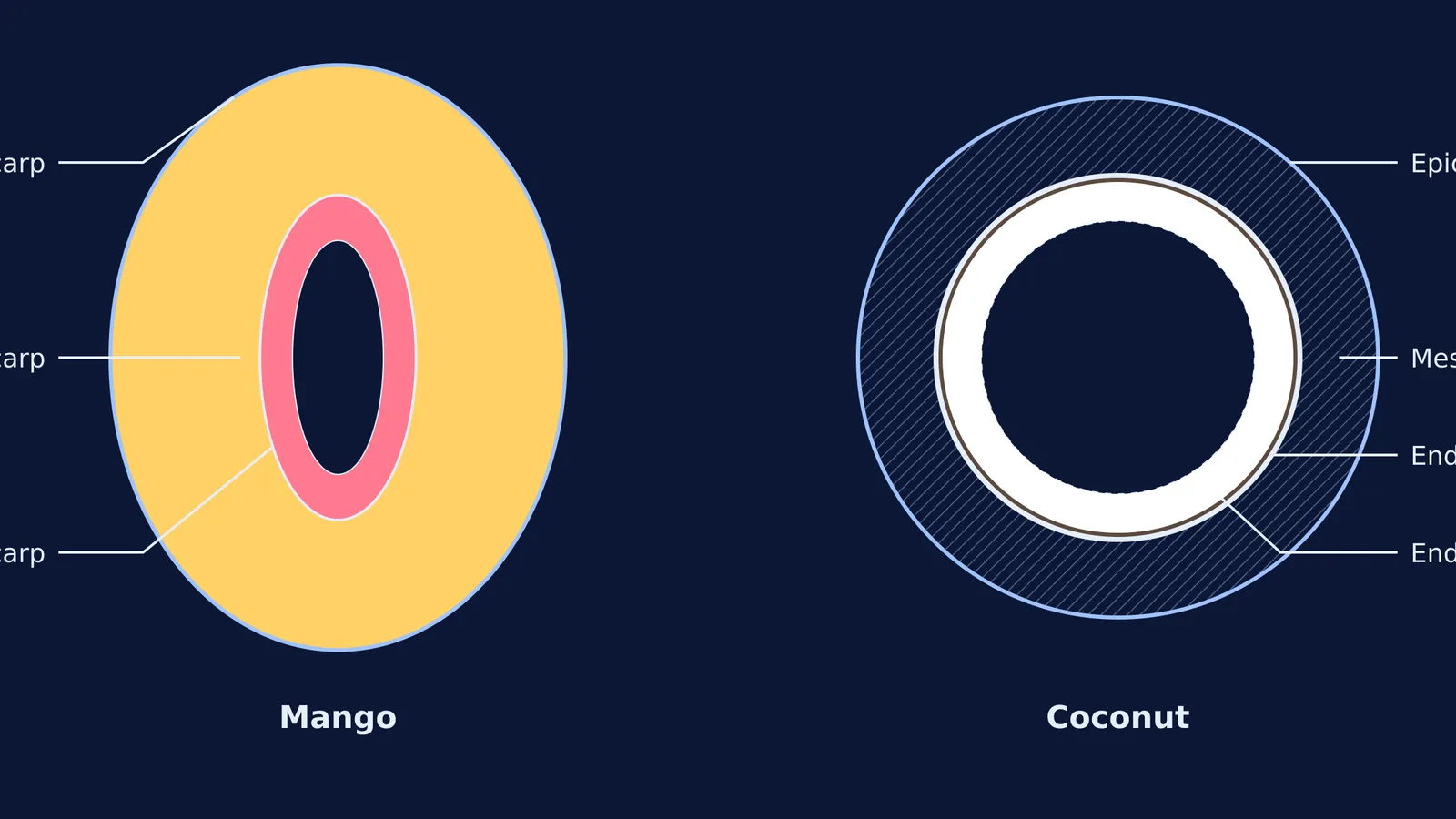
To understand the structure of a drupe, we must look at how the flower's ovary transforms after fertilisation. The ovary is said to be monocarpellary because it consists of a single carpel, the fundamental female reproductive organ of the flower. It is also superior, meaning it sits above the attachment points of the petals and sepals. As the fruit develops, the ovary wall ripens into the fruit wall, which botanists call the pericarp. In a drupe, this pericarp is highly differentiated into three distinct layers: the epicarp on the outside, the mesocarp in the middle, and the endocarp on the inside.
What are the three layers in a mango?
The mango (*Mangifera indica*) is the classic example of a fleshy drupe. Its structure is designed by nature to attract animals, which eat the sweet flesh and then discard the hard seed, aiding in seed dispersal.
Epicarp: This is the thin, leathery outer skin of the mango. It protects the inner fruit during development and changes colour from green to shades of yellow, red, or orange as the fruit ripens.
Mesocarp: This is the thick, sweet, yellow layer in the middle. In a mango, the mesocarp is the fleshy and edible part that we eat. It is packed with water, sugars, and nutrients.
Endocarp: This is the innermost layer. It is stony and hard, forming the "pit" or "stone" that securely encloses the single seed. This hard boundary protects the developing seed from being destroyed when an animal eats the fruit.
Because of this hard inner layer, drupes like mangoes, peaches, and cherries are often referred to as stone fruits.
What are the three layers in a coconut?
The coconut (*Cocos nucifera*) is also a drupe, but it takes an entirely different approach to survival. Instead of attracting land animals with sweet flesh, the coconut is adapted to drop from palm trees into the water and float across oceans to new shores.
Epicarp: The outermost layer is the smooth, waterproof skin. It is often green or yellow when the coconut is growing on the tree, though you rarely see this layer in a grocery store.
Mesocarp: The middle layer in a coconut is fibrous rather than fleshy (Testbook). This thick fibrous husk, also known as coir, traps air and provides extreme buoyancy, allowing the heavy fruit to float in seawater for months.
Endocarp: The inner layer is the dark, woody, hard shell that you have to crack open. It contains three distinctive germination pores, or "eyes", through which the new plant shoot will eventually emerge.
Which part of the coconut do we eat?
If the epicarp is the waterproof skin, the mesocarp is the fibrous coir, and the endocarp is the hard wooden shell, what exactly is the white meat and the water inside?
The edible part of a coconut is not the pericarp at all. We eat the endosperm, which is the tissue that provides necessary nourishment for the developing plant embryo (Testbook). The endosperm in a coconut takes two distinct forms as the fruit matures.
First, there is the liquid endosperm, which we know as coconut water. This is a free-nuclear endosperm, meaning it contains many nuclei floating in a nutrient-rich fluid. It provides hydration and minerals to the growing embryo. Over time, cellular walls form, creating the solid white flesh known as the cellular endosperm, or coconut meat. When you eat a coconut, you are consuming this nutrient-dense seed tissue rather than the fruit wall.
How can you study plant morphology effectively?
Details like the pericarp layers of a fleshy drupe or the various placentation types in flowers are frequent targets in competitive biology exams. Because the terminology can be dense, visualising the cross-sections of everyday fruits is a highly effective way to anchor these concepts in your memory.
If you find it hard to picture how floral structures turn into mature fruits, exploring the Fermi Concept Library can help. Fermi's AI tutor works through complex morphological terms and checks your understanding as it goes, so you can sit down to your next exam knowing exactly where the epicarp ends and the endosperm begins.


